The palaces of Montjuïc are warming up to be completely renovated ahead of the first centenary of the 1929 Universal Exhibition. After seeing its older brother, the Gran Via exhibition center, lay the first stone of its expansion, the historic complex now faces the international architecture competition that will redefine its structure and provide it with new buildings. "It is one of the most ambitious transformation projects that Barcelona will experience in the coming years," celebrated its mayor, Jaume Collboni, "we do it with conviction to show the confidence we have in the economic future of the city."
The Barcelona City Council and Fira de Barcelona, together with the College of Architects of Catalonia (COAC), are currently finalizing the last details of the architecture competition, with the forecast of publishing the tender documents next Wednesday, May 15. As explained by the chief architect of the Barcelona City Council, Maria Buhigas, it will be divided into three lots, although there will be a single jury that will evaluate all proposals to guarantee the unity of the project, chaired by architect Josep Lluís Mateo. The possibility of a single firm submitting proposals for all three lots is contemplated. In total, a global investment of 290 million euros will be added.
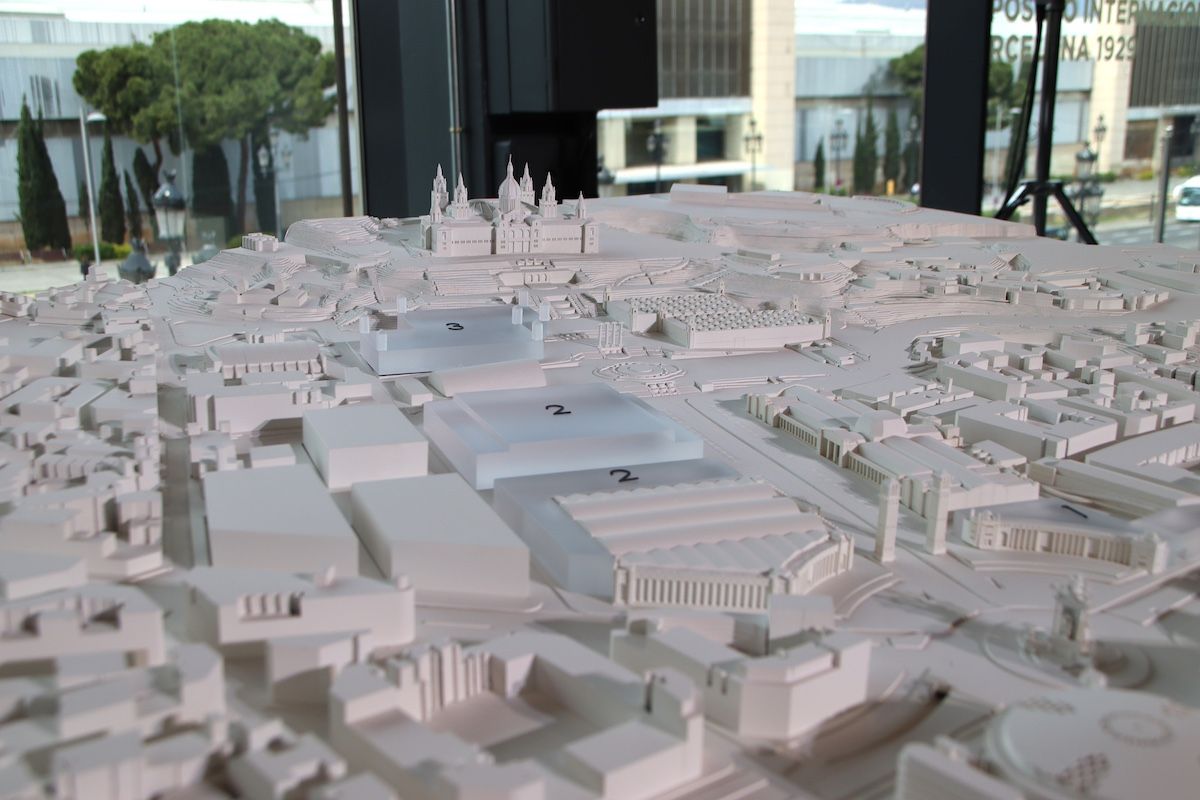
The first area will focus on a part of the current palace 8, located on the right side of the exhibition center. In what is today the access from Plaza Espanya, the old Palacio del Vestido, large companies, SMEs, startups, research centers, and universities will be permanently installed under the same roof to find new business avenues, following the model of other spaces of these characteristics in the city such as Pier 01 of Tech Barcelona. In the future Fira Innovation Hub, its tenants will develop solutions for sectors in which the fair institution is an international benchmark with its events, such as smart cities with the Smart City Expo World Congress and food with Alimentaria. With an investment of 40 million euros, 16,000 square meters will be enabled for this project incubator.
The second lot of the international architecture competition will serve to modernize the spaces located on the left side of the venue, where palace 1 ---the first thing seen from Plaza Espanya--- and the Palau de Congressos de Barcelona are located. Palace 1, with 12,000 square meters, will be updated, while the Palau de Congressos will be moved and replaced by a two-story exhibition pavilion. With the new multifunctional palace, it will reach 19,500 square meters, also covering the square meters of the current palace 4. In this area, catering spaces are also planned.
Finally, the third element will refer to the new Palau de Congressos, which will be located in the now empty Palacio Alfons XIII, on the left side of the Montjuïc fountain. A large auditorium, with 1,600 seats; an exhibition hall; two multi-purpose rooms, with capacity for 1,400 people, and meeting rooms are planned. These last two lots will have a budget of 215 million euros.
The Palau de Congressos will move to the now empty Palacio Alfons XIII, on the left side of the Montjuïc fountainTo this figure must be added the urbanization works of the surroundings, valued at 35 million euros, with notable actions such as the demolition of the Italy Pavilion, gaining public space in Plaza Carles Buhigas, the elimination of private vehicles on Avenida Maria Cristina, where only buses and taxis will be able to circulate, and the connection with the neighboring streets of Mèxic and Lleida. The original porches facing Plaza Espanya will also be recovered. "All this will allow us to have a 21st-century Fira in Montjuïc, combining the proper exhibition uses in a modernized but very urban venue, with citizen uses," said the president of Fira de Barcelona, Pau Relat.
Works are expected to begin in 2026, with the goal of reaching 2029, the centenary year, with the Fira Innovation Hub, the two-story multifunctional palace, and the new Palau de Congressos completed. In a second phase, planned from 2029 onwards, palace 1 will be updated, thus avoiding leaving the Montjuïc venue without fair activity during its transformation project. The rehabilitation of palace 8 ---the part not affected by the Fira Innovation Hub--- will remain pending. It will also be necessary to address the expansion of the Museu Nacional d'Art de Catalunya (MNAC) in the Palacio de Victòria Eugènia, where the Tim Burton exhibition and the Balloon Museum are currently located, and the construction of 500 public housing units in the current palace 2, the one behind Plaza del Univers, which will be demolished. Another pending issue will be to find a future for the dilapidated Sports Palace, closed since it ceased to be a musical theater and with homeless people living in its surroundings.
The commemoration will focus on climate change
The launch of the international architecture competition for the Montjuïc venue coincides with the announcement of the creation of a group of experts who will be responsible for defining the events to be organized to commemorate the centenary of the Barcelona Universal Exhibition, as well as the legacy projects that may arise. The former manager of the Liceu and Macba, Gemma Sendra; the former director of Macba and the Reina Sofía Museum, Manuel Borja-Villel; the businesswoman and Fira de Barcelona board member, Helena Guardans; the founder of ICFO, Lluís Torner; the former Assistant Secretary-General for Communications of the United Nations, Cristina Gallach; the rector of UPF, Laia de Nadal; the general director of Tourism of Barcelona, Mateu Hernández; the director of CCCB, Judit Carrera; the president of MNAC, Joan Oliveras, and the associate director of BSC, Josep Maria Martorell, will be part of it. According to Collboni, one of the lines to be addressed is the role of science and technology in cities to tackle climate change.
Add The New Barcelona Post as your preferred Google source for free
Stay informed with the latest news.