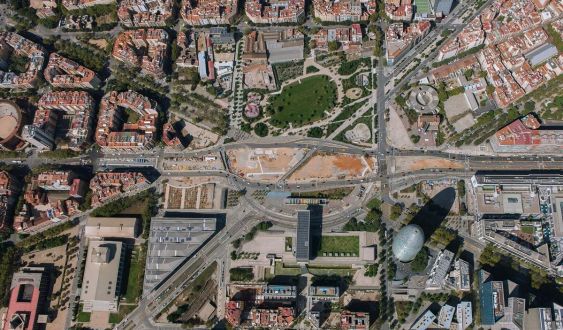
The Glòries tunnel will be fully operational next weekend. On the night of April 2-3, the Llobregat-bound side of the tunnel will be put into service, after the lanes going towards the Besòs did so at the beginning of November. This will put an end to many years of accumulating delays and cost overruns to complete this infrastructure, which buries traffic and generates new spaces for public facilities and housing, surrounded by greenery, and allows for the meeting between the different neighborhoods that converge in this square, historically divided and segregated by the road ring. The final budget for works that began in 2015 is estimated to be around 190 million euros.
The opening of the tunnel in the Llobregat direction will entail modifications in mobility. Basically, the surface traffic lanes that remained on Gran Via, between Bilbao street and Padilla street, will be eliminated. In this area, there will be no through traffic and only vehicles belonging to residents, services, public transport, and emergencies will be able to move along the sides. In this way, the surface of Plaça de les Glòries will be completely free of private traffic and only pedestrians, bicycles, buses, and taxis will be allowed to pass. Likewise, with the new road configuration, vehicles circulating through the tunnel, upon exit, will be able to go up Padilla or Marina streets. Only buses will be able to circulate in a straight line along Gran Via.
Getting here has not been easy at all. Beyond the process it has entailed, with two awards, the Glòries tunnel is one of the most technically difficult works carried out in the city, with some sections at a depth of 25 meters below the square's grade. In addition, it has been built below existing railway infrastructures: the L1 metro tunnel; the R2 Rodalies tunnel; and the R1, R3, and R4 tunnels. This has involved constructing the new road tunnel through a process of excavation by successive advances, with the aim of guaranteeing minimal deformation of the upper railway tunnels and not affecting their structure. It has also been excavated below several collectors of the sewage network and service galleries.
At a technical level, the future Glòries tunnel has a total length of 957 meters, which increases to 1,157 meters if access ramps are included, and is made up of two independent tubes with one-way traffic, with two lanes for private vehicles and one for public transport in each direction. It is the first bus lane enabled in a tunnel in the city, with the same scheme for both exit and entry, allowing continuity to the one that already exists at the city entrance and extending it to Rambla del Poblenou at the exit. It is estimated that more than 500 coaches enter and exit through this route every day, reaching a total of about 30,000 users.
Add The New Barcelona Post as your preferred Google source for free
Stay informed with the latest news.
