
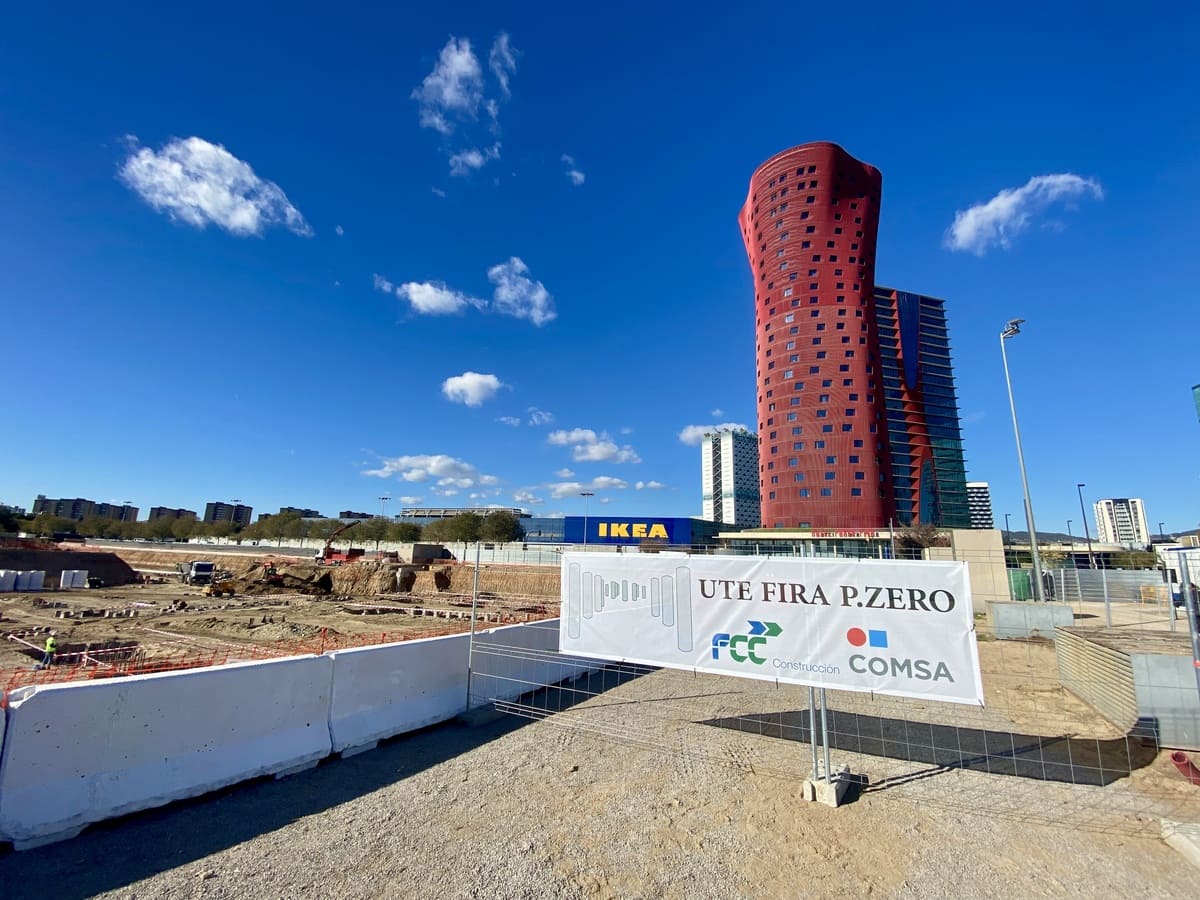
The heavy machinery of construction companies Comsa and FCC has been working for weeks inside an immense hole on the plot that until last January was occupied by the emblematic store that Porcelanosa had in L'Hospitalet de Llobregat. Located opposite Ikea and the iconic red tower that houses the Hotel Santos Porta Fira, this land will host the pavilion that will allow to increase by 25% the exhibition area of the Fira de Barcelona venue in Gran Via. Budgeted at more than 320 million euros, this is a strategic project for Barcelona and the whole of Catalunya, as the 60,000 new square meters of exhibition space will allow the institution chaired by Pau Relat to strengthen its position in the Champions League of the trade fair sector and attract new global reference fairs and congresses.
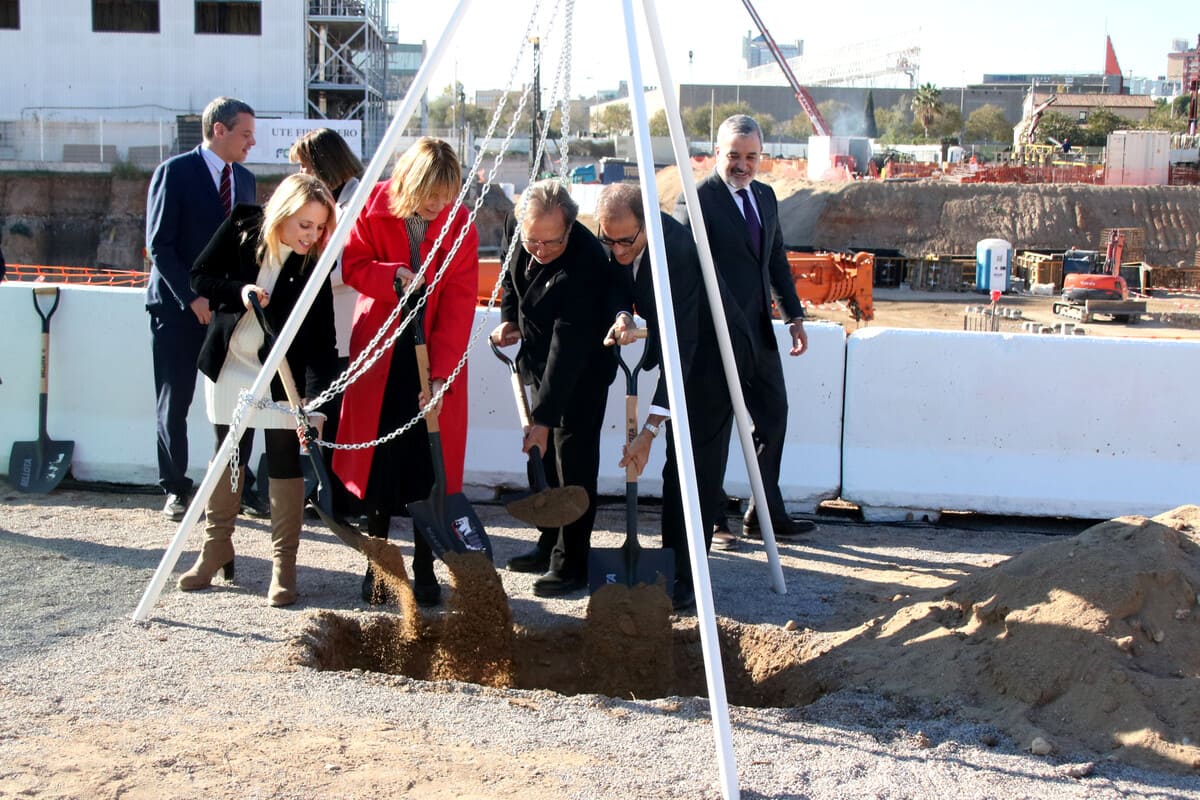
"We are facing a historic day," Relat highlighted this Monday during the symbolic act of laying the first stone of a gigantic building (120 x 135 meters), called Hall Zero, which could house an Eixample block, two soccer fields or 10 Olympic swimming pools inside. "It will be a unique building, a true benchmark in the trade fair world that will give us a bright future," predicted the president of Fira de Barcelona, after emphasizing that the entity reaffirms with this project its strong vocation to be "an engine of economic and social development" for the entire territory. The forecast is that the works of the complex, designed by the Japanese architect Toyo Ito and the Barcelona studio B720 ---led by Fermín Vázquez--- will be completed in the third quarter of 2026.
With a total built area of 135,400 m², the new building will add 63,600 m² of exhibition spaces, so the Gran Via venue will go from the current 240,000 m² to more than 300,000 m², placing it in the world elite of facilities for fairs and congresses, both for its dimensions, and for its advanced technological infrastructures and a unique location, just minutes from an international airport and the center of Barcelona, one of the most desired cities in the world for business tourism.
The new Hall Zero pavilion will be connected to the current Gran Via venue through an elevated walkway over Avenida Joan Carles I that will connect with the central spine running through the different exhibition halls. The exhibition area of Hall Zero will be distributed over two floors, which will be accessed through a gigantic 11,800 m² lobby that will house a congress center for 1,500 people, with two auditoriums, four conference rooms, a protocol area, 66 meeting rooms, a press room, and a large foyer with spaces for accreditations and visitor services. There will also be a commercial space and large terraces with green areas. From the lobby, there will also be access to the office tower that completes the real estate project, promoted and financed by the Fira 2000 company, controlled by the Generalitat.
This tower, which will rise next to Plaza Europa, on Ciències street in L'Hospitalet, will have 12 floors totaling a constructed area of 22,880 m², at a rate of 1,990 m² per floor. Since the project was conceived in 2019, it was planned that these offices would be used for administrative purposes, but a week ago it was announced that the Generalitat itself will occupy most of the floors of the building, an announcement that is part of the new patrimonial policy that the Govern plans to promote in the coming years and that will involve reinvesting in owned properties to house its different departments and officials. This decision implies that the Generalitat will buy the new office tower from Fira 2000, where around 1,200 people will be able to work. The details of the transaction are unknown, but the Departament d'Economia has estimated the construction budget for the tower at 68 million euros.
But, how much will the entire new complex cost? Including the new double-height Hall Zero pavilion, the rear loading and unloading dock area, the lobby, the twelve office floors, the elevated connecting walkway, and the urbanization of the surroundings, the current budget amounts to 323 million euros, a figure that is significantly higher than the initial estimates made in 2019, when 200 million was mentioned. To these 323 million allocated to the expansion of Gran Via, another 175 million must be added, which, according to the Fira de Barcelona infrastructure plan, will be invested in the comprehensive remodeling project of the historic Montjuïc venue, which raises the investment budget to a total of 498 million. The goal is for the Gran Via expansion to be ready in 2026, while the work to update Montjuïc will not culminate until 2029, coinciding with the centenary of the 1929 International Exposition.
And how will these 500 million euros be financed? The decision to gain space in Gran Via is the result of a major institutional agreement reached in February 2019 despite the extremely complex political context. Revalidating the spirit of maximum consensus and public-private collaboration that allowed Fira de Barcelona to be successfully refounded in 2000, the Generalitat, the Cambra de Comerç de Barcelona, the Barcelona City Council, the L'Hospitalet City Council, the Barcelona Provincial Council, and the Barcelona Metropolitan Area managed to agree on a financial project "with a long-term vision" that contemplated both the request for bank loans and significant public contributions in the form of capital.
As already happened with the first major expansion of the Gran Via venue between 2000 and 2009, the entire project is executed through the patrimonial company Fira 2000, which owns the fair palaces, so Fira de Barcelona pays it an annual fee for the use and exploitation of the facilities. Currently, the Generalitat controls 52.42% of the capital of Fira 2000 and the rest is distributed among the other five institutions previously mentioned: Barcelona City Council (24.05%), L'Hospitalet City Council (7.44%), Barcelona Provincial Council (7.44%), Àrea Metropolitana (7.44%), and the Cambra de Comerç (1.21%).
When the economic structure of the infrastructure plan was signed on November 29, 2019, it was estimated that the works for Gran Via and Montjuïc would cost 333 million. This figure, however, has now climbed to 498 million. The financing plan foresaw incurring a maximum debt of 350 million by requesting a syndicated loan of 175 million from banks, plus another 175 million to be requested from the European Investment Bank (EIB). An agreement with the EIB was finally reached in June 2022, when a first loan for an amount of 110 million was agreed upon.
In 2019, it was estimated that the works for Gran Via and Montjuïc would cost 333 million, a figure that has now climbed to 498 million.Along with bank loans, the financial project established that the six shareholder institutions of Fira2000 had to make capital contributions of 157.91 million euros during the period 2022-2026in the same proportion as their shareholding. "The financial project also includes the commitment of all these institutions to continue with contributions totaling 576.07 million euros between the period 2027 and 2051," the agreement added. Finally,it was agreed to increase from 8 to 12 million euros ---10 million fixed and 2 million variable--- the annual fee paid by Fira de Barcelona, until reaching a total of 60 million in 5 years, but with the commitment to gradually increase the fee, from five-year period to five-year period, until reaching 116.7 million in the 2047-2051 period, which would translate into 23.3 million fixed euros and 20 millionvariable.
At the groundbreaking ceremony for the expansion works, no authority referred to the cost of the works or the financing plan, which is unknown if it has undergone changes as a result of the increased budget. The construction of the complex was awarded to a temporary union of companies (UTE Fira Zero) made up of the FCC (60%) and Comsa (40%) groups.
A project for the economy of the future
The president of the Generalitat, Pere Aragonès, described the start of the works as "very relevant", as they represent the opening of "a new stage" of success for Fira de Barcelona. "These 60,000 additional m² are the prelude to new world-class congresses that will choose to be held in Barcelona in the coming years", emphasized the president. "We have planted a seed for the creation of many new jobs and the attraction of new investments", Aragonés pointed out, alluding to the virtuous circle that having a "solid industrial base", a "powerful network of technological centers", competitive logistical infrastructures, talent, and a "first-class exhibition space" entails. "Catalunya is the technological capital of southern Europe thanks to factors such as having the MWC. We are building the Fira and the economy of the future", underlined the president.
For his part, the mayor of Barcelona, Jaume Collboni, stated that the expansion project conveys a very clear message: "we believe and trust in the economic future of Barcelona and its metropolitan area". "We want to grow economically, but not in any way. We want to do it by betting on technology, sustainability and added value, to be able to have better paid and more stable jobs. The Fira allows us to advance in these areas", said the mayor. "We have the ambition to lead the exhibition sector in the world", concluded Collboni, a declaration of principles that he assured will only be possible if institutional consensus and public-private collaboration, which has already shown "that it yields tangible results", are maintained.
According to Fira 2000, a company chaired by Josep Maria Vilarrúbia (general secretary of the Department of Economy) and directed by David Poudevida, the new Hall Zero will be an exemplary building in sustainability (LEED certification) and will incorporate advanced water saving and utilization systems, in addition to generating renewable energy, both wind and solar. Specifically, the pavilion will have 2,152 photovoltaic panels that will produce 2.2MWh/year, and 19 wind turbines that will provide an additional 3,895 kWh/year. The building will also have geothermal energy and will connect to the Ecoenergies heating and cooling network.
Add The New Barcelona Post as your preferred Google source for free
Stay informed with the latest news.
