Uncertainty has become our reality, and not only because of a geopolitics that makes us dizzy daily. A hundred years ago, quantum theory warned us of something crucial: things are never just one way. Based on this premise, Jordi Oriol has written and directed with his company Indi Gest L'últim àtom, an apocalyptic tragicomedy that will be at the Teatre Goya until June 21, 2026.
Oriol unites science with our own existence. In the end, both in physics and in life, when old laws stop working, we are left helpless and with broken beliefs. But, far from making a philosophical treatise on how to survive in a world adrift, the director translates it into a fun and surprising story.
L'últim àtom or the ultimatum: when language and physics want to save chaos
Ten years after the disappearance of their daughter, a linguistics professor, Sara (Mia Esteve), and a quantum physics professor, Pere (Joan Carreras), cope with their grief as best they can with the help of their friend Manel (Carles Pedragosa), Maria (Carme Milán) and a mysterious Lara Segur. Among the five, they bring to life fifteen characters in a production where music, vaudeville, theater, and metatheater intertwine.
The play begins with the explanation of two different conceptions of seeing life. On the one hand, we have the linguist, who considers how human beings have insisted on naming things, determining them, so that they don't scare us so much. An intelligent technique that helps to define and recognize the world, but that also strips language of all its magical part: once something is determined, it is no longer questioned. Language is presented as a definer and creator of the world, but also as a limiter. Grammar helps us build that external world we share, but which each one interprets and receives in their own way. In short: the uncertainty of the world attempted to be encapsulated by the false certainty of language.
On the other hand, we have the physicist, who tells us about the theory of the last atom, a theory that raises the contradiction of physics in its attempt to know and understand the world. This science, which aims to unravel how our reality is formed, also encounters points of uncertainty where it is contradicted. The last atom suggests that if, in a closed space, we could eliminate all the atoms inside it, what would we get? Nothingness? But nothingness is also something...
Both characters are "observers" of reality from different perspectives (language and science), but, precisely because of that, by being mere spectators, they also influence what is being observed. This is how the "Observer Theory" of quantum physics is introduced, which indicates that external reality is modified when it is observed. Therefore, it is impossible to know the world objectively; objectivity itself does not exist, everything is uncertain.
The certainty of uncertainty
This certainty of uncertainty is the basis of a show that constantly moves within the idea of being blind people in a world full of images. A play of perspectives that not only refers to the metaphysical uncertainty of life (what we do in the world, how it is built and how we identify it), but also to the social uncertainty in which we live: the functioning of politics, defense services, or emergency organizations. In Oriol's work, existential doubt appears, but also social doubt (the moment that refers to the pandemic and the use of masks is brilliant). Uncertainty occupies everything and we wander with our eyes covered, blind and lost, trying to understand everything, but failing to understand anything.
Given this, we are confused and create our own realities and lies to survive. Joan Carreras is the character who most interprets this aspect, that of the creator of his own world, choosing to believe his own story because he does not want to accept reality. And, just as it is posed in Schrödinger's cat theory, as long as the cat remains locked in the box, it may be alive or dead. Uncertainty is served and you decide how to deal with it.
Hilarious interpretations for a deep and reflective story
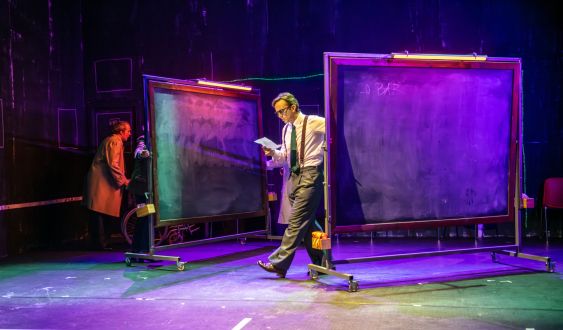
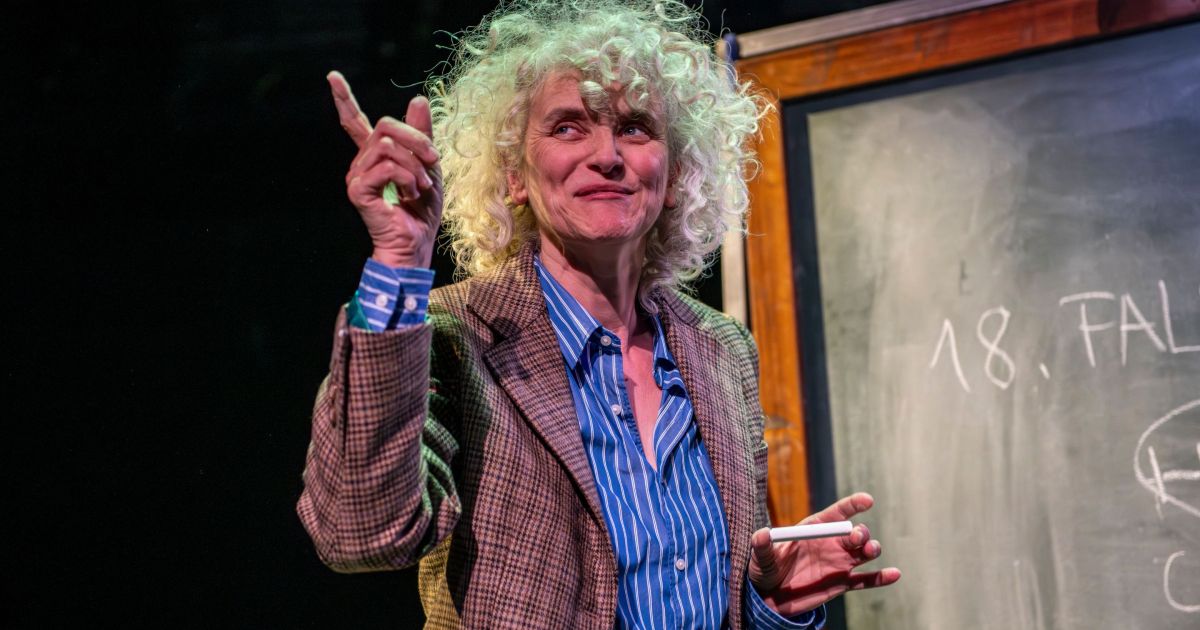
Joan Carreras gives us a physicist who wanders lost through the labyrinths of his own mind, shaping the environment as it suits him. In addition, the staging hides one of the most ingenious scenic proposals I have seen in a long time: the face-to-face between the two characters played by Carles Pedragosa Torres. Jordi Oriol's direction here is pure magic; using a blackboard that covers the actor as he speaks and subtle touches of costume, we witness a dialogue sustained by a single interpreter. An original and well-rounded scene.
The original idea of L'últim àtom is very interesting: we live in a world that, physically speaking, is impossible to comprehend. So, what are we doing trying to bring order to all that is impossible? This is the absurdity of human life, of the endeavor of wisdom. Trying to bring order to the chaos that is life. And this is how these characters live: going around in circles, crashing against walls, and playing a game of handball that never ends. Furthermore, and without intending to give spoilers, the final scene of the play with which the curtain closes is one of the best I have seen lately. A scene that, in a simple way and full of humor, condenses the entire message: human beings determined to be right and life going in another direction...
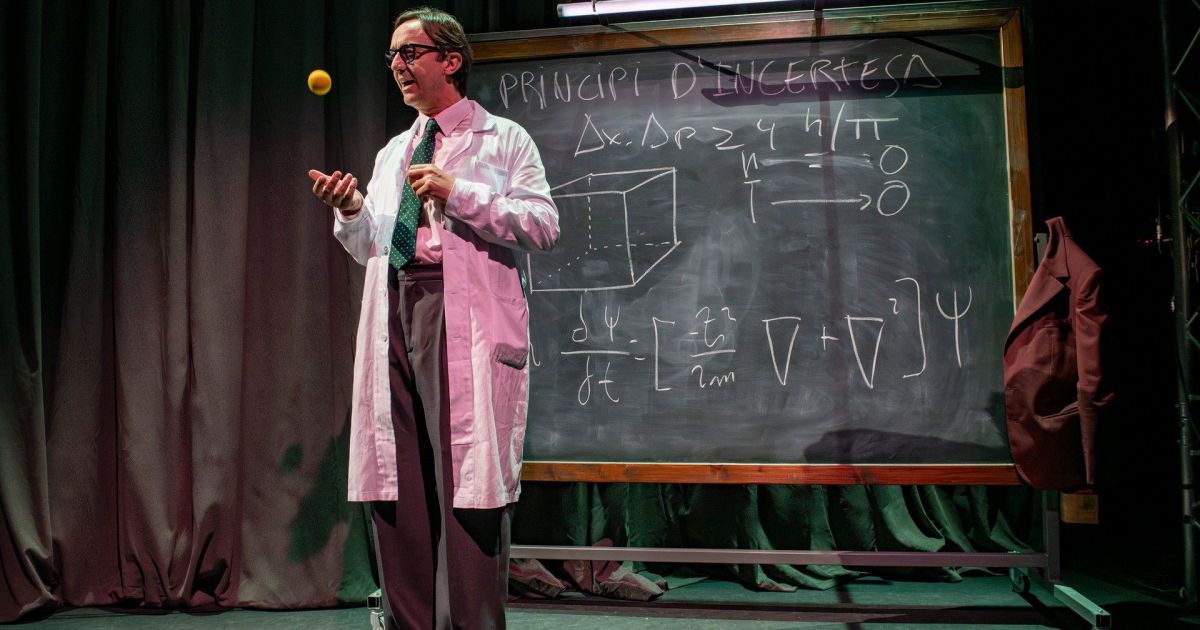
The blackboard loop
The idea of presenting the play through blackboards that move, hide, and configure the space is an original idea that is very visually appealing. However, the staging overuses this resource so much that it ends up losing its surprise effect and works against it. The stage sometimes becomes a labyrinth in constant flux where many of the blackboard movements feel forced or unnecessary. Instead of accompanying the viewer on this mental journey, so much movement ends up dizzying and diverting attention from what is truly important: the words and the actors' work. In the end, it generates an exhaustion that blurs the rhythm of the proposal.
Jordi Oriol plays with theater again
Jordi Oriol is what in the industry we would call a total creator: he is an actor, musician, playwright, and director. He trained as an actor at Nancy Tuñón and the Col·legi de Teatre, expanded his musical facet at the Taller de Músics, and graduated in Direction and Dramaturgy from the Institut del Teatre with the Extraordinary Award in 2007. All this knowledge explains why in his works the text rhymes with the score and physical movement.
As an author and director, Oriol has more than fifteen shows under his belt, among which are successes from our billboard such as Europa Bull (produced by Temporada Alta and TNC in 2019) or La mala dicció (Teatre Lliure, 2021). In addition, he combines his own company with a career as an actor under the direction of renowned directors such as Xavier Albertí, Oriol Broggi, Àlex Serrano, or Jordi Casanovas, while also teaching at centers such as Sala Beckett or the Institut del Teatre.
It is necessary, brave theater with the capacity to shake your brain.
In L'últim àtom we see a play in the purest Jordi Oriol style: profound, philosophical and that invites us to think. It is one of those plays that leave a mark. Perhaps when you leave the theater you leave confused and dazed by so much information, but when you sit down and stop to reflect you realize the genius they have created on the Goya stage. It is necessary, brave theater with the capacity to shake your brain.
Add The New Barcelona Post as your preferred Google source for free
Stay informed with the latest news.