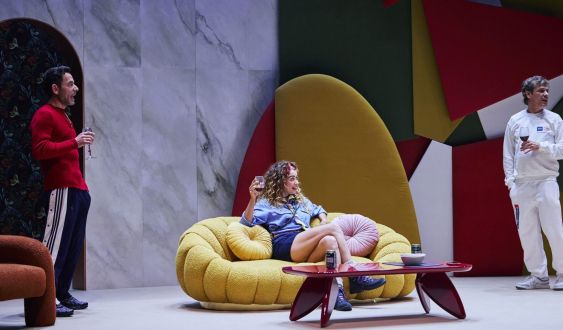
After the great success of La presència, Pau Roca directs a new comedy that moves between laughter and thriller. We are talking about La promesa, a text written by four hands by Sílvia Navarro Perramon and Yago Alonso that uses humor to launch a critique against the hypocrisy of our bourgeois lives.
The staging is conceived as a macabre countdown that starts with a reunion party and ends up becoming a pressure cooker where youth secrets and personal miseries are about to explode. The premise is very simple: what would you do if, in the middle of a party with friends, you found out that your drink is poisoned? From there, the characters begin to understand that the only possible salvation is to be honest with oneself.
The perfect prelude: a 90s party
The play invites us to a 90s themed party. A group of friends reunites after a year apart and the hostess decides to set the evening in the era that marked them. The stage becomes a time machine where Spice Girls, OBK or Michael Jackson play, and where friends are dressed as some typical characters of that decade: from the bakala with tracksuit and oval glasses to the grunge girl fan of Nirvana, passing through the esplai girl or a very funny nod to the Olympic Barcelona of '92.
But this is only the context of the story… Because, as always happens with the pen of Yago Alonso (playwright of other successful comedies such as La pell fina or Ovelles), the plot has a great social and critical background. On this occasion, together with the playwright Silvia Navarro, they have created a work that talks to us about job insecurity and the abuses of current home delivery companies: companies that do not comply with laws, that take advantage of legal loopholes and that put the safety of their workers at risk. A direct dart towards the lack of protection of the most vulnerable groups (such as newcomers) who are forced to accept abusive clauses out of pure necessity.
The hallmark of Sixto Paz, which has been shaking up theater for more than a decade
To understand this production, one must understand who is behind it. Sixto Paz Produccions was born in 2013 with a very clear premise: to change the rules of the game. Since its inception, this production company has argued that theater is not only art, but an activity that must be sustainable and that needs new formulas to connect with the viewer and always seek the direct complicity of the public.
Artistically, they define themselves as "eclectic," and their show history proves it. In recent years, they have made us travel through memory with El més bonic que podem fer (2022), moved us with social drama in Cost de Vida (2023) or Bèsties (2023), and had already collaborated with the authors of La promesa in productions such as Biològica by Sílvia Navarro (2024), La presència by Yago Alonso and Carmen Marfà (2024), or Qui va matar el meu pare (2025). With La promesa, the company remains faithful to its foundational objective: to place the human being, emotions, and current events at the center of the debate.
A comedy with fresh and current gags
The best part of the proposal is that we are facing a very funny comedy, full of fresh, current gags that generate immediate empathy with the audience. The characters, despite playing with the genre's own clichés to elevate the comedy, work wonderfully thanks to a dedicated cast. Eduard Lloveras is sublime nailing Michael Jackson's forbidden moves on stage and stars in one of the most brilliant moments of the play: an intense, forced, and ridiculously funny wine tasting. Marc Rodríguez, as a textbook hypochondriac linked to the Olympic spirit, delivers some of the most delirious scenes of the show, well accompanied by solid Eduard Buch and Mercè Martínez.
Special mention must be made of what happened on opening night. For health reasons, Carol Rovira could not perform, and in a record time of only three days, Clara Altarriba took on the role of the hostess (the engine of the play's conflict). Her performance is exceptional; the actress defends a complex text with a confidence and magnetism that make one completely forget that it is a last-minute addition. She deserves a giant ovation.

The verisimilitude is the weakest point of the proposal
However, the weak point of La promesa lies in its lack of verisimilitude. Placing this group in a life-or-death situation due to alleged poisoning, does not fit with the relaxed tone of the comedy. It is very difficult to digest that the characters, faced with such a great betrayal, agree to undergo tests that seem like camp games. The plot feels forced and loses realism.
This becomes even more evident in a very rushed ending. The change in the characters' perspective occurs suddenly, without prior psychological evolution on stage; consciousness appears abruptly, after ten years of silence. The script is aware of this forced turn and, just in case the audience doesn't understand it, it gives it to you chewed with a line of dialogue that justifies it by saying: "It's remorse." A too simple resolution for such an extreme conflict.
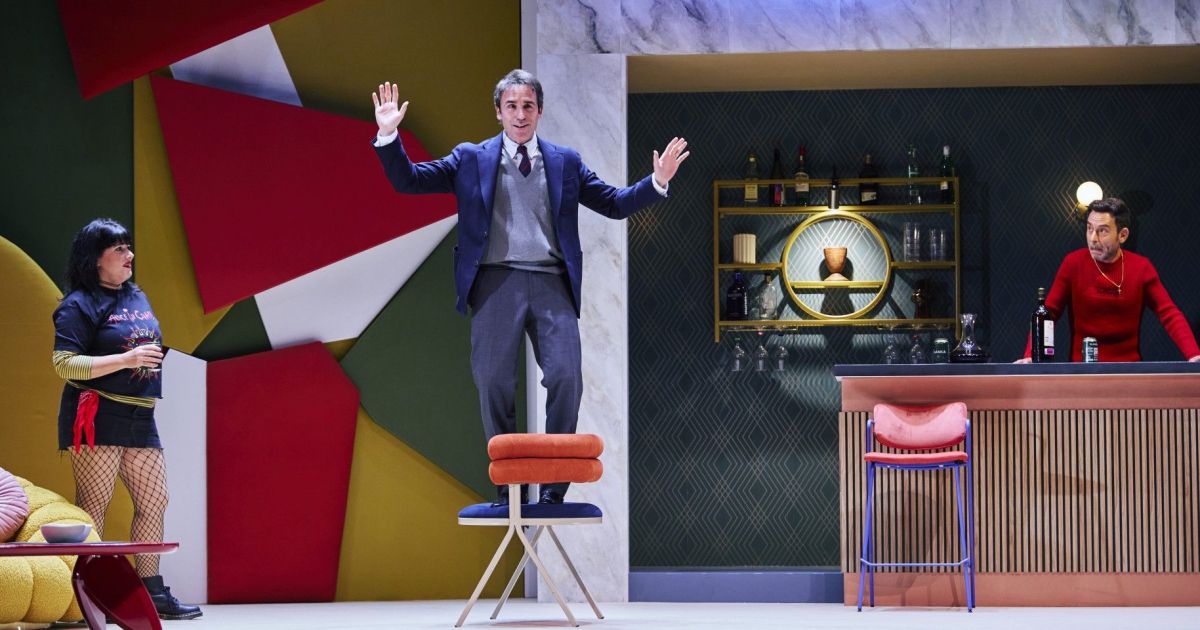
Despite the text faltering in its final stretch and asking for a significant "leap of faith" from the viewer regarding the plot's credibility, the final result of The Promise is positive. The play more than fulfills its main objective: to connect with the audience, to make us travel through the nostalgia of the 90s and to put a much-needed social debate on the table.
Pau Roca manages to maintain a lively pace that makes the hour and a half fly by. The feeling upon leaving the theater is that of having had a very fun time, of having laughed a lot and, why not, of leaving humming some hit from our youth.
Add The New Barcelona Post as your preferred Google source for free
Stay informed with the latest news.