
A robot makes its way through the crowd. It is crowned with a smiling face and turns to look at the congress members it passes. A few steps further, a companion of his decorates the Seoul stand, dressed in a costume to make it more endearing. But the one that captures the most attention is a Boston Dynamics robot, poorly popularized by Black Mirror. It is lying on the floor, completely deactivated, waiting for someone to turn it back on so it can do one of its dances. As much as one might think that a hall about the cities of the future like the Smart City Expo World Congress will be plagued with futuristic proposals with many robots, these end up being nothing more than something accessory and curious, even Instagrammable, used to bring attendees closer to the exhibitors, where more realistic and simpler solutions are presented.
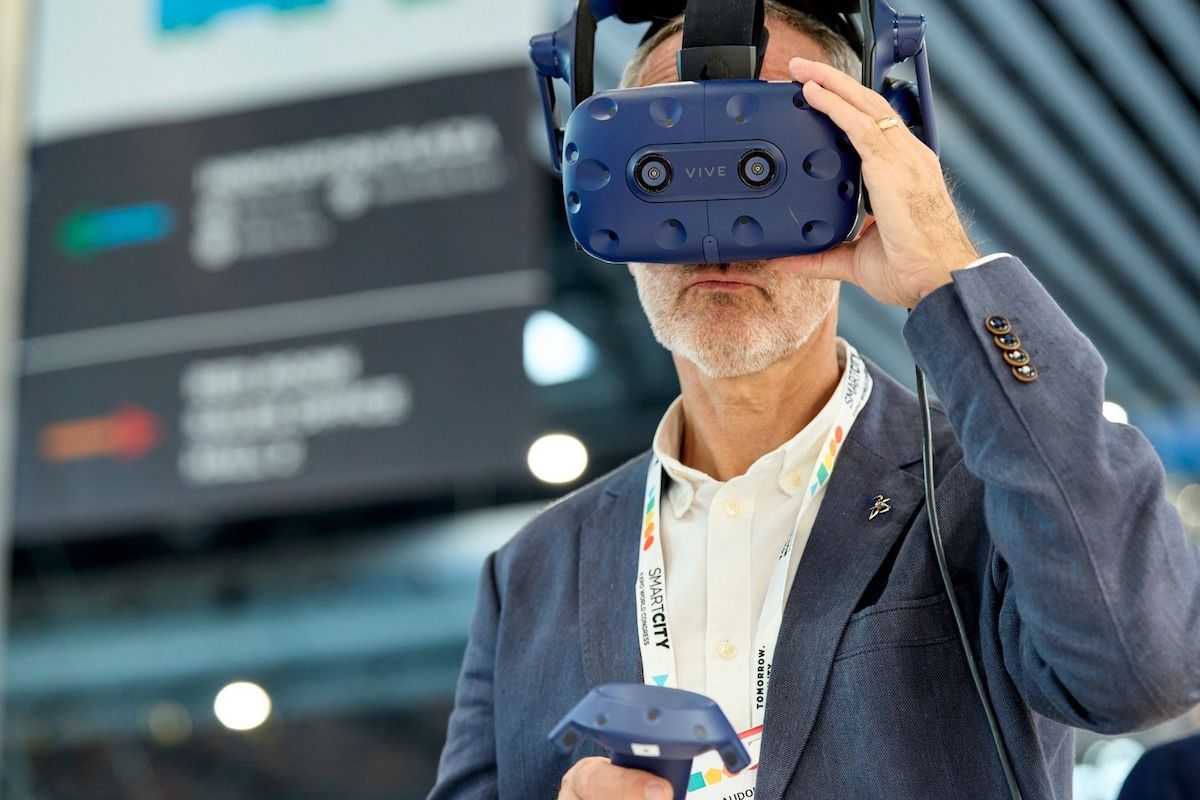
It becomes even clearer when a group of elderly people are seen entering the Gran Via venue. They are not congress members in the usual sense, always suited and in a hurry, but rather attend the Smart City Expo to participate in workshops to improve their digital skills, organized by the L'Hospitalet de Llobregat City Council. They dedicate the morning to learning how to use ChatGPT to create avatars, something they find complicated but very interesting. They even put on virtual reality glasses to travel the world without moving from their chair.
Although this group of attendees is a minority among the more than 25,000 congress members who will visit the exhibition this year, many of the solutions presented are designed to make their daily lives easier in increasingly digitized cities. One of them is the Atenea project, a mobile phone without a touch screen or buttons with which one can only interact through something as common as a conversation. The Catalan company Momentum Analytics is behind a phone designed for that large majority of elderly people who are excluded from services that can no longer be called or require getting lost among too many screens and passwords. Its CEO, Albert Isern, calls this situation "digital violence," citing as an example the difficulties his parents have in trying to request an appointment with the CAP. For this reason, the Atenea mobile will be in charge of speaking with its users and managing these tasks, but also of reacting to emergencies and calling 112. "As if they were asking their grandchildren," Isern illustrates. With a budget of 2.3 million euros, financed by European funds, this phone is expected to be tested in 500 Catalan homes next year.
From this Tuesday until Thursday, the Smart City Expo, organized by Fira de Barcelona, debates how to improve the quality of life in capitals around the world with proposals such as the Atenea mobile phone. It will be a record edition with the participation of a thousand exhibitors and representatives from 800 cities, leaving behind the impact of the pandemic. In addition, more than 600 expert presentations have been scheduled, among which Airbnb co-founder Nathan Blecharczyk stood out this Tuesday. Moderated by journalist Mar Galtès, Blecharczyk expressed support for regulating the platform's activity on a day when the Generalitat approved leaving 28,000 tourist apartments without a license in the most crowded areas.
At the Smart City Expo, you can also see solutions that improve the quality of life in cities even if you don't even realize it. This is the case of the tool developed by the Basque multinational Sener, with its Catalan headquarters in Cerdanyola del Vallès. It uses artificial intelligence (AI) algorithms to regulate thermal comfort in spaces such as the Barcelona metro. It began to be tested during the pandemic, when public transport was still operating and it was necessary to ensure that no contagions occurred. At that time, recalls Business Development Director Aurelio Muñoz, CO2 concentration was measured to see when it was necessary to ventilate and renew the air. Now, it is more designed so that it is neither too hot nor too cold, adapting to the number of travelers, which allows energy savings when it is empty and the air does not need to be very high. Based on this first experience, it is being tested in other spaces, such as hotels, with a pilot at the Iberostar chain, the Azkuna Zentroa leisure and culture center in Bilbao, and Valencia Airport. They are also starting to work with Fira de Barcelona, with very large venues where achieving the right temperature is not easy at all.
Another solution presented these days at the fair, which many will not even notice when they step on it, is the new flower panot that is being tested in the city. Sorigué, through Constraula, participated in the competition launched by the city council to find a more sustainable tile, but without losing its identity. Architect María Agustina Etcheverry explains that her proposal has managed to reduce the thickness, which allows saving construction material and reducing emissions during manufacturing, in addition to using less cement and more recycled aggregates, and managing to recover rainwater. Sorigué's panot is being installed on the green axis of Almogàvers street, in Poblenou, although it shines like a trophy at the Catalan group's stand. And it is that the Smart City Expo serves as a showcase for companies, meeting new clients and reconnecting with those from other countries with whom they usually speak remotely. This is what the corporate vice president of Moventia, Sílvia Martí, believes. The group takes advantage of the fair to make itself visible at a time of expansion, as confirmed by the recent announcement of the launch of a new intercity transport service in Saudi Arabia, where they have been operating a bus to Mecca for a year. All in all, the Catalan multinational will grow to 6,000 employees and more than 2,000 buses.
At the Smart City Expo, you can also see solutions that improve the quality of life in cities even if you don't even realize it.But not everything is about proposals already underway. Fairs are also doors to learn about future trends, as demonstrated by the Barcelona Supercomputing Center (BSC) and the Institute of Photonic Sciences (ICFO). The BSC has brought solutions to the Smart City for which they want to find partners to bring them to market. But sometimes it is also important to sow and bring closer technologies that few understand. With that objective, ICFO has embarked on the mission of explaining in a few-minute demo what photonics and quantum consist of, tools that have allowed the development of everyday devices such as mobile phones, enabling them to take photos or be tactile, and will continue to do so in the future, with pavements or roofs that will serve to charge vehicle batteries.
And, for those who want to relax after so many complicated concepts, Puzzle X, a congress on the materials that will mark the future, has the best offer. They have set up a bar counter where they offer shots and coffees, with waiters dressed in lab coats. Of course, they are a bit alternative, serving in test tubes and looking for new formulas, such as oil with worm salt for coffee. The proposal is from Futurity Systems, a Barcelona-based company incubated by Telefónica. They are dedicated to bringing science closer to large companies. As proof that it works, they propose coffee with oil, healthier and more sustainable than milk, they say, even with a better taste for some. A mixture that serves as a metaphor for what they want to convince companies of: you can combine things that a priori don't fit and find a new point of view.
Add The New Barcelona Post as your preferred Google source for free
Stay informed with the latest news.
