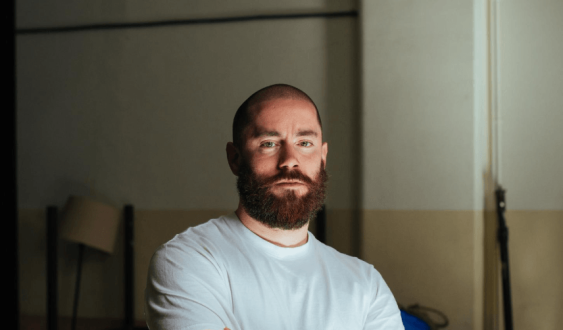
Tarot, spirituality, hippie ideology, and family. These are some of the themes addressed in the new proposal by Oriol Puig Grau, the resident playwright at Sala Beckett who, within the framework of the Grec 2026, presents El número setze dels Arcans Majors (The Number Sixteen of the Major Arcana), a play with a very explicit title that already gives us clues about what we will find on stage. With a cast led by Lluïsa Castell, accompanied by Mariona Pagès, Alba Pujol, and Laura Roig, the show places us in an abandoned country house that captures the attention of a journalist due to the curious story behind it.
We have spoken with Oriol Puig Grau so that he can better explain what his new play consists of, what inspired him, and what the audience will find when, this July, they visit the Beckett to embark on a journey into the spiritual world.
— Good morning, Oriol. This Grec, you are presenting El número setze dels Arcans Majors at Sala Beckett. Can you give us a summary of the play?
— Oriol Puig Grau: The play basically follows a journalist who is writing a report. At the beginning, she investigates some parties that took place around a house located on the outskirts of a village. Throughout the story, we see how this journalist unfolds the family trees and the lives that have marked this house over the last few years. The show consists of accompanying her as she unearths all the history hidden within these walls.
— The format of the proposal is an interview. Why did you choose this format and how has it allowed you to play with it when creating the narrative?
— I wasn't sure at first, but it appeared the moment the journalist character was born. The writing process has a very intuitive part, especially in the first phase, when you don't quite know what you're creating yet. This writer is nothing more than an alter ego of mine: I am constructing a story and, at the same time, I have a character within the text who also constructs one.
I quickly discovered that if I moved away from the moment of the interview or the conversation with the witnesses to place her in other spaces, the structure lost strength. I was much more interested in staying directly in the moment of the statement. In fact, the entire play goes by cuts: we enter when she is already interviewing and we leave before the conversation has ended. There is a lot of life before and after the play.
The writing process has a very intuitive part, especially in the first phase, when you don't yet know very well what you are creating.
— How does this character relate to you? Why do you consider her your alter ego?
— This is the fourth work I've written. Although each creative process is new, there are parts of my "writer self" that I know better now. My process is very intuitive and fluid, and in this same way, this creature ended up appearing on stage, living the search process at the same time I was living it. Having someone within the story who is also searching for the narrative allowed me to channel it. Through her questions, she controls where the narration goes. It's as if I were literally inside the work moving the levers and deciding where we are going.
— Listening to you speak, it seems that the writing process is almost a magical process where characters appear on their own.
— Yes, writing has a layer that consists of tuning into a frequency, connecting with a channel, and being open to what appears. Then comes the more technical or "detail-oriented" work: when you start accumulating symbols, characters, creatures, and events, you have to connect everything so that it makes sense and has dramatic force. But the initial flow is purely intuitive. Normally, I do this process alone at home, but in this work, I have a character who is doing it live on stage.
Writing has a layer that consists of tuning into a frequency, connecting with a channel, and being open to what appears.
— The main themes of the work are spirituality and family. What kind of spirituality and family are we talking about exactly?
— Throughout the show, many questions are opened. When we talk about spirituality, we refer to the fact that there are many characters in a constant search, with the need to connect with something that brings order to the inexplicable in life. That's why we talk about the cosmos, tarot, or the zodiac. We also have characters who are literally magicians or who in their daily lives are connected to the realm of surprise and what is beyond human control.
As we talked about where we are spiritually rooted, during the writing, questions of where we are rooted familially or geographically naturally arose. Everything revolves around this house: there is talk of those who have left this place and those who have left other places to take root here. A very beautiful mirror is generated between where we are energetically rooted and where we are physically rooted.
— The play features themes very present in current society such as tarot, zodiac, or astrology. Were you familiar with these practices or did you have to research them?
— At the core, tarot and zodiac did not appeal to me at all nor were they close to me. I did have a personal curiosity for something more cosmic, but I didn't experience it translated into such concrete elements. However, when the text began to open up these questions, it seemed fun to offer these ties that are so commonplace. It allowed us to bring very big questions into the present through a person who, simply, has their cards read.
— Precisely, the title refers to card number 16 of the Major Arcana of the tarot. What does it represent?
— It is the Tower card which, in a very general way, evokes a forced change or a catastrophe. On the card, a lightning bolt strikes against the earthly and human. The symbol of the lightning bolt is very present throughout the piece: in the three interviews we see, reference is made to this link between the divine and earthly worlds. The tarot card allowed me to invoke this lightning bolt, and that is why it gives the work its title.
I believe that tarot or the zodiac are a kind of shared and collective game board that allows us to converse.
— Why do you think so many people today turn to these spiritual practices to satisfy uncertainty?
— I believe that tarot or the zodiac are a kind of shared and collective game board that allows us to converse. When you share these symbols, you can talk with other people about very big questions from a more playful and fun place. They are elements that help us to order very complex cosmic intuitions that we all have, but which are sometimes difficult to express in words. Suddenly, you have some cards with illustrations and a pre-established order by someone who has distilled these symbols, making it easier for you to apply them to your own reality.
— Unlike your other works, you define this text as "expansive." In what sense?
— It has to do, on the one hand, with the place from which the characters communicate. There isn't an intimate narrative directed directly at the audience; instead, they are sharing it among themselves on stage, through a quite open channel where they discuss very grand existential questions. On the other hand, the expansiveness also arises from the stories opened by the journalist, which are enormous geographically and existentially: we have characters who come from Russia and live in the house, and others who have gone to America to live with hippies.
Furthermore, it talks about the danger and ease of manipulating people by using this need to bring order to the inexplicable, making them act for the benefit of another's interest. In my latest pieces, there was a more introspective and individual search; here it is clearly more collective.
— You explained that you were inspired by a line from the play The Glass Menagerie. Which one is it and how has it influenced your piece?
— At the end of that play, the protagonist abandons his family and tells his sister to blow out the candles, because in the world what illuminates it are lightning flashes. I have somehow latched onto this brother who leaves (in our piece we also have many family members who return or leave) and these lightning flashes that illuminate the world. I have taken them and re-signified them, linking them directly with the divine.
— What exactly does the house symbolize in this story?
— On a very simple level, we are talking about family, and the house on a theatrical level is the symbol par excellence of the box that houses the family nucleus. Then, this house also serves me to show the passage of time. In the present, it is abandoned and full of graffiti. This allows the passage of years, which at many moments of the play takes on a very esoteric and intangible flight, to remain on a very physical and earthly material plane for the spectator: to see when it has been inhabited, when it has been closed, and how it has accommodated the human and the everyday.
— This is the first time you've worked with actress Lluïsa Castell. Why did you think of her for this character?
— I have followed her for years and she is a fantastic actress. The character she plays called for a very specific relationship with the past. She has a very deep wound, but in the present, she doesn't show it as a first layer. I knew I needed someone capable of building and playing with all that pain, but who at the same time could connect from the present with a certain irony and with a darker, more playful energy. I knew Lluïsa could connect with this channel, and so it has been. It was a great moment when we could confirm she would be on the team.
— You have explained that you wrote many more pages than what has finally been seen on stage. How has this distillation process been and why did you decide to cut text?
— All the dramatic tension of the play is in the past; what we have on stage are people who, from the present, tell us things that already happened. In other shows of mine, the characters lived the story in the present, here and now. In this case, I had to write more to be able to distill what was essential. The management of information had to be very careful to maintain the dramatic tension of the interview. If too much was explained, the rhythm dropped and interest was lost. You had to regulate how and when you gave the details of the past.
It is a very porous show that highlights that all of us are much more connected than we think.
— Did you do this cutting process alone or already in the rehearsal room with the actresses?
— I have really enjoyed how the resident authorship calendar works at Sala Beckett. I was already putting together the team when I was still halfway through the writing process. We confirmed the cast and organized some preliminary readings to test the text. A very interesting dialogue opened up with the actresses; they themselves shared with me what material resonated best with them. Although we started rehearsals with the text quite closed, there has been a previous dialogue that has influenced all of us.
Furthermore, the fact that the team joined halfway through the writing process made it a truly collective work. Paula González (scenic space), Rai (lights), or Fernando Epelde (music) were sending me images and materials while I was still writing, so our processes fed back into each other much more than usual.
— How exactly does the residency process with Sala Beckett and Festival Grec work? Do they propose the theme to you?
— No, it's a blank canvas. The only limit they set for me was the maximum number of actors due to budget constraints. Then there's a follow-up: I would deliver material to them, we would have meetings to discuss it, and it functioned as a support, like a mirror where I could share the doubts that arose. More than imposing a theme, they give you a laboratory space with the theater team with whom you can dialogue. We would send each other materials, and it's greatly appreciated; in the writing process, you're very alone, and here I've felt very accompanied.
It speaks of an energy that is above the making and unmaking of the human and that reveals something that runs through all of us.
— You explore the connection with "that which is divine." What is divinity to you? Are we talking about God, energies...?
— In the show, it's not linked to religious spirituality, but rather to an energetic plane that I also consider divine. It speaks of an energy that is above the making and unmaking of the human and that reveals something that runs through all of us. We have different characters from different generations who don't know each other, but who have passed through the same space at some point in their lives. In some way, they are connected and, energetically, they are resolving generational issues of which they are not even aware. A cosmological and cosmic terrain opens up, which I call "that which is divine."
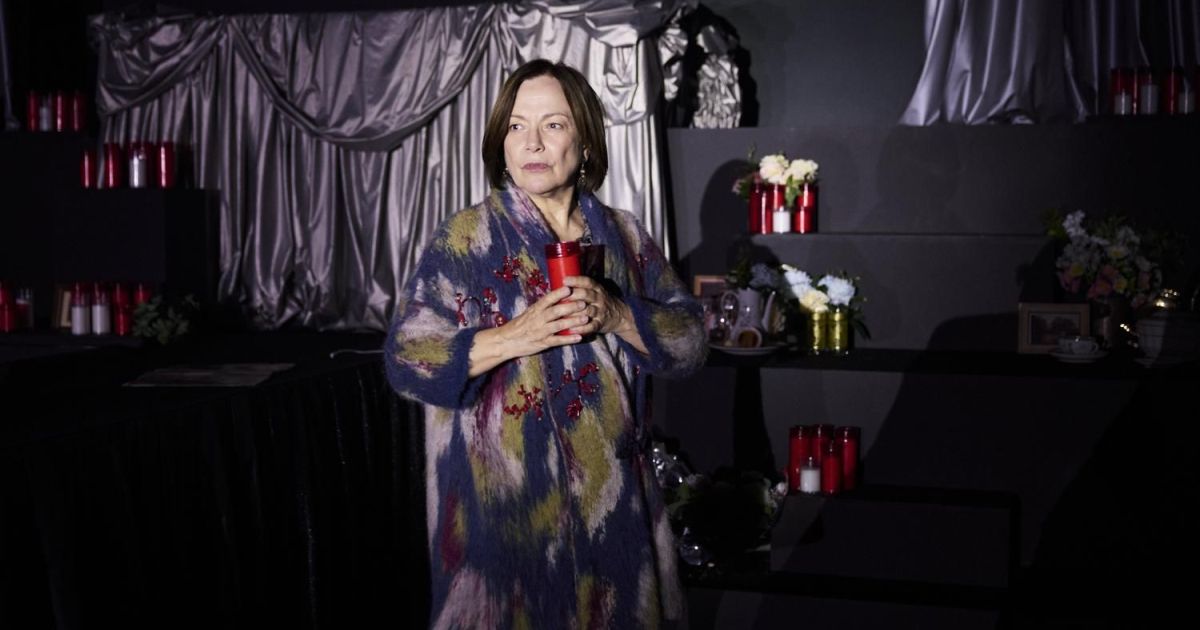
Of course, we have the set full of candles, funeral wreaths, and photos, including a photo of the Pope placed in a little corner. We know that perhaps only three spectators will see it, but we find it amusing that it's there among the teacups, like a small visual joke.
— To finish, if you had to complete the sentence: "El número setze dels Arcans Majors is..."
— It's a very porous show that reveals that all of us are much more connected than we think.
From July 1st to August 2nd, this proposal by Oriol Puig Grau can be seen in the Sala de abajo of the Sala Beckett. A work that invites us to open our minds and let ourselves be carried away by all that invisible that surrounds us and that we cannot explain with words.
Add The New Barcelona Post as your preferred Google source for free
Stay informed with the latest news.