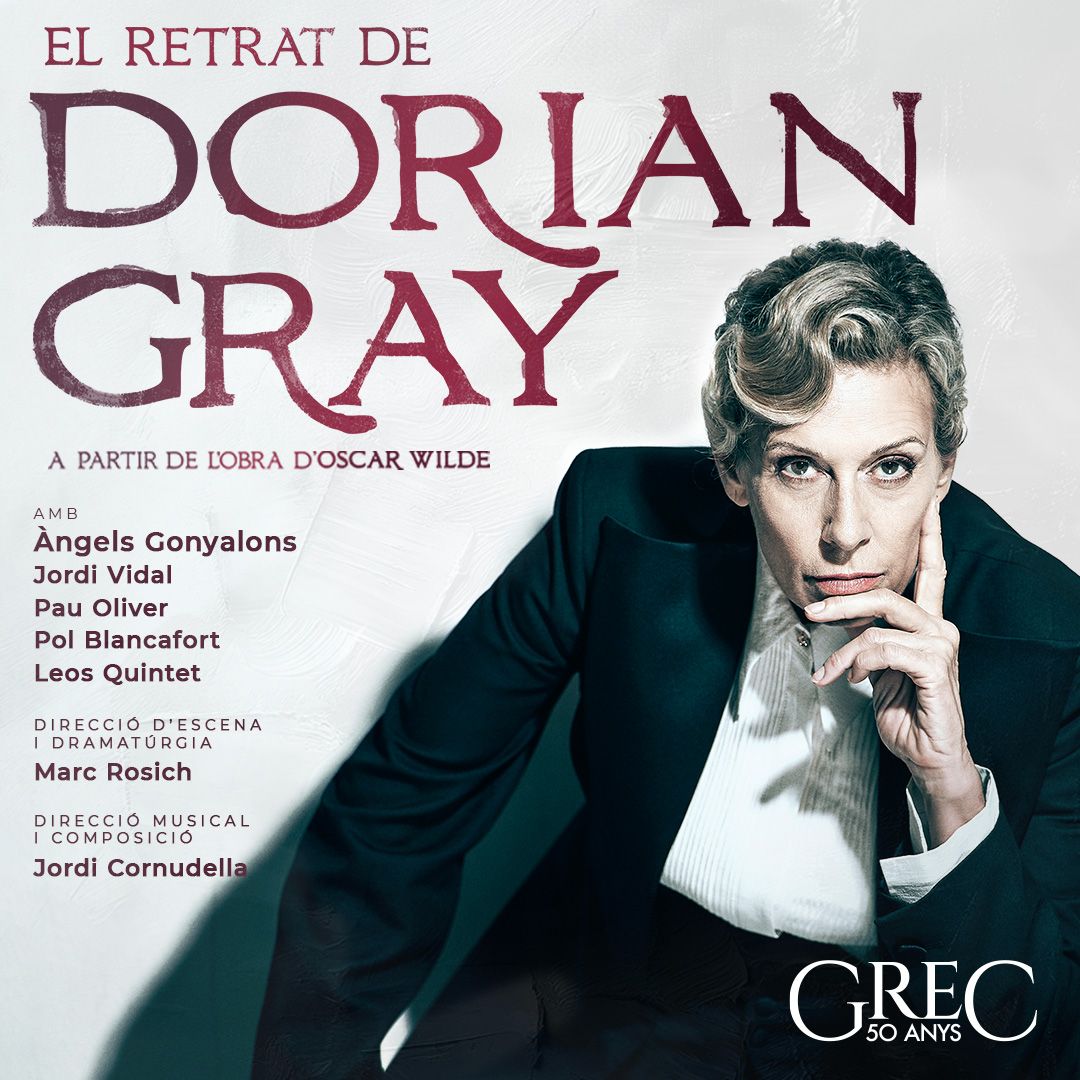
Within the Grec 2026, the Teatre Romea presents The Picture of Dorian Gray, a proposal that, as Marc Rosich has described, is "a chamber piece, where text and music complement each other." Therefore, it is not a musical in the usual sense, but rather a theatrical proposal that harnesses the power of words and music to depict this story that delves into the darkness of the human soul.
The director and playwright of the piece, Rosich, has explained to us that the play begins with Wilde himself defending "the precious uselessness of art as a philosophy of life." In fact, Josep Maria Pou has recalled that the first word spoken on stage is the word "art," therefore, the show vindicates the value of art for its own sake, the value of art for art's sake. And, as Pou has remarked, we find ourselves in such a turbulent world that "art is more necessary than ever."
Actress Àngels Gonyalons will embody Wilde himself, but she will also play the three male characters in the play. Pou has highlighted that "Àngels performs a monstrous tour de force where she represents all the characters," but she wanted to clarify that the play is a team effort and that she is surrounded by a lot of talent: such as composer Jordi Cornudella and performers Jordi Vidal, Pau Oliver, and Pol Blancafort. In fact, the presence of this musical and acting cast means that the play could be re-baptized with the name of Dorian Gray and the Holy Trinity, as Josep Maria Pou joked.
We have spoken with Marc Rosich to better understand how this work was conceived, which shies away from technological artifice to opt for theatrical craftsmanship and ignite the spectator's imagination.
— In the play, we see Oscar Wilde appear to talk about his novel. What is this Wilde that we will see on stage?
— To create this character, we have based ourselves, above all, on the preface to the second edition of the novel. From this precious text, we have built the character of Wilde on stage, who is the one who tells us the story. We have not had to resort to anything else: it is Oscar Wilde himself who receives us in an almost museum-like space to talk to us about art, about "art for art's sake," about the necessity of the "uselessness" of art and how it saves our lives. We have simply arranged his preface to head the work.
"Oscar Wilde who receives us in an almost museum-like space to talk about art, about art for art's sake, about the need for the "uselessness" of art and how it saves our lives."
— How have you imagined him physically? Have you looked for specific sources for the characterization?
— We have imagined Oscar Wilde in the body and voice of Àngels Gonyalons. For her to say "I am Oscar Wilde" is enough; no artifice is needed, there is nothing more theatrical than that: you say it and the spectator believes it. As for the costumes, there are small ironies as a tribute to his iconic photos.
But, beyond elegance, we have not dressed the characters from the novel, but rather we have thought about the wardrobe Oscar Wilde would have if he received us in his home. There are robes, one more feminine and one more masculine, maintaining an elegance that is not historicist. We imagine that he receives us in a contemporary art museum today; he is aware that he is speaking to a 21st-century audience, despite coming from the 19th century. This same code is used by the male vocal trio that accompanies him, and this ambiguity is the same one we play with when an actress embodies a character and a male voice.
— Why have you chosen for the space to be a museum? Does it have to do with the concept of "art for art's sake"?
— It is a museographic space presided over by a work that for us is a great monolith, a kind of homage to 2001: una odisea del espacio. Normally, portraits are vertical, and this monolith represents art, art for art's sake, in the initial monologue. However, during the piece it becomes the object where we pour all the imagination of Dorian Gray's painting. Every time the portrait is mentioned, the monolith appears or becomes present. It is like the white painting by the artist Robert Ryman: a blank canvas where we want the spectator to imagine all the descent into hell that the piece invokes. As Josep Maria Pou used to say, what we do is make the spectator imagine the novel. This performance space serves to ignite the audience's imagination.
At no point is any image of Oscar Wilde or Dorian Gray seen. When she plays Dorian Gray, she does so only with her body and her voice. It is the ancient strategy of the story told orally: I tell you the novel and interpret all the characters. There is nothing more theatrical than that.
"It's the old strategy of the story told by word of mouth: I explain the novel to you and interpret all the characters."
— It has been said that your proposal is based on craftsmanship...
— In the London version of The Picture of Dorian Gray, the craftsmanship was also very strong, but they had four cameras on stage, giant screens with continuous movement, and a lot of live post-production work. They managed to have the actress dialogue with herself: the cameras recorded her playing each character and, thanks to technology, you saw Basil, the painter, and Lord Henry on screen, all interpreted by her simultaneously, without even understanding how they had technically done it.
Our version is something else. I bought the dramaturgy of the London version, but we hardly followed any of its paths. In that one, for example, there is no prologue. Ours has a different structure, closer to a libretto for a musical piece.
— What attacks did Oscar Wilde receive for the novel? Why did he have to write the prologue?
— It was a very conservative era. The first edition contained more explicit mentions of homoeroticism and relationships between men. Although some graphic descriptions were toned down in the second edition, the impulses and desires remain the same. It must be remembered that Wilde ended up imprisoned for being homosexual; in fact, years later, the same novel was used as evidence in his trial to condemn him.
But the attacks were not only because of homosexuality, but because the novel is profoundly amoral. Characters are presented who commit immoral acts while Dorian Gray retains his beauty and it is the portrait that ages with each sin. The ideals of Lord Henry were defended, which are pure hedonism and radical individualism, themes that are still fully relevant today.
"It must be remembered that Wilde ended up imprisoned for being homosexual; in fact, years later, the same novel was used as evidence in his trial to condemn him."
— This idea of "art for art's sake," have you maintained it in your version?
— Yes, especially thanks to the preface. One of the key points Wilde defends is that there are no moral or immoral works: works are either well-written or badly written. Art should not be a tool for morality; art exists for itself and saves us precisely because of that, because of its own beauty.
— In addition to playing Wilde, Àngels Gonyalons also embodies all the characters in the novel. How have you, as a director, approached these transformations so that the audience understands and sees each of the characters, without the scene looking "messy"?
— Everyone is surprised and tells me it's very difficult, but in reality, it's the simplest thing in the world. Theater is born from this: from a person telling a story, like the aedos in ancient Greece, who told the Odyssey and all the characters passed through their body. The same happens with Àngels: no great transformations or set changes are needed. It's much more effective to do subtle things: a change of voice, a turn of the head, a glance. As a spectator, you already understand who is speaking. And when the situation is more complex, with three or four characters at once, we use the narrator to distribute the play and guide the spectator at all times.
— Do you have any curious anecdotes from these weeks of rehearsals?
— What has been very beautiful has been seeing how the male vocal trio, which initially only existed as annotations in a Word document or in scores, has come to life in the rehearsal room. Characters have been born who, despite not having a name, create a unique reading of the piece. These are the magical things about theater. My goal is to create magic: with four performers and a string quintet, we seek to ignite the audience's imagination. This museum space, where the story is told to us, uses all possible resources so that each spectator "paints" the novel as they wish.
I always say that, as spectators, we have a mental "screen." There are shows that fail to light it up because they are too literal, and that makes them lose theatricality. Unlike cinema, which is photographic and descriptive, theater has the power to activate this mental screen. Our strategy of having Oscar Wilde tell us the novel goes precisely along these lines: we want the spectator to imagine Basil, Lord Henry, Dorian, or his fiancée with the freedom and intensity that each one desires. We do not want to limit the spectator; we want them to actively participate in the creation of the work.
"My goal is to create magic: with four performers and a string quintet, we seek to ignite the audience's imagination."
— Why did you decide to transform this drama into a musical show? What does music add to the whole?
— Whenever I do text theater, there is a musical dramaturgy behind it, either because the play calls for it or because of my experience with opera and musicals. In this case, the project was born around Àngels Gonyalons. She is a great actress in both text and musical theater, and the intention was precisely to take advantage of these two potentials so that she could demonstrate her strength in both disciplines.

— What do you think are the central themes of the novel that challenge us today?
— Undoubtedly, the fear of aging. It is the core of the plot: Dorian Gray's desire for his portrait to age while he remains eternally young. It is a very current anguish, the feeling that life is slipping through our fingers. It is very powerful that an actress like Àngels, at such a sweet and mature moment in her career, talks to us about this fear. It is a feeling that we can all understand, even the youngest, in a society marked by ageism and an obsession with aesthetics where the passage of time is to be avoided at all costs.
— Finally, how would you define The Picture of Dorian Gray in a single sentence?
— I'll stick with one of Oscar Wilde's aphorisms that we have in the play: "The drama is not to grow old, because there will always be someone younger." The play is full of these truths, and this one summarizes very well the conflict we present.
Add The New Barcelona Post as your preferred Google source for free
Stay informed with the latest news.