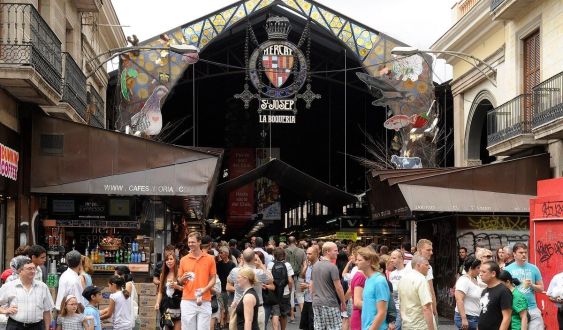
La Boqueria is Barcelona's most universal market, and Barcelona is determined that its attractiveness does not diminish its role as a neighborhood market. With this objective, the City Council has set in motion the machinery to reform the market, with works that will start in 2025 and extend until 2027, at a cost of between ten and twelve million.
The objective of the reform is to preserve La Boqueria's dual facet: that of a neighborhood market and that of an essential place to visit for tourists, two realities that may seem contradictory, but which are intended to be made compatible in the market. To do this, the space will be updated and its model rethought, with the purpose of guaranteeing the balance between the sale of fresh and prepared products, with the former more aimed at residents and the latter at visitors.
To move in this direction, the market has decided not only to improve its internal distribution, but also its access, and not precisely the much-photographed one from La Rambla. The access through Gardunya square, at the other end of the market, will be dignified "so that it has two entrances, and not as it happens now, where it seems to have one entrance and one exit", as highlighted by the Councilor for Commerce, Restoration and Markets, Raquel Gil.
And it is that, with the current configuration, Gardunya Square resembles a "storage room of La Rambla", according to the Councilor for Ciutat Vella, Albert Batlle. The also Deputy Mayor for Security has committed to turning the area into a hub of facilities, for which he recalled that it will be necessary to "recover for public use" spaces that are occupied. The square, where specific interventions are already planned to be added to other improvements in the area, will gain with the market reform "a very dignified entrance gate to La Boqueria".
Reconfiguring this access is part of a market transformation that stands as a strategic objective of this mandate for the City Council. To carry it out, the aim will be to guarantee balance within its offer. Although "it has never ceased to be a fresh produce market", as Gil has claimed, work will be done to ensure that this aspect "gains more weight and muscle" so that prepared products do not steal its ground.
"We will see how we regulate it and how we guarantee that the balance between fresh and prepared is maintained over time," added the also president of the Municipal Institute of Markets, and the stallholders share this view. The president of La Boqueria, Jorge Mas, corroborated this, and defended that "fresh produce cannot be lost, and this is what must be guaranteed for the future," in a market that last year received more than 23 million visits, and which was also recognized as the best market in the world.
The market will update the central fish area and replace its fiber cement roofsTo achieve and maintain this balance, the market will be equipped with internal regulations that are being addressed with its stallholders, with whom a "common minimum denominator" has been reached, Gil highlighted. The objective is to reach a majority consensus among the merchants, "and with 178 stallholders, there are opinions of all colors today," emphasized Jorge Mas, who specified that the decision will be made in an assembly of all merchants. Precisely La Boqueria is the market with the most stalls in the city, and its 178 establishments place it far above any other.
In addition to seeking a change in the market model to guarantee the continuity of fresh product sales while coexisting with prepared food, the reform will also involve significant physical changes in La Boqueria. Among these changes, the replacement of the market's roof stands out for its complexity and scale, which continues to be made of fiber cement.
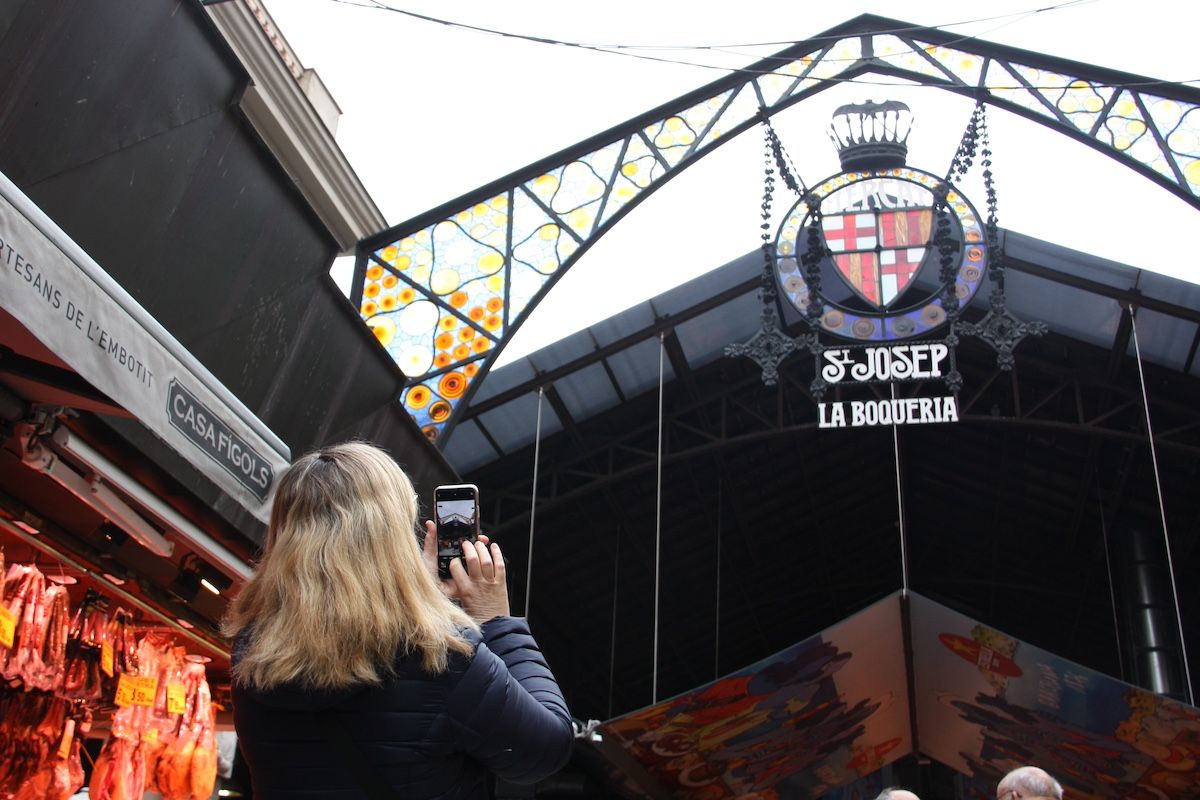
Removing asbestos from the city's most international market will not be easy. "We will try to ensure that the impact is minimal, always guaranteeing safety," highlighted the councilor, who pointed out that technicians and experts are pending to analyze the current state of the roof and its anchors to specify how its removal will be carried out.
"What happens in other markets cannot be applied here until professionals indicate the procedure," added Gil, referring to the Mercat de l'Abaceria de Gràcia, which since 2018 has been operating from a provisional tent on Passeig de Sant Joan while awaiting the completion of a reform that has included removing its entire asbestos roof. In the case of La Boqueria, the intention is for the reform to proceed with minimal impact and that, "if there have to be closures, they will be partial."
The replacement of La Boqueria's roof will not be the only physical change brought about by the reform: oxygenating some aisles will also be studied, and the central fish area will be transformed to provide it with the services "that a 21st-century market in Barcelona should have." Thus, the plan is to maintain the structure of the central oval and the current aisle, improving the conditions for stallholders, so that "the experience not only of buying but also of selling improves."
The market's reform, which will maintain the current stalls, will be combined with another of the major transformations underway in the city: that of La Rambla, which is expected to be ready in 2027, so both calendars will advance in parallel with the aim of finishing the works on the city's most universal avenue and those of its oldest and most emblematic market at the same time.
Add The New Barcelona Post as your preferred Google source for free
Stay informed with the latest news.
