
In the debate about the necessary infrastructure for the progress of a metropolis like Barcelona, the emphasis is usually placed on those related to mobility, both internal (commuter trains and public transport in general) and external (high-speed rail, airport, etc.). This bias has its logic if we consider that a metropolis is usually defined by the intensity of habitual displacements, for work, study, or leisure reasons of the people living in a certain territory, and by its connectivity with the global system of cities.
However, other infrastructures that form the basic framework of our quality of life go more unnoticed, and we only pay attention to them when some crisis episode erupts.
This is the case, for example, of water supply infrastructures. The persistent meteorological drought is leading to a hydrological drought, that is, to a water scarcity, which is starting to be very worrying and forces certain restrictions, difficult to apply at the municipal level with elections around the corner. The critical situation reached in the 2004-2008 episode led to a public awareness and a generalized reduction in consumption, but the territory and river basins demand greater care and better management, just as a strong commitment to water regeneration and reuse is necessary.
But this situation has also highlighted the water waste caused by deficiencies in the supply network. Thus, these days figures have been revealed stating that in Catalonia, a quarter of drinking water is lost as a result of leaks due to the poor state of the network. Some cases that have come to light, such as that of the Canyet stream, in Badalona, with a leak of about 180,000 liters daily since 2005, highlight the lack of investment and understanding between the corresponding administrations.
An understanding that is essential and urgent to correct situations like this. Last year, the Barcelona Metropolitan Area (AMB) approved a strategic plan for the integral water cycle that included an initial investment of more than 130 million euros largely for network maintenance, but which set investment needs for 2050 at more than 2,000 million to be contributed by both the AMB itself and the municipalities that form it and the Agència Catalana de l'Aigua (ACA).
Another current open front, not without controversy, is that of energy infrastructures. The data tells us, in this case, that the metropolitan region of Barcelona consumed 22,600 GW of electrical energy in 2019. A significant fact, however, is that only 0.8% of the area requested for new photovoltaic installations in the Catalan territory in 2021 corresponds to municipalities in the region (which covers all of Vallés and Maresme), while no authorization has been requested for wind farms within the region itself.
The AMB, for its part, made its first "solar map" in 2014 to calibrate the capacity for self-generation of photovoltaic energy on roofs. The result obtained was a theoretical maximum of 42% self-sufficiency, but, considering the technical feasibility of the installations today, the percentage dropped to 12%. Even so, we must emphasize the development of a broad distributed energy infrastructure taking advantage of legal changes regarding energy communities.
Investment in renewables and digitalization
With this panorama, and taking into account that estimates indicate that the installed renewable power must be multiplied by 18 to achieve climate neutrality, the government of the Generalitat has calculated that an investment of 59,000 million euros will be necessary and occupy 2.5% of the territory with the necessary infrastructures to generate clean energy until 2050.
The digitalization of the economy poses another major challenge. To begin with, and linking them to energy consumption, the annual CIDOB report pointed out that in 2019 almost 4% of global CO₂ emissions (and growing) are generated by the energy consumed by "the cloud".
In any case, it is inevitable to also focus on the necessary adaptation of digital infrastructures to the requirements of economic activity. The Barcelona metropolis has an advantageous situation with the high-capacity submarine cable landing station in Sant Adrià del Besòs, which should be an impulse for the deployment of next-generation networks. An area where investments are slower than expected, although it should be noted that Catalonia is one of the leading regions in advanced 5G and 6G research.
In this area, however, one of the main concerns currently is security. The cyberattack suffered by Hospital Clínic, as happened months ago with the Autonomous University of Barcelona or those regularly suffered by hundreds of municipalities, require new investments to extreme the protection measures of these infrastructures.
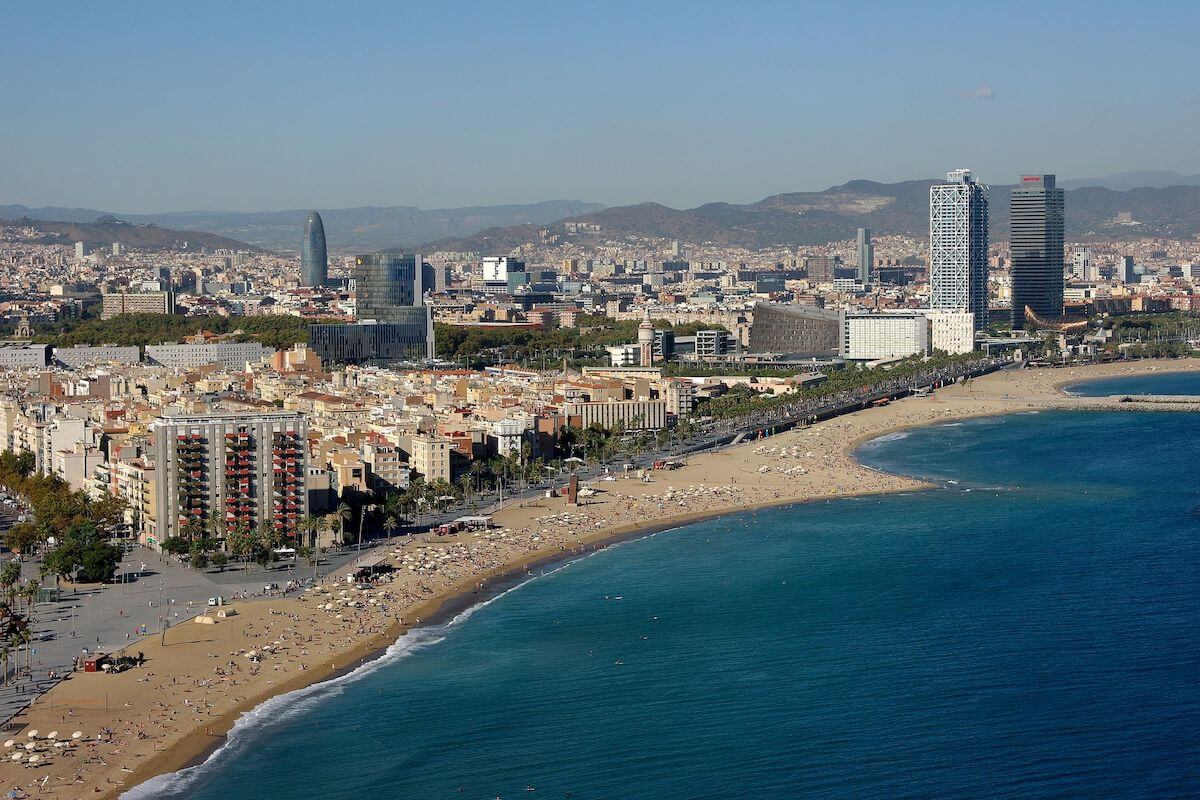
The fourth package of essential infrastructures is grouped under the label of "green and blue," which are all those that form the natural or semi-natural substrate of the urbanized space and provide ecosystem services to the metropolis. According to the definition used by the AMB, open spaces improve air quality, enhance biodiversity, act as CO₂ sinks, and offer recreational and social use to citizens as spaces for leisure, recreation, and sports. Temperature moderation is another of the primary services they provide.
Among these green infrastructures, we highlight two here: agricultural spaces and the metropolitan coastline.
Regarding the former, figures indicate that between 1976 and 2016, 40,000 Ha of agricultural land have been lost in the Barcelona metropolitan region. In the AMB alone, according to the preparatory studies for the Metropolitan Urban Master Plan (PDUMet), with the necessary investments 5,000 Ha of productive land could be recovered and made available to producers who cannot find it. It should be noted that the Parc Agrari del Baix Llobregat, one of our key green infrastructures, occupies about 3,500 Ha. In the rest of the metropolitan region, in addition, there are an additional 5,000-6,000 Ha in protected agricultural areas. All of this, together with support for producers, should allow for an increase in local production and, consequently, greater resilience of the food system.
The coastline constitutes one of the most fragile systems, as well as one of the most exploited, of our natural environment. It is a complex system and very sensitive to the effects of climate change. The increase in extreme weather events and rising sea levels annually generate economic losses and negative social and environmental effects. One of the most visible effects is the regression of metropolitan beaches. Integrating these coastal spaces as green/blue infrastructure means proposing adaptation measures with nature-based solutions, to make it more resilient, while protecting its biodiversity.
An outdated planning
The adaptation of these and other infrastructures requires updating territorial and urban planning. Today, we are still thinking about and configuring the 21st-century metropolis based on a design from half a century ago, that of the Metropolitan General Plan (PGM) of 1976. The recent initial approval of the aforementioned PDUMet must give way to the instrument that will replace the PGM (the so-called Metropolitan Urban Planning Plan) and that, therefore, will renew the principles on which we manage the territory and develop an infrastructural base appropriate to the new times. Principles that should also be incorporated into the planning of the rest of the metropolitan territory, today included in the Metropolitan Territorial Plan approved in 2010, which must be conveniently reviewed and updated, as well as activated after more than a decade of scarce progress.
The adaptation of these and other infrastructures demands updating territorial and urban planning. Today, we are still thinking about and configuring the 21st-century metropolis based on a drawing from half a century ago, that of the 1976 Metropolitan General Plan (PGM).In short, we verify how some of our most basic needs depend on infrastructures that do not usually make headlines, but without which our quality of life would be infinitely lower. Furthermore, its development and management generate localized employment in the territory, as defended by the Foundational Economy collective, which calls for paying more attention to what these infrastructures represent for collective well-being and, therefore, allocating the necessary resources to them as a priority.
An unrepeatable opportunity
The availability of European funds and, in particular, of the NextGenerationEU funds is a great opportunity to update our essential infrastructures. Those that allow us to breathe, drink, eat or warm ourselves. Hopefully, our society will also consider housing as essential infrastructure, to finish satisfying what psychologist Abraham Maslow identified as the basic needs of the human being. As a society, more than ever, we must have clear investment priorities because perhaps we are facing an unrepeatable opportunity.
Hopefully, our society will also consider housing as essential infrastructure, to finish satisfying what psychologist Abraham Maslow identified as the basic needs of the human beingFrom the Barcelona Metropolitan Strategic Plan, furthermore, and as reported by the Metropolitan Commitment 2030, we recognize that the proper functioning of many of these infrastructures, or their deployment, require a pact between the urban world, which is their main beneficiary, and the rural world, which is the territorial support or the place where the resources that circulate through them originate. A "space pact" that distributes burdens and benefits more equitably, just as the social pact once did between capital income and labor income. Only then can we guarantee quality of life for everyone, wherever they live.
Add The New Barcelona Post as your preferred Google source for free
Stay informed with the latest news.