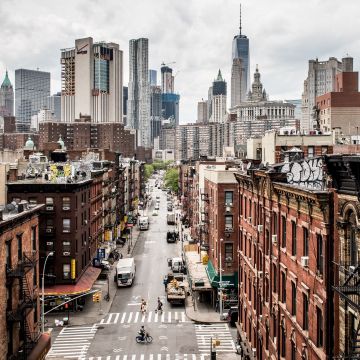
There's an image that sums up Anne Hidalgo's Paris rather well. In July 2024, a few days before the Olympic Games, the mayor dived into the Seine and swam out in front of cameras from around the world. It could have looked like an electoral marketing stunt. But behind that photograph lay almost ten years of sanitation works, more than €1.4 billion in public investment, and coordination among administrations, operators and municipalities well beyond the boundaries of Paris. In 2025, after the Games, three bathing zones were opened to Parisians, just as Jacques Chirac had already envisioned back in 1988.
Using global-city status to transform the everyday city is one of Hidalgo's legacies. Paris has continued to compete for visitors, talent, businesses and major events, but at the same time it has pursued policies that in many other cities would be considered bold, to say the least. Drastically reducing space for cars, turning traffic lanes along the Seine into promenades, cutting speed limits on the Périphérique, multiplying bike lanes, removing parking spaces and restricting tourist flats are hardly the usual recipe for making life easier for visitors, investors or drivers arriving from abroad.
This is one of the main challenges facing most large cities today: how to be a global city without unconditionally putting the city at the service of global flows. In other words, how to harness the resources, appeal and visibility that this status provides in order to improve the lives of the people who actually live there.
This philosophy is especially visible in housing. City hall points proudly to the fact that Paris has reached 25% of rental housing at regulated prices, up from 13% at the turn of the century, and the new bioclimatic plan reserves land to keep expanding this stock and sets particularly strong requirements in the central and western districts, where such housing is scarcer. At the same time, the city has fought a legal and regulatory battle against tourist accommodation, to the point of limiting the rental of a primary residence to 90 days a year. It hasn't solved the housing problem at all — some 320,000 applicants are still waiting for social housing — but it has made clear that there is a political priority for Paris not to become merely a desirable place to visit or invest in, and to remain a city where it's possible to live.
The same logic explains much of the transformation of public space. I've written elsewhere about how the famous "fifteen-minute city", formulated by Carlos Moreno and turned by Hidalgo into a political banner, has less to do with an exact distance and more with a particular idea of the city, one in which schools, shops, urban greenery, culture, care and everyday life should regain their weight against an urban model built around constant movement from one place to another. It's a policy of proximity applied, paradoxically, in one of the most global cities in the world.
But here comes the second major shift. The fifteen-minute city isn't enough if the real lives of its inhabitants play out across a metropolis of millions of people.
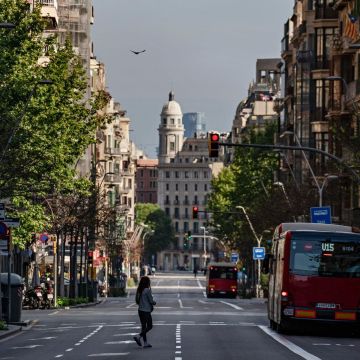
Paris, the municipality, has just over two million inhabitants. The Métropole du Grand Paris has 7.2 million inhabitants across 130 municipalities, and the Île-de-France region far exceeds even that figure. This disproportion is even sharper than Barcelona's: 1.7 million inhabitants in the municipality, 3.3 million across the 36 municipalities of the AMB, and more than five million in the metropolitan region. In both cities, many of the problems city halls are trying to solve have long since stopped being municipal in scale.
The fifteen-minute city isn't enough if the real lives of its inhabitants play out across a metropolis of millions
In the French capital, the 2024 Games made this especially clear. Paris used the event to project itself onto the world stage, of course, but a substantial part of the legacy went to Seine-Saint-Denis, one of France's poorest territories, which hosted facilities such as the Olympic Village, the aquatics centre, new infrastructure and various urban-regeneration projects. The Games thus served to link Paris's international profile with the rebalancing of the metropolis.
The Seine illustrates this new geography even better. A river doesn't recognise municipal boundaries. Getting someone to swim opposite the Île Saint-Louis required work on the wastewater treatment plants at Valenton and Noisy-le-Grand, the correction of thousands of faulty connections upstream, and coordination among the state, Paris, the Métropole du Grand Paris, the municipalities and the sanitation agencies. Today, around twenty potential bathing zones have been identified across sixteen municipalities in the metropolis. What has stuck in the global imagination as a spectacular image from the Games has, in practice, become a metropolitan policy of environmental regeneration that also provides leisure — and climate refuge — for residents.
Even so, it wouldn't be fair to credit Anne Hidalgo alone with the political construction of Greater Paris. The Métropole du Grand Paris was created in 2016, driven mainly by state reforms, and during her terms Hidalgo never made metropolitan institutional reform one of her great battles. What she did show, perhaps without meaning to, is that some of Paris's biggest transformations could only be achieved through cooperation beyond Paris itself.
Her successor as mayor of Paris, Emmanuel Grégoire, has brought an interesting shift on this front. Hidalgo's first deputy mayor for much of her tenure, Grégoire represents clear continuity on issues such as housing, ecological transformation, reducing car use and reclaiming public space. But he has added the metropolitan-governance dimension that had taken a back seat under Hidalgo.
His framing is anything but timid. As he put it in Le Monde in April: "Paris et sa métropole forment aujourd'hui un même espace de vie" [Paris and its metropolis today form a single living space]. From that observation he draws an equally forceful institutional proposal: moving towards the direct election, by universal suffrage, of a mayor of Greater Paris. The idea is to give recognisable political legitimacy to a reality that already exists in everyday life, and to be able to address housing, transport, energy, waste, economic development and territorial inequalities at this scale. Grégoire also proposes turning the Périphérique — for decades the physical and mental border between Paris and the banlieue — into a boulevard métropolitain.
The proposal seeks, once again, to untangle France's proverbial administrative mille-feuille, given that the state, the region, the Métropole du Grand Paris, the departments, the municipalities and numerous specialised bodies continue to overlap. However, the metropolitan institution itself favours a different model from Grégoire's, based on a "métropole des maires" and governance shared among municipalities. The debate, then, remains open. But the simple fact that the mayor of Paris is proposing that his city's future depends on strengthening a metropolitan political authority is significant in itself.
Looking at Barcelona, the first observation is that there must be ways to make a different model of global city possible — ways that start from prioritising everyday life. Barcelona, like many other cities, can aspire to international standing without turning every square metre into a resource for those arriving from abroad. Paris set out to prove precisely that it's possible to host the Olympic Games while, at the same time, restricting cars, strictly regulating tourist accommodation, and putting enormous public resources into affordable housing.
Even so, these are actions whose impact can only really be gauged in the medium term. For now, cars have been pushed out, but traffic seems to have shifted onto the Périphérique and other metropolitan routes. And the urban environment has improved, but for the moment residents are still being pushed out too.
Impacts that can only truly be gauged in the medium term
The second observation is that good municipal policy isn't enough on its own. You can't make Barcelona more liveable by shifting the costs onto L'Hospitalet, Badalona, the Vallès, the Baix Llobregat or the Maresme. A policy of proximity needs a metropolitan policy to match.
Barcelona has a metropolitan institution that is probably more consolidated than its Parisian counterpart, but one that covers only 36 municipalities within a real city of more than five million inhabitants. Mobility, housing, water, economic activity, green infrastructure and climate adaptation all need instruments that allow action at this wider scale — instruments that must, by necessity, be as flexible as the boundaries of any metropolis.
The third observation concerns leadership. Hidalgo showed that a central city can drive transformations that end up reaching well beyond its own borders. Grégoire seems willing to go a step further and accept, politically, that Paris can no longer be governed from Paris alone.
This is a question Barcelona too will have to face one day. I'm not talking about a metropolitan mayoralty — impossible to even begin without a Catalan electoral law, which looks harder to achieve than even a fair deal on regional financing. It will be the mayors of the real metropolis, not just of the municipality of Barcelona, elected in May 2027, who will have to show the leadership, generosity and cooperation needed to build a city of five million inhabitants.
Because metropolitan governance doesn't simply appear by drawing a new administrative boundary on a map. As Paris shows, we must first start thinking about it — as we proposed in the Compromiso Metropolitano de 2030 — then work together towards shared goals, and finally find a democratic way to govern it for the benefit of citizens.
Add The New Barcelona Post as your preferred Google source for free
Stay informed with the latest news.