
They look like just another group of tourists wandering through the city center, but the sticker they're wearing doesn't bear the name of any cruise company, nor do they speak English. They are looking at some cast iron balls scattered on the ground of the Paseo del Born, beneath its benches, alone or grouped, until they come across an imposing trunk.
Of course, their sticker says Jaume Plensa and they are scrutinizing the artist's timid traces throughout the city, starting with Born, the sculpture commissioned for the 1992 Olympic Games. It is so discreet, or integrated into its surroundings if one wants to get technical, that it cannot be ruled out that many have not even noticed its presence, sitting next to it without understanding what those balls were doing there, looking so heavy and reminiscent of bombs, numbered and marked with letters, abandoned to their fate. There are many possible meanings, explains the guide, but the most vivid is the one given by the residents of the Ribera neighborhood, who appreciated this minimalist work, asking each other which bench they had sat on, if it was the one with ball 2 or ball 4.
The route continues to Plensa's most popular work in the city, although depending on the perspective, one might miss it. Carmela has won the affection of many, through many Instagram photos, with a calm and reflective pose, as introspective as all the works of the Barcelona sculptor, always inviting one to be carried away by an aesthetic peace and rise above the noise. So tranquil is Carmela that one day she might leave without warning, considering that the artist's cession ends in 2024 and, if the city does not request it, she will abandon a space she has filled with meaning, creating a new place to stop and think about different points of view.
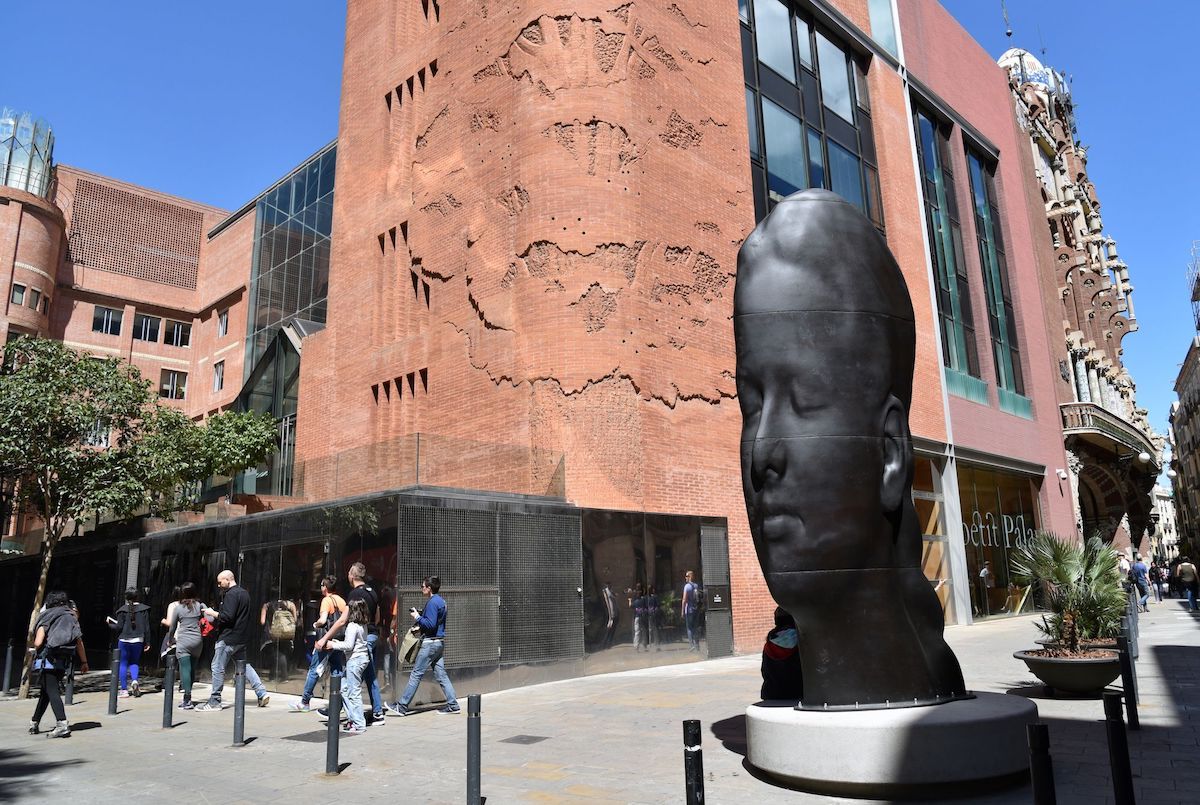
The local tourists adorned with the Jaume Plensa sticker continue their walk to the last stop, the new doors of the Liceu, that culmination of a season in which the sculptor has dared for the first time with the stage direction of an opera, after doing the costumes and set design for many. Macbeth, one of his fetishes, was chosen, with an impressive proposal that was a bit excessive and poorly justified.
As in the Paseo del Born, Plensa's proposal for the theater on the Rambla respects its façade, without clashing, even though it has a much more modern approach. It includes letters from the different alphabets with which he works ---up to 9!---, as a song to universality. Sometimes, he also works with musical notes and even with chemical symbols, according to Chus Roig, from the Galería Senda, who accompanies the group on the route.
In fact, the gallery, with which Plensa has worked for ten years, also keeps some of his works, in case you want to add a new stop to the route through Ciutat Vella. The Senda has some of the artist's most visceral creations, the early ones, far from the spiritual ones with which he has become most famous. Ah, and very close to the Senda, in the reception of the Yurbban Passage hotel there is one of Plensa's faces. It is accompanied by a drawing made by the artist himself in one of the exhibitions that the gallery has dedicated to him, tracing on the wall, making them too sorry to paint over it and turning it into a painting for their neighbors.
An exhibition that expands
The route following in Plensa's footsteps has been one of the activities organized by the Pedrera to extend beyond its walls the exhibition dedicated to the sculptor, Jaume Plensa. Poesia del silenci. The immense silent face that has appeared in front of it, Flora, competing with Carmela in popularity on social networks, while Barcelona waits for the arrival of a great work like those that find space in other cities of the world, was not enough. In addition to the walk, the Fundació Catalunya La Pedrera has organized proposals such as an analysis of the figure of the Barcelona artist under the Egyptian gaze and a concert by the Quartet Casals to describe his artistic universe in a sonic way. For those who are interested, there are still a concert at the Palau de la Música on Tuesday, July 4 and a dialogue by the artist about the verses that have most inspired him at the Ateneu Barcelonés on Tuesday, July 18.
The route following in Plensa's footsteps has been one of the activities organized by the Pedrera to extend beyond its walls the exhibition dedicated to the sculptorPrecisely, the word serves as the common thread of the major retrospective hosted by La Pedrera, with more than 100 pieces, the vast majority sculptures, large and small, and allowing some works on paper, such as the drawings he made for a book by the publisher Galaxia Gutenberg about Shakespeare.The exhibition can be seen until July 23 and has already been visited by almost 45,000 people. It covers five decades of Plensa's work, making it dialogue with Gaudí, one of his references, placing works in front of his facade, but also flooding his interior patio, attic, and terrace, with a watchman who for a few months misses nothing of what happens on Paseo de Gracia.
Going back to its origins, La Pedrera discovers quite groundbreaking pieces, such as Mothers, Brothers, or Fathers, all three from 1990, featuring dildos, in a quite sexual and dreamlike stage of Plensa. But they are not the only surprises. The first, Song of Songs (2005), curtains made with letters from the Song of Songs. They remind him of when he accompanied his mother to shops and crossed curtains, the musicality of which stuck with him, so, here's a tip, you have to dare to cross them to hear them, even if many don't. Also noteworthy are some gongs, Matter-Spirit (2005), with which one must again dare to break the coldness of the museum and make them sound, to see that they seem the same but are not.
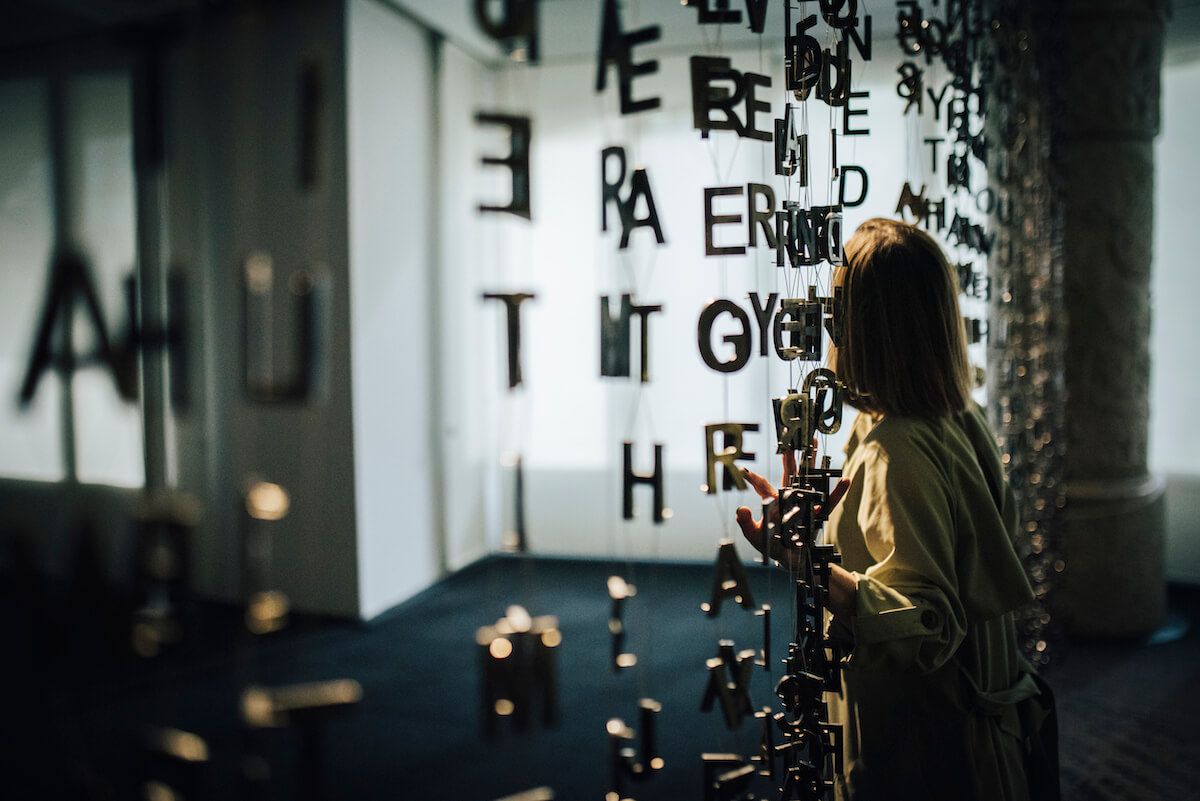
The most participatory, and unexpected, works are mixed with his most characteristic introspective pieces, starting the tour with one that asks for silence, Rui Rui's Words (2021), and including the first of his human figures with letters, Tel Aviv Man XX (2008). There are personal ones, like Love of Home (2002), created from the dolls he inherited from his mother, inscribed with words that refer to family, and Domestic. Propensities, speaking of the same thing from three birdhouses for which he was inspired by watching their tenants come and go. And those who went to see his Macbeth at the Liceu will see something familiar in Silhouettes (2011). Finally, Green Self-portrait (2007), a self-portrait with one of his kneeling figures in which the words he inscribes are the foods he eats. That is, asparagus, wine, cheese, soup, and broccoli, among others.
Add The New Barcelona Post as your preferred Google source for free
Stay informed with the latest news.
