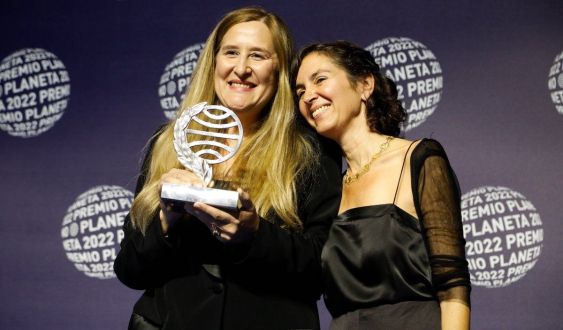
In the end, there have been no big surprises. Beyond revealing the names behind a pseudonym as suggestive as Hoja de fresno and another more conventional one like Gabriela Hausman, the 71st edition of the Planeta Prize has concluded without ups and downs, after the frantic expectations set last year with the unmasking of Carmen Mola. The traditional awards gala has once again filled the Museu Nacional d'Art de Catalunya with the country's main political and cultural authorities, among them, Vice President Yolanda Díaz; the Minister of Culture, Miquel Iceta; the Minister of Culture, Natàlia Garriga, and the Mayor of Barcelona, Ada Colau, as well as writers such as Carme Riera, Najat el Hachmi, Care Santos, Sergio del Molino, and Javier Sierra. The talk of the dinner, beyond following the votes and wanting to fill out the pool well, could not be other than the small anecdote of this edition, the elimination of one of the finalist novels a few days before the winners were announced.
Even so, the mystery of the night has been to know who was behind Hoja de fresno, the pseudonym under which the winning novel was presented. Shortly before midnight, it was revealed that Luz Gabás (Monzón, 1968), author of Palmeras en la nieve, cinematographically adapted by Atresmedia with Mario Casas and Adriana Ugarte, was hiding. The writer from Huesca has won the Planeta Prize, endowed with one million euros, with Lejos de Luisiana, a historical novel that presents "a story of unbreakable love in turbulent times", as its author defined it shortly after collecting the award, "but also a story of friendship, loyalty, and betrayal," she added, adding a little more intrigue. "It speaks of the battle between passion and reason," a topic that obsesses her, she confessed.
The plot is set west of the Mississippi, in the colony that Spain had in North America, and takes place in the last 40 years of the 18th century, focusing on the country's role in the War of Independence. "A novel, above all, about the effort and strength needed to move forward in times of uncertainty, illness, and war," Gabás stated. And the title Río arriba (Upstream), with which she camouflaged the novel's true name to submit it for the award, shows the importance that the Mississippi itself has in the plot, where many of the characters of "a choral novel" live, but also because, as the author says, "life is like a river that sometimes flows gently and other times overflows."
She didn't say it just to say it. In her speech, she indicated how writing the novel had been an exhausting job, with her office turned into chaos to be able to document herself well, even learning a bit of the dialect spoken in the area, with which she even addressed the audience. "It almost cost me my health," she said. She wrote the novel in the midst of the pandemic, "also during three difficult years personally," which is why she repeated an Aragonese saying, "sin reblar, siempre adelante" (without giving up, always forward). As one of the characters in the novel says, "don't ask for an easy life, ask for strength to endure a difficult life."
Gabás, who went on stage to a melodic rhythm that perfectly matched the plot her story narrates, is also the author of Regreso a tu piel (Return to Your Skin), Como fuego en el hielo (Like Fire on Ice), and El latido de la tierra (The Earth's Beat). Beyond her literary career, the brand new winner of the Planeta Prize was mayor for the Popular Party of the town of Benasque between 2011 and 2015. Precisely, Benasque has been one of her beloved Huesca towns to which she dedicated the prize, along with Monzón, where she was born, Serrate, Anciles, and Cerler. About politics, she was emphatic, remarking that it serves to better understand writers like Shakespeare and words like betrayal, but she does not plan to return to it: "Less politics and more literature."
From failing grades to Planeta Prize finalist
Far from Luisana has little to do with the finalist novel, Stories of Married Women, by Cristina Campos (Barcelona, 1975). Campos comes from the world of cinema, where she has worked as a casting director and screenwriter for the last 20 years. Although she also has a book under her belt, Lemon Bread with Poppy Seeds, recently adapted to the big screen by Benito Zambrano.
Cristina Campos (Barcelona, 1975) has worked as a casting director and screenwriter for the last 20 years"I have poured my soul into this novel," Campos explained, quite nervous as she went on stage. She has written the novel about three women "white and privileged, university-educated and with enough purchasing power to be able to separate if they wish."Situated between Barcelona, Boston, and Formentera, the plot unfolds in a fashion magazine, where the three main characters forge a friendship that will allow them to confidently unravel the truths behind their marriages.The protagonist, Gabriela, hence the pseudonym with which she entered the contest, will be unfaithful to her husband, opening the door to being able to speak openly about female intimacy.
The Barcelona writer took advantage of her acceptance speech to ask the Minister of Education, Pilar Alegría, who was present among the audience, for an educational system that prioritizes creativity and less the memorization of content. She did so by giving a very clear example: she was "a terrible student" and failed many subjects, including Physics and Chemistry and Catalan, but, now, thirty years later, she has become a finalist for the Planeta Prize.
Add The New Barcelona Post as your preferred Google source for free
Stay informed with the latest news.
