
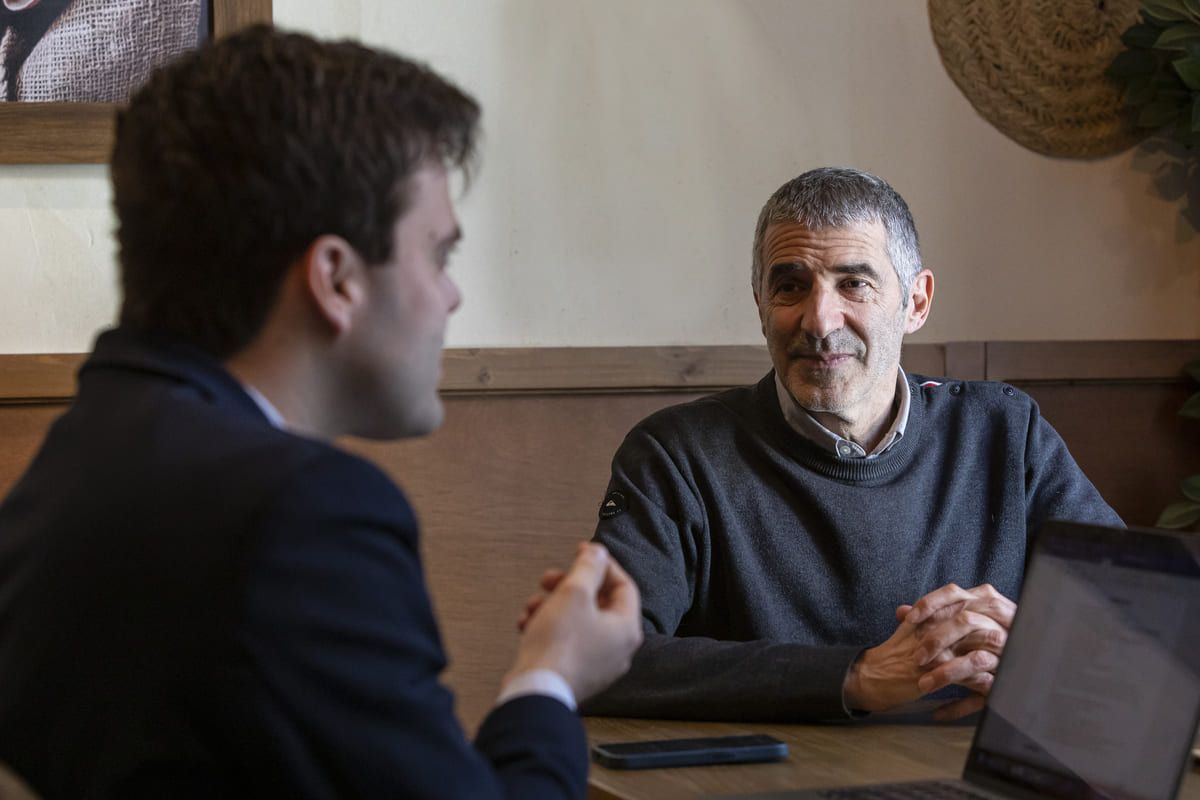
Ferran Ramon Cortés is the director of Isla de los 5 Faros and founder of the Instituto de la Comunicación. He left behind a long career as an executive in the advertising world to undertake and fulfill a dream at just 45 years old. Without an umbrella and with a communication problem. Who would have thought. Oriol Pujol Borotau changed his life. Nada por obligación, todo por ilusión was the title of his book.
Ferran Ramon Cortés defines himself as air in transition towards water. That is, an active-emotional person transitioning towards reflection. He likes to walk for a good while every day and listen with his gaze. He says that metaphors help him a lot and he is more about inviting than pushing. He is also passionate about photography due to family roots and his dream is to live on a sailboat.
"Happiness is the sum of many small moments that fill you and the minimal subtraction of moments that hurt and go against you. It scares me to always be happy and in fact, I wouldn't like it," he reflects. We take a walk to remember up to Monterols Park in Barcelona, talking about the psychoanalysis of communication, the chemistry of relationships, the four elements of personality, the lighthouses of Menorca, the wardrobe of friendships, or business emotions. Cinema Paradiso, Inside Out, Achilles, Isabel Allende, and The Little Prince help us shed some light.
Earth, fire, water, or air? Join us.
--- You worked almost 20 years in the advertising world.
--- I made the leap from marketing to an agency where I worked 19 years as an executive and manager. I was more interested in the personal than the professional side of communication. I had always said that I would work in the advertising world until I was 40.
--- Did you fulfill that?
--- I dove in headfirst when I turned 45. I quit my job, returned the car and the company card. I left everything.
--- What is it like to leave everything?
--- It was an exciting and terrible moment. For the first time in my life, I had no umbrella. My income would be everything I was capable of doing. It was the professional change I needed. I had already asked the company a couple of years earlier to work part-time to be able to organize my future work and make an orderly exit.
--- The dream of a job.
--- I had a communication problem. Terrible. The CEO who then ran the agency told me that I was a very good professional, but that I was unbearable because I didn't handle relationships with people well.
"I left the job, returned the car and the company card. I left everything. For the first time in my life I had no umbrella. My income would be everything I was capable of doing"--- A communication problem.
--- I had no left hand, I didn't know how to deal with people. This led me to put myself in the hands of a former Catalan Jesuit who lived between India and Barcelona. I spent a decade with Oriol Pujol Borotau who was my guru. I thought that all that important stuff I had learned, I should put it in the hands of others.
--- Learning and teaching.
--- I made good on the saying that we end up teaching what we most needed to learn. In my case, it was out of my own necessity.
"We end up teaching what we most needed to learn. If you don't accept it, you don't overcome it. What resists, persists and what accepts, transforms"--- What did you learn with Oriol Pujol?
--- The first lesson was acceptance. Whether you like it or not, if you don't accept it, you don't overcome it. If you don't accept it, you get stuck. What resists, persists, and what accepts, transforms.
--- Accept to overcome.
--- Communication with others begins within you. Listen to yourself. If you are critical of others, you will also be critical of yourself. If you don't take care of yourself, you won't take care of others either. I realized that I related to myself in a very harsh way and didn't forgive myself for anything.
--- If you don't forgive yourself, you cannot forgive others.
-Out of self-demand, out of responsibility... I believed that my value was not to fail and to do everything well. Not so much out of academic concern, but for the simple fact of never disappointing. I stopped it in time. This is not how it works. I discovered the world of communication and it fascinated me to the point of training during weekends and holidays.
"People don't fail due to technical inability, but due to communicative inability. The glass ceiling is the ability to generate relationships. Without communication, there is no leadership"--- Any learning from the advertising world?
--- I met many clients, many organizations, and many cultures. I realized that people don't fail due to technical inability, but due to communicative inability. The glass ceiling is the ability to generate relationships. Without communication, there is no leadership.
--- What is the chemistry of relationships?
--- Chemistry is a harmony that occurs in the first instance through non-verbal communication. That is, the tone of voice, body posture, gesticulation, gaze, or the way of doing and being. A first layer is established here, but we need to go deeper to build a relationship.
--- Harmony as the seed of depth.
--- Imagine there are thirty people in a place and you feel comfortable with four of them. An absolutely unconscious harmony has occurred. We call chemistry the subtle forms of communication that resonate from one person to another. However, there are relationships with a lot of chemistry that go nowhere over time. And vice versa. The beginning is very important
"Chemistry is a harmony that occurs in the first instance through non-verbal communication. A subtle form of communication that resonates from one person to another"-- How does one listen with their eyes?
--- It is the idea of observation and curiosity beyond auditory listening that gives us little information, it can even be contrary to what a person wants to say. Now, if you activate observation, it can give meaning or counter-meaning to what the other person is saying and thus have much more valid and complete information.
--- What is the Bridge model like?
--- People are different in both biology and trajectory, and at the same time they also have a different way of expressing and receiving communication. Two similar styles can have initial chemistry and resonate well. However, one must be aware that not all styles are the same and that communication must also adapt to other styles to start on the right foot.
--- Let's go back to acceptance, now between people.
--- We must be aware of this to avoid relating only to those who are of our style, because then we greatly narrow our relationship parameter. We cannot understand it in terms of those I like are great and those I don't like are idiots.
"We must change judgments for the characteristics of people"--- The psychoanalysis of communication: from the subconscious to the conscious.
--- That's the idea: we must change judgments for people's characteristics. If you have a bad first impression with someone and you label them, you won't see beyond that, and the confirmation bias will be activated that this person is exactly as they seemed to you. Everyone has their personality characteristics.
--- Look at the characteristic and not the judgment.
--- Our model is earth, fire, water, and air. A person who is fire could be aggressive, but is also brave, energetic, and action-oriented. It's very different to say that a person is fire ---characteristic--- than to say they are unfriendly ---judgment---.
--- In memory of pre-Socratic philosophy.
--- It comes from the pre-Socratics, but we adapt it to current reality. There's a lot of psychology behind it. It's a model that takes two dimensions of personality: rational-emotional and reflection-action.
"Our model has two dimensions: rational-emotional and reflection-action. From there, four elements emerge: earth, fire, water, and air"--- From dimensions to elements.
--- That is, if you start deciding from reason and add emotion, or if you decide from emotion and add reason. The other axis is whether you reflect before acting or if you act after reflecting. From these two dimensions, four elements are derived.
--- Let's start with earth.
--- The reflective-rational is very pragmatic, orderly, methodical, stable, and resistant to change. Earth is the root. It doesn't like someone to communicate with headlines.
--- Let's go back to fire.
--- The rational-active is pure energy. Fire is brave, energetic, entrepreneurial, and action-oriented, but always from reason. It gets nervous if someone talks too much and doesn't realize when it touches the emotions of others.
--- We pass through water
--- The emotional-reflective adapts, flows, is conciliatory, and prefers to avoid conflict. Water seeks solutions that suit everyone. It gets offended if it's pushed too hard.
--- Let's fly with air.
--- The active-emotional is air because it is volatile, creative, unstable, and a bit of a wild card. If two airs meet on the way, they might have chemistry, but they might lack long-term solidity. They recognize each other and their style resonates, but it's not enough. Air and earth, together, get very bored.
--- We need the diversity of elements.
--- If you only surround yourself with people like you then everyone will have the same virtues and the same shortcomings. This is the problem. The first question is: who am I? This way I can recognize my patterns of communicative functioning and not exaggerate them. If you are earth, I will address you differently than if you are fire or water. Executives who have the ability to surround themselves with all styles are the ones who succeed the most.
"Executives who have the ability to surround themselves with all styles are the ones who succeed the most"--- Can one move from one element to another?
--- Your nature does not change, but how you move from your nature does produce important changes. Over the years, you evolve and may approach other styles. We estimate that between 40% and 50% is pure genetic nature and the rest is adaptive to education, environment, or life circumstances.
--- Evolution from consciousness.
--- There are people who suffer a lot because they are not aware of their style and, therefore, are relating with patterns that are not natural to their style, either due to certain learnings, family environments, or authoritarian parents. A person suffers when they play a role that is not their own.
--- And you, what element are you?
--- I am a clear air in transition towards water. I monitor myself as part of the model and test myself continuously. Over the years, I remain in the emotional dimension, but I transition from active to reflective. The years have given me patience.
"Communicating in public is wanting to be a lighthouse and mark a path: the unique message, memorability and impact, language directed at the audience, the staging, and inviting instead of pushing"
--- We arrived at the Island of the 5 Lighthouses.
--- It's a metaphor I found while researching public communication. It was my great moment of inspiration at the Cavalleria Lighthouse in Menorca.
--- Eureka moment!
--- I took the five main lighthouses on the island of Menorca to explain the five most basic and simple things about public communication: unique message, memorability and impact, language directed at the audience, staging that communicates as one wants to communicate, and inviting instead of pushing.
--- Much better to invite than to push.
--- It's better to show your conviction than to try to convince. The metaphor of the five lighthouses on the island of Menorca explains itself in essence. Communicating in public is wanting to be a lighthouse and mark a path with impact.
"It's much better to invite than to push. That is, to show your conviction before trying to convince"--- Lighthouses like the islands in the movie Inside Out.
--- When you lose the islands, you become an orphan. The same happens with lighthouses. The movie Inside Out is an absolute marvel and has memorable didactics about emotions.
--- "Friendships are like wardrobe clothes," he assures.
--- I am not a disciplined theorist, and metaphors help me a lot when it comes to reaching the simplicity of things. There is a permanent wardrobe background that gives meaning to your style of dress, and then there are seasonal clothes.
--- You speak of three types of friendship depending on where you invite them to eat: in a restaurant, at your house, or in your home kitchen.
--- Think about who you took into your home kitchen 15 years ago and who you take now. You have changed. Not everyone fits in the kitchen, and when you have a party, you think that maybe there's someone who shouldn't be in the kitchen. For intimacy. In the kitchen, you see dirty dishes, vulnerability, and shortcomings. In the dining room, you show complicity, but you prefer to take the dishes to the kitchen yourself. Showing a dirty kitchen is another level of intimacy. Eating out with someone is exploring a friendship that can reach the kitchen dining room, but for now, is in the restaurant.
"In the kitchen, you see dirty dishes, vulnerability, and shortcomings. It is unrealistic to maintain all the friendships we have throughout our lives"--- Where do you eat?
--- I am in a significant change of friends, unlike other life stages. Some say that friends cannot be lost, but friends are not lost; they simply hibernate and disconnect.
--- What a pity.
--- Don't worry, if it's a good friendship, it will come back. It's unrealistic to maintain all our friendships throughout life. The wardrobe change can be psychological and overcome a stage you no longer want to live.
--- We enter the kitchen of companies.
--- Relationships in companies are much more important than executives are able to accept or understand. This is a serious problem in our country. Generally, executives do not take care of relationships and do not dedicate the time and energy needed. They don't quite buy into the idea that relationships are the foundation on which a company will function.
"Relationships in companies are much more important than executives are able to accept or understand"--- It's not easy to lead by example.
--- The Sikkhona model studies the level of trust and cohesion a team has. Does an open, involved, and complicit team work by pure chemistry? Many hours of flight and relationship are needed. However, there are teams that we test after a few months and they remain the same because they claim not to have time to change their relationship.
--- The excuse of time... If you don't have it, it's because you don't want to prioritize it.
--- When you have a relationship of trust, the other person gives their all. It's not that you end up making your time profitable, but that you directly multiply it. A cohesive team endures, no matter what happens.
--- Business humanization.
--- We are people. It fascinates me how there are conflicts and talent losses that are explained in many different ways, but in the end, it's as simple as the person leaving because they feel mistreated or unrecognized. A lot is being done, but much more still needs to be done.
"Directors must talk to people. If someone leaves, it's because they feel mistreated or unrecognized"--- What do you recommend to managers?
--- I ask them what percentage they dedicate to talking to people. They look at their schedules and do a calculation. I tell them that if it's less than 50%, they can change positions and return their card. If they dedicate less than 50% of their time to talking to people, they can be whatever they want, but they cannot be directors. Directors must talk to people.
--- Let's talk about mental health, the great, almost forgotten pandemic.
--- Now it's even more serious. Before, it was silenced, and a manager would be ruined by taking sick leave for depression because it was very frowned upon. Mobile phones have a great responsibility because they are killing us at an appalling speed.
--- Why?
--- Because of the voracity with which we consume information, videos, impacts... All this is overwhelming us and taking away all that time we used to have for relationships. Now you no longer go to look for a colleague in the office next door because you have many impacts. The pandemic has contributed to the explosion of demands for psychological attention, but let's not lose focus: the problem is social networks and mobile phones. It's an ideal world, constructed and pure fantasy that doesn't exist. At work, you have email, WhatsApp, Teams, and meetings. It's all the same, but someone has decided to communicate through four channels.
--- By land, sea, and air.
--- We are overwhelmed. A manager receives between 250 and 400 emails a day. Enough to drive you crazy. Some companies are already starting to rationalize it. We need to organize, reach agreements, chat when appropriate, and also meet in the office at least a couple of times a week. Agreements are healthy to avoid harming ourselves.
"Mobile phones are killing us at an appalling speed. We cannot set quotas for teleworking. We are companion animals," Ferran Ramon Cortés--- What can we do to have better communication with our environment?
--- Listen much more and dedicate more time to face-to-face interaction. With teleworking, there is confusion, as it is a great tool for motivation and management, but it cannot consume personal relationships. Teleworking should be chosen based on the nature of the task, not tactical convenience. We cannot set quotas for teleworking.
--- No quotas for teleworking?
--- Welcome be for the planet and for health everything you can do at home, but we also need relational and creative activities because otherwise, we have a problem. We are companion animals.
--- We come to the big question: What is happiness?
--- I don't know, happiness is too complex. No one has ever felt happiness as a state to settle into. Happiness is the sum of many small moments that fill you and the minimal subtraction of moments that hurt and go against you. I consider myself happy, and that means that on average I am well and that enough worthwhile things happen.
"Happiness is the sum of many small moments that fill you and the minimal subtraction of moments that hurt and go against you. It scares me to always be happy, and I wouldn't like it. If you have a conflict with yourself or with others, it's difficult to be happy," Ferran Ramon Cortés--- It has to be worth it!
--- How to achieve happiness? I don't know. It scares me to always be happy, and I wouldn't like it because it's like eating chocolate all day.
--- "I'm going to tell you a secret, the gods envy us because we are mortal and because every moment of ours could be the last, everything is more beautiful because there is an end. We will never be here again," Achilles says in the Iliad.
--- Being happy or not is emotional. If you have a conflict with yourself or with others, it's difficult to be happy. We are winning the game because we are starting to whitewash emotions, and now we can talk and debate openly. 20 years ago, emotions could not be discussed.
--- Emotional repression.
--- Before, there were gender and position stereotypes. Men could not express their emotions, and managers could not show vulnerability. In business schools, they recommended being absolutely opaque to avoid being taken advantage of.
--- What a great word: vulnerability.
--- Understanding emotional intelligence has been very difficult. Now there is a real sensitivity and managers who have a real interest in talking about and working on emotions.
"We have a very explicit culture with criticism and very sparse with recognition. We move in ratios of critics vs. recognition that are toxic"--- Psychologist Inma Puig talks about the emotional revolution and the Chief Emotional Officer.
--- The Chief Executive Officer must be competent with emotions. If there is an explicit figure, it is because there is a deficiency. I understand it, I respect it, and surely we need it, but we must try to make the CEO sensitive to emotions and help their team. Leadership cannot be incompetent with emotions.
--- "Never leave a 'I love you' unsaid," he advised me almost a decade ago.
--- We have a very explicit culture with criticism and very sparse with recognition. We operate at criticism vs. recognition ratios that are toxic.
--- The previous interviewee Pati Roura asks him the following questions:
--- How to improve the communication of foundations?
--- Foundations need to be explained much more and in a much simpler way. I have worked a lot in the third sector and in NGOs. They are conceptually very powerful, but people don't quite understand what they do, and since they don't understand it, they don't get hooked. They have to simplify their discourse and get to the essence. It's very difficult for others to understand if they can't clearly explain what they do.
"Foundations are conceptually very powerful, but people don't quite understand what they do, and since they don't understand it, they don't get hooked"--- "Alone we cannot do it, we have to do it together." How to work on relationships between people to strengthen the idea of the collective?
--- Be very aware that people are different, we need different communication guidelines, we are motivated by different levers, and we function differently. It's the only way. If we go full throttle, we don't get much right. We can strengthen relationships by being aware and embracing difference.
--- What lessons from Saint Exupery's The Little Prince should we review and apply today?
--- There's a quote that goes: "If you want to build a ship, don't begin by gathering wood or distributing the work. Evoke, first, the passion for the free and wide sea among people." We should be less instrumental and more visionary. People are moved by vision, not by task.
SEVEN LIVES OF FERRAN RAMON-CORTÉS
- Role Model: Oriol Pujol Borotau
- Book: The House of the Spirits, by Isabel Allende
- Movie: Cinema Paradiso
- Song: The soundtrack of Cinema Paradiso
- Favorite Spot: The Cavalleria Lighthouse, on the Island of Menorca
- Life Motto: We do what we can.
- Dream: To live on a sailboat.
Add The New Barcelona Post as your preferred Google source for free
Stay informed with the latest news.
