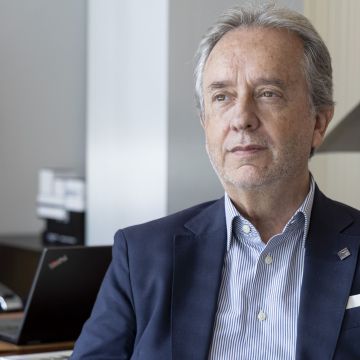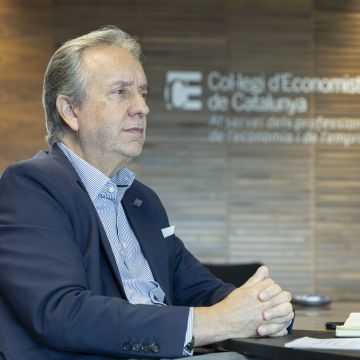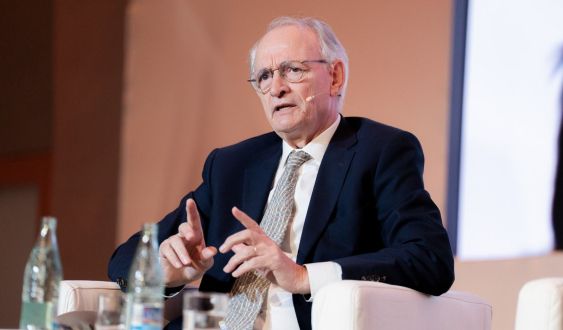
"Economic growth, social welfare, liberal democracy." Amen. This is what Antón Costas has described as Europe's 'Holy Trinity': the three pillars that have defined the continent's prosperity model over recent decades and that must be preserved in an increasingly uncertain and competitive international context. The President of Spain's Economic and Social Council revisited this idea at the 2026 Economists' Conference, raising a fundamental question: how can Europe continue to combine these three pillars without having to sacrifice any of them? And what role can Catalonia play in this regard?
To answer this question of faith, Costas invoked another almost saintly figure in European economics: Mario Draghi, 'or at least a beatified one', he joked. The former President of the European Central Bank argues that Europe's high levels of social protection and redistribution 'are non-negotiable'.
But are European prosperity and the preservation of the welfare state compatible? Is the current model sustainable, given that GDP and GDP per capita have followed markedly different trajectories?
These are some of the questions addressed this morning by the economists gathered at the Economists' Conference, organized by the College of Economists of Catalonia, which this November 13 brought together nearly 1,900 people at the Hotel InterContinental Barcelona under the motto New global order: the Catalan economy at stake.
"Today we sit under a tree that someone planted years ago." With this reflection, the dean of the College of Economists of Catalonia, Carles Puig de Travy, wanted to recall that much of the well-being we enjoy today is the result of the decisions and efforts of the generations that preceded us. But he also claimed the responsibility of planting now the trees that will provide shade for future generations: those of innovation, education, sustainability, and hope. Because, as the dean argued, "the new global order cannot be observed from the stands": it is necessary to anticipate risks, propose solutions, and, above all, "take action."
Carles Puig de Travy: "Today we sit under a tree that someone planted years ago"
In the same vein, the President of the Generalitat, Salvador Illa, placed "shared prosperity" at the center of his speech. To continue generating it, he pointed out several key levers for Catalonia, such as infrastructure, energy, water, talent, administrative reform, and housing. And, recovering the dean's metaphor, he also kept one of the trees mentioned by Puig de Travy: "the tree of hope," in a context where, too often, public debate "focuses on risks and not on opportunities."

But what decisions need to be made to ensure these trees continue to provide shade? How can the welfare state be sustained without sacrificing competitiveness and growth? These questions centered the round table on the pillars of the welfare state, moderated by Joan Tugores, emeritus professor of Economics at the University of Barcelona, and with the participation of Anton Costas, president of the Economic and Social Council of Spain; Teresa Garcia-Milà, president of the Cercle d'Economia; Xavier Ferràs, professor of Innovation at Esade, and Judit Vall, professor of Economics at the University of Barcelona and director of the Barcelona Institute of Economics.
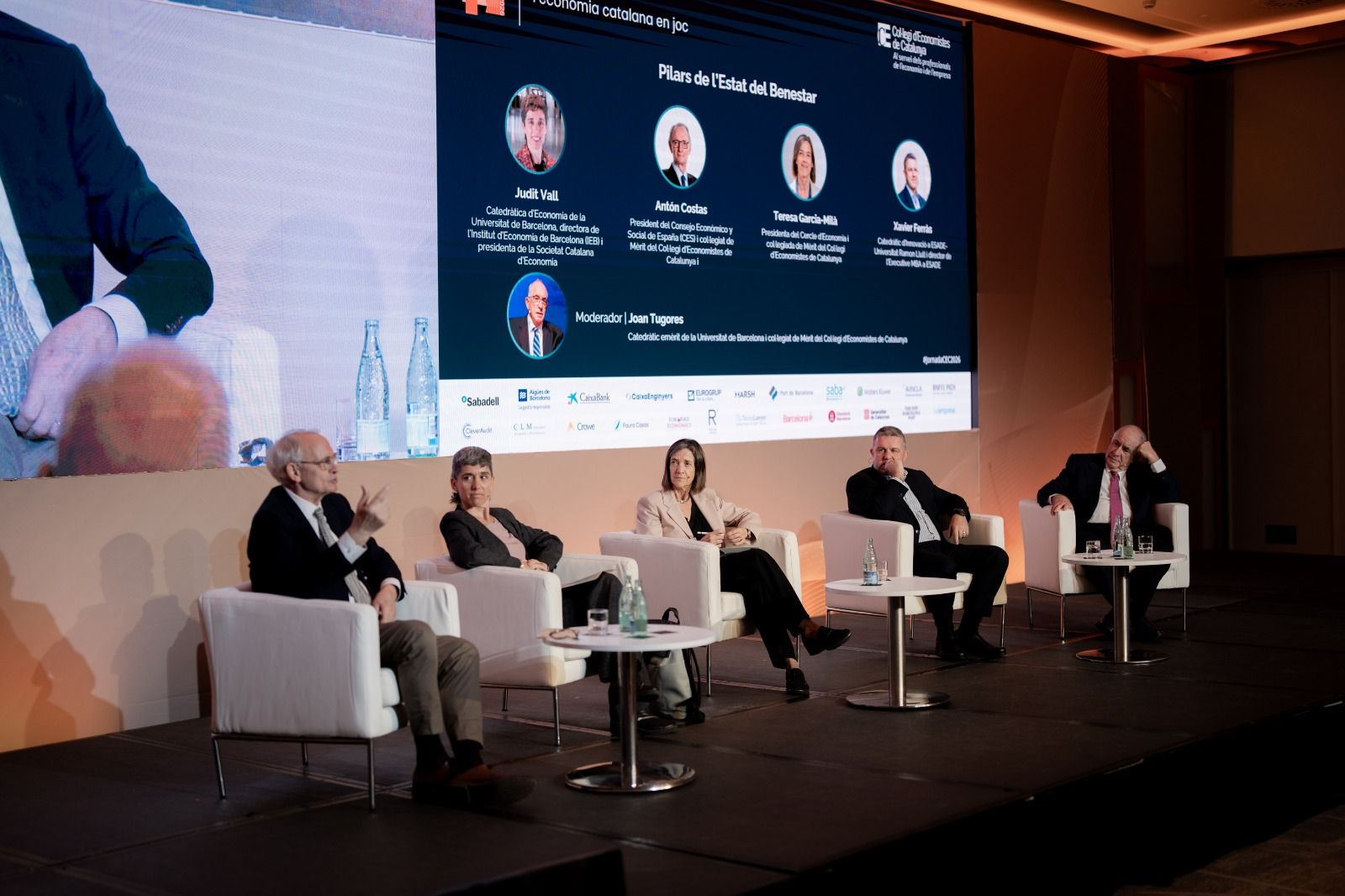
From their interventions, seven major proposals emerged.
1. Recover good jobs
For Anton Costas, the starting point is to recover the economy's capacity to generate quality employment. The president of the Economic and Social Council of Spain recalled that the social contract that sustained the so-called "thirty glorious years" —the three decades after the Second World War— was largely based on good industrial jobs. These occupations allowed for the consolidation of a broad middle class and offered many people something more than a salary: stability, security, and the possibility of building a life project.
Costas linked the loss of these job opportunities to the social and political unrest that has manifested itself in phenomena such as Brexit or the rise of Donald Trump in the United States. For this reason, he argued that the new European social contract must ensure that anyone who wants to work and is able to do so can find employment.
This commitment, however, should not be limited to recovering the weight of industry, which it also should. Costas recalled that the industrial sector is strategic, but that services must also become a source of good jobs, as they concentrate a very significant part of employment.

2. Increase productivity
The second proposal involves improving productivity, one of the pending issues of the Catalan and Spanish economy. Teresa Garcia-Milà warned that, despite the GDP growth in recent years, the evolution of per capita income has been much more modest. Between 2000 and 2025, she explained, GDP has increased by more than 55%, while growth per inhabitant has not reached 20%.
For the president of the Cercle d'Economia, this difference shows that growth is not enough: it is necessary to generate more value with the available resources. And this is especially important at a time when population aging will increase pressure on benefits and public services. A more costly welfare state needs a more productive economy and higher quality employment that expands the resource base with which it is financed.
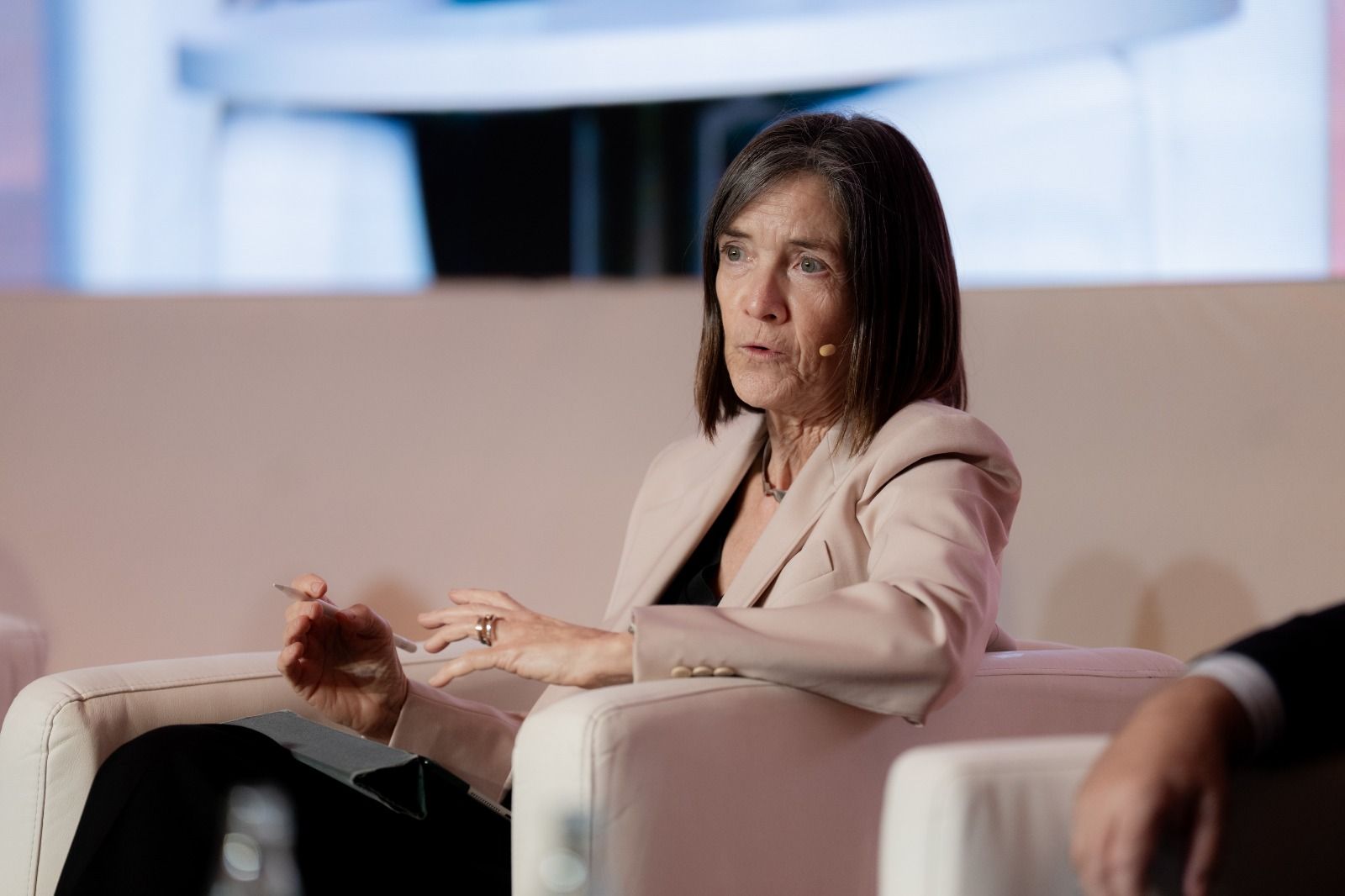
Among the levers to achieve this, Garcia-Milà highlighted the incorporation of specialized research personnel into companies, which she identified as one of the factors that most contribute to improving their productivity. She also pointed out the importance of infrastructures —both transport and connectivity—, business competition, health, and more effective education, with a prominent role for vocational training.
3. Better design of the welfare state
More resources, but also a better way to use them. Garcia-Milà argued that the sustainability of the welfare state does not depend solely on having more funding, but also on reviewing its operation, incentives, and efficiency.
The economist recalled that the European model fulfills three essential functions: redistributing income, protecting people in vulnerable situations, and guaranteeing opportunities through services such as education and healthcare.
And to improve its design, he has given several examples. In the healthcare sector, he has raised the possibility of introducing payment mechanisms linked to the use of services, modulated according to income and with exemptions for the most vulnerable groups. Regarding pensions, he has advocated for formulas that facilitate combining retirement with the continuation of work activity. And, as for unemployment benefits, he has called for more effective active policies that support people in returning to employment and incorporate incentives and continuous training. In education, he has also pointed out the need to improve the governance of centers, strengthen the leadership of management, and invest in teacher training. The underlying issue, according to Garcia-Milà, is to make the welfare state more effective, not just larger.
4. Improve regional financing
To the two main general lines —more productivity and a better system design—, Garcia-Milà has added a specific issue for Catalonia: the need to improve the regional financing model.
The reason is that a fundamental part of the policies that sustain the welfare state, such as education, healthcare, and social services, falls to the autonomous communities. Therefore, Catalonia's ability to maintain and improve these services also depends on the resources it has to manage them.
5. Bet on innovation and technology
The fifth proposal was put on the table by Xavier Ferràs, "an engineer among economists," who warned that globalization as it has been understood in recent decades has transformed. In a more fragmented world, where great powers compete for control of strategic technologies, the ability to innovate and develop proprietary technology has become a matter of competitiveness and also of sovereignty.
Ferràs pointed out that Europe runs the risk of being caught between the United States and China, two powers that have adopted much more decisive technological strategies.

Catalonia, he pointed out, has important assets: research, talent, competitive industrial companies, and entrepreneurs. But this is not enough if the leap of scale is not made. His proposal is to think big and promote technological projects with enough dimension to compete internationally. Without an innovative economy capable of controlling a larger part of the technologies it uses, he warned, it will be difficult to maintain levels of prosperity and well-being.
6. Investing in health to generate productivity
The professor of Economics at the University of Barcelona, Judit Vall, has introduced a perspective that often remains outside the debate on competitiveness: health is not only an expense of the welfare state, but also an investment that generates productivity.
The central idea of her intervention was clear: "Investing in health generates productivity." A way to remember that competitiveness and well-being are not opposing goals, but can mutually reinforce each other.
Judit Vall: "Investing in health generates productivity"
A healthier population can participate more in the labor market, work more hours, and produce more per hour worked. In contrast, the worsening of health has direct consequences on economic activity. Vall pointed out that in Catalonia, hours of work lost due to sick leave have increased from 2.5% a decade ago to 5.3% currently, and that sick leave related to mental health has more than doubled.
To reverse this trend, she advocated for strengthening primary care, prevention, and mental health, as well as improving coordination between the health and social systems.
7. Leveraging longevity with more flexible retirements
The increase in life expectancy also forces a rethinking of the relationship between age, health, and work activity. Vall recalled that life expectancy in Catalonia stands at 83.7 years, about three years above the European average, and that part of this increase corresponds to years lived in good health.
To illustrate this, she compared the current situation with that of the late seventies: a 71-year-old man today has a similar state of health to what a 63-year-old man had then. However, while at that time nearly 60% of men of that age worked, currently only 2% of 71-year-old men do so.
According to the estimates he presented, this change represents a potential of about eight additional years of working life for men and six for women. Vall clarified that it is not about asking everyone to work longer, but about creating the conditions so that people who want and can remain active have this possibility. For this reason, he defended flexible and gradual retirement formulas, compatible with good health in advanced stages of life.

A 'bonus track' and a red line
Beyond the proposals to make the system sustainable, Vall wanted to make a clear warning: the universality of public healthcare cannot be questioned, nor can access be restricted to certain groups with the argument of saving resources.
According to his research on the consequences of the access restrictions introduced in 2012, these measures do not generate economic savings, but can end up causing higher health and social costs, such as a worsening of children's health, more complications during childbirth, and a lower detection of certain diseases, such as cancer.
The defense of universality thus served as the final counterpoint of the debate: sustaining the welfare state requires improving its funding, efficiency, and capacity to generate prosperity, but not necessarily cutting its principles.
And so we end with the same saint from the beginning, Mario Draghi, and one of the maxims that best summarizes the European challenge: Europe's levels of social protection and redistribution "are not negotiable."
Add The New Barcelona Post as your preferred Google source for free
Stay informed with the latest news.