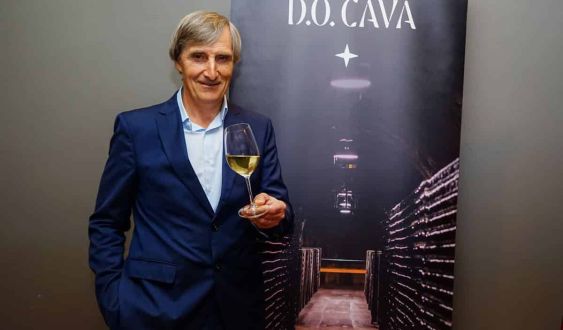
The cava sector closed the 2022 financial year better than expected. In total, it marketed 249 million bottles, a figure that represents an increase of 4.58% compared to 2021, above the 3% forecast made before the Christmas campaign. This figure corresponds to the bottles actually marketed by the wineries, although if the stocks about to be released that were in the companies at the end of the year ---bottles already certified and with the seal of the Regulatory Council--- are also added, the total number of units produced (shipments) amounts to 254 million, 0.69% more.
This volume is the highest in the historical series, as it surpasses the record of 2021 (252.9 million bottles) and that of 2017 (252 million). "Cava has demonstrated its great capacity for resilience, it should be a source of pride, because it occupies a privileged position in the global wine sector," highlights Javier Pagés, president of the Cava Regulatory Council. According to Pagés, DO Cava is the third in the world in sparkling wines and the second to apply the traditional champenoise method (that is, with the second fermentation carried out inside the bottle).
In terms of revenue volume, DO Cava estimates that the aggregated turnover of all wineries has grown by 15%, from 1,905 million in 2021 to 2,192 million last year. The average price per bottle, says Pagés, is now 10 euros, although this figure varies greatly depending on the sales channel. The growth of the sector is due to the end of the pandemic and the dynamism of the restaurant and tourism sector.
69% of the cava marketed is exported to 150 markets, with six large countries driving foreign sales: Germany (+2%), the United States, Belgium, the United Kingdom, Sweden ---which has experienced significant growth of 35%--- and Japan. Exports grew by 1.2% in 2022, compared to the 13% increase recorded in the domestic market (77 million bottles were consumed in Spain). Double-digit sales increases have also been registered in countries such as Switzerland (+50%), Brazil (+24%), Estonia (+22%) and Lithuania (+21%).
In the Spanish market, the 32% growth experienced in the hospitality sector in value (i.e., in turnover) and 30% in volume stands out. In parallel, in the supermarket sales channel, cava sales have increased by 10.5% in value and 4.3% in volume. According to Javier Pagés, who uses data from the consulting firm Nielsen, in 2022 cava gained market share in the sparkling wine sector in Spain, as champagne sales in supermarkets fell by 12.9% in volume and other types of sparkling wines by 8.7%.
"Despite the economic difficulties experienced in 2021, 2022 has been a year of recovery, with very positive results," says Pagés. The president of the DO Cava especially highlights the 12.87% growth experienced by superior aged cavas, that is, those with higher added value, as they have a minimum aging of 18 months. Specifically, gran reserva cavas (more than 30 months) have advanced by 10% and reserva by 13%. Cavas with less aging (from 9 to 18 months) grew by 3%.
Another clearly upward trend is the increase in the production of organic cavas, with a growth of 40% in the last year. Thus, in 2022, 32 million bottles of cava from organic vineyards were already sold, although Pagés is convinced that "in the long run all cava will end up being organic." On the contrary, in 2022 there was a 3.69% decrease in sales of rosé cava.
Pagés believes that 2023 will also "be a good year" and that there is no indicator that suggests that the sector's growth rate will be interrupted, although he admits that there is a lot of "volatility, conditioning factors and uncertainty, so we must be cautious."
Total opposition to the creation of a DO for sparkling wines in Penedès
After it became known a few weeks ago that the partners of Corpinnat, the group of wineries that left the DO Cava to create their own collective brand, had restarted negotiations with the sparkling wine producers of the DO Penedès (Clàssic Penedès) to promote the creation of a new designation of origin specialized in sparkling wines from Penedès, Javier Pagés has shown himself to be radically against the project, which he considers "a joke." "It is an initiative that I do not understand and that cannot be, it does not fit in my head, I do not conceive it in any way," says the president of the Regulatory Council emphatically.
According to Pagés, the DO Cava is historic in the Penedès area, so "others cannot come and destroy a DO that produces 70% of Catalan wine; it makes no sense to anyone." "It could only go ahead with a decree-law from the European Union" and he stresses that this is "unfeasible," since it goes against community regulations. "To pretend to create a DO within another DO is something that is not understood, and even less so to make the same product, with the same method and within the same territory; it's just talk, it cannot be something serious, I don't understand anything," he exclaims. According to the DO Cava, no one has officially communicated the existence of this project to them, which they only know "through the press."
Pagés warns that "one must be careful" with these issues and, again, asserts that "what is good for the sector" and for Penedès is that "we all go together," to avoid generating more confusion among consumers. "We share the same production method and the same territory; what we must do is jointly build value for the entire sector," he concludes.
Add The New Barcelona Post as your preferred Google source for free
Stay informed with the latest news.
