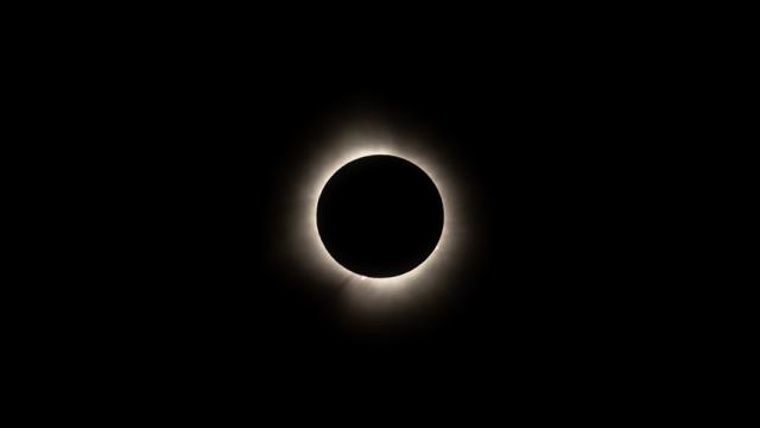
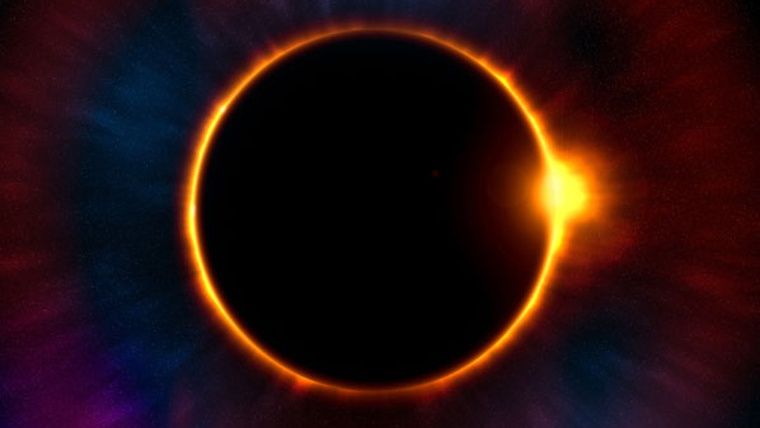
The next August 12 a solar eclipse will take place, one of the most spectacular astronomical phenomena that can be observed from Earth. This event occurs when the Moon is positioned exactly between the Earth and the Sun, blocking the sunlight that reaches our planet.
This Wednesday's phenomenon is very special because it is the first total solar eclipse visible from Catalonia in more than 120 years. From Barcelona, the eclipse will be partial but will obscure approximately 99.7% of the solar disk, so the Sun will be practically covered during sunset. To accompany this historic event, the city has organized a set of informative and cultural activities in different spaces.
Viewing the eclipse from Montjuïc Castle
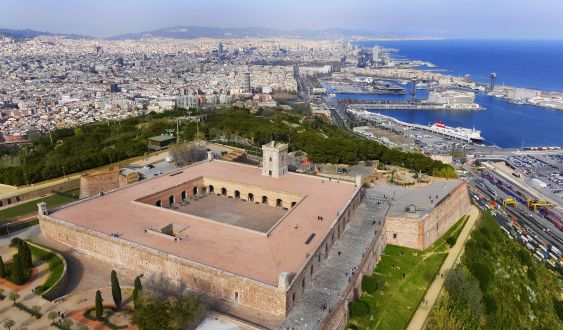
On Wednesday, August 12, Montjuïc Castle will be a key setting to watch this astronomical spectacle. From 7:00 PM to 9:30 PM (the last permitted access will be at 9:00 PM) the public will be able to access the enclosure and enjoy an observation experience in a unique environment. In addition, until 8:00 PM, the castle's exhibitions will be open, in case visitors wish to see them.
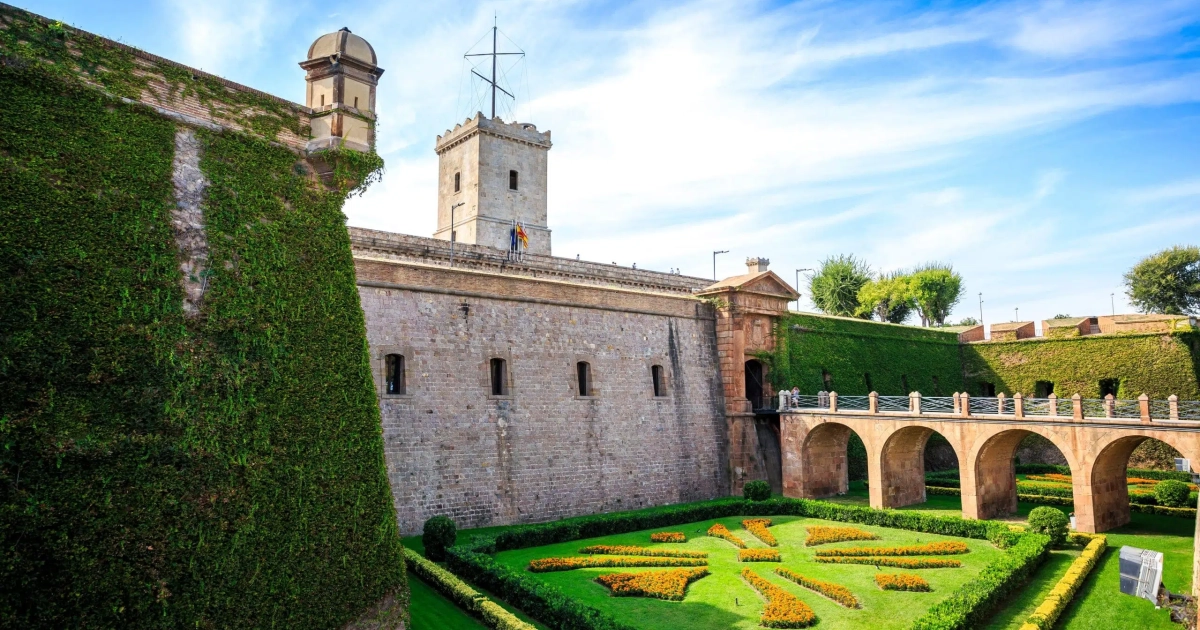
The ticket for the day includes approved glasses (essential for safely observing the Sun), as well as protection instructions to ensure a responsible and risk-free experience. A brief guided explanation will also be offered to understand the eclipse and the reasons why this event is so unique. Places are limited and the activity will take place on the upper terrace.
The eclipse on the city's hotel terraces
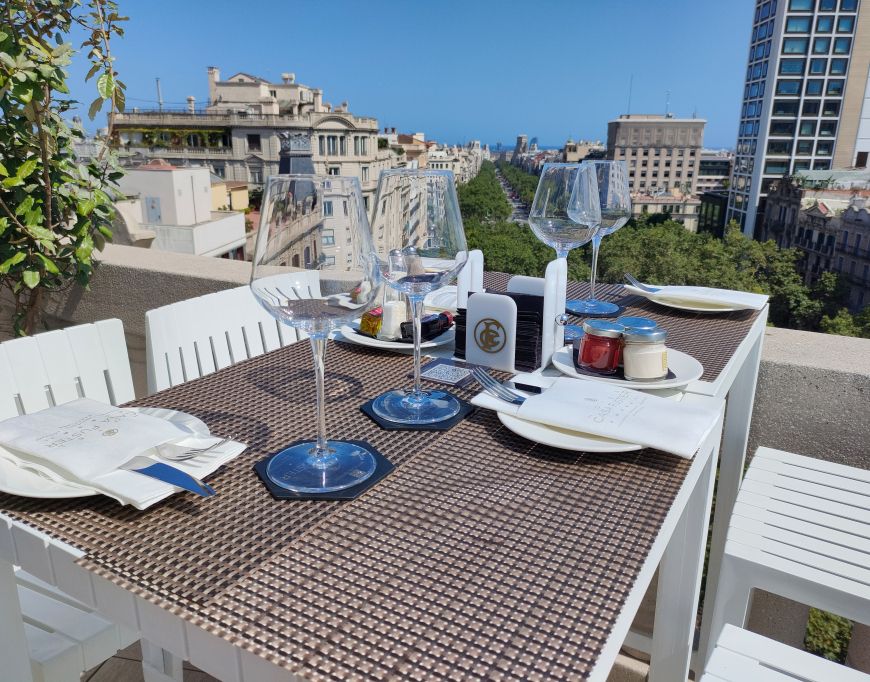
Also on Wednesday, the city's hotel sector has joined the celebration by organizing special experiences on their rooftops so that all citizens can follow the phenomenon. For the occasion, emblematic hotels such as Casa Fuster, Mandarin Oriental Barcelona, ME Barcelona, Ohla Eixample, Claris Hotel & Spa GL, H1898, Kimpton Vividora Barcelona, Majestic Hotel & Spa Barcelona, Nobu Barcelona, and Sofitel Barcelona Skipper will open their rooftops with proposals designed to enjoy this historic day in an elegant and exclusive way.
The exhibition of the Royal Academy of Sciences and Arts
The Royal Academy of Sciences and Arts of Barcelona is the oldest institution in Spain dedicated to the study of sciences and, for this August 12, it features the exhibition Eclipses, which will be open until September 30.
Since its inception, the institution has had a historical interest in astronomical observations. Due to the expected arrival of an exceptional series of three solar eclipses observable from the Peninsula in three successive years, between 2026 and 2028, the exhibition reviews the trajectory and contributions of the RACAB to the study of these astronomical phenomena.
CosmoCaixa's family and educational proposals
CosmoCaixa joins this event with different proposals designed for the whole family. A clear example is the projection Planetari 3clipsi, available until September 6, 2026, an immersive experience that shows the spectacular nature of the solar phenomena that will be seen in Spain during the 2026-2028 triennium. The initiative invites you to experience firsthand the effect of the lunar shadow band (200 kilometers wide), an instant of darkness that allows you to see the stars in broad daylight.
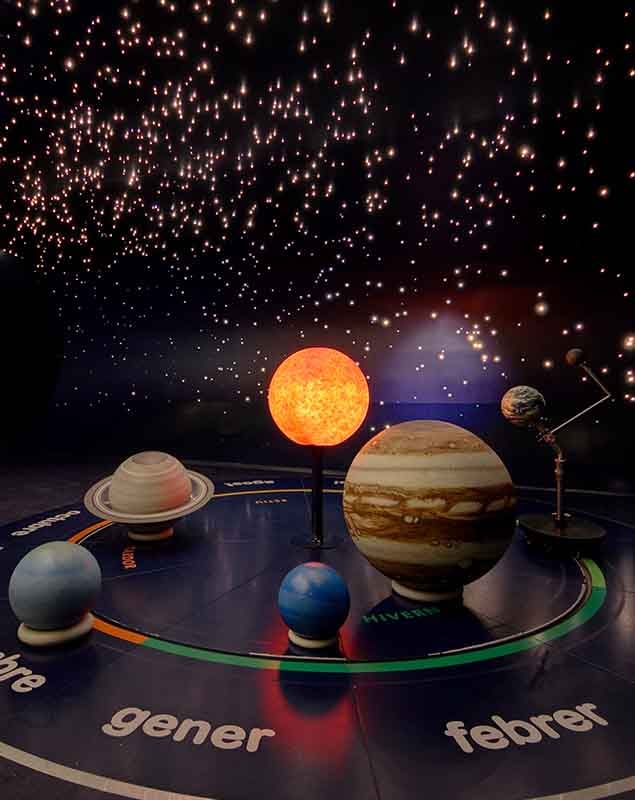
For children aged 3 and up, the planetarium projects Kiru i el misteri de la Lluna perduda, a film where the characters of Kiru and the little worm Candeleta help discover the lunar phases while teaching how to manage the fear of darkness. For children aged 5 to 8, the Planetari bombolla offers a first contact with astronomy through scale models of the Sun, Earth, and Moon to interpret the cycle of day and night, the seasons, and the constellations.
For children aged 8 and up, the family workshop A la recerca de l'eclipsi, available until August 26, allows understanding the functioning of the universe through models and digital tools such as Stellarium. In this activity, participants use materials to build a box-type solar projection artifact to take home, which allows for indirect and safe observation of the Sun.
The best places to see the eclipse in Barcelona and surroundings
The eclipse will begin at 7:35 PM, with a Sun that will still be relatively high and, therefore, will allow its observation from many points at street level. But the culminating moment will arrive shortly before sunset, around 8:29 PM.
To see this phenomenon in Barcelona city, the neighborhoods located in the upper part must be avoided. The Collserola mountain range acts as a natural wall up to 500 meters high and will cast a shadow long before the event. Thus, the best options are found in areas near the coast or in elevated points, but avoiding the shadow, such as private rooftops or hotel terraces that have a direct orientation towards the west.
In this sense, the Montjuïc areas oriented to the west are one of the most suitable options. The upper terrace of the Montjuïc Castle, the Plaça d’Europa of the Olympic Ring, the Montjuïc viewpoint, the Mirador del Migdia or the Mirador d’Ocell de Mar offer unbeatable conditions. Likewise, the Bunkers del Carmel are also a good option, thanks to their 360-degree panoramic view of the city and the absence of visual obstacles.
The Tibidabo is also an excellent option for celestial observations and city views. It is the highest point of the Collserola mountain range and offers an unbeatable panoramic view of the entire city of Barcelona and the sea. Since the eclipse occurs towards the west/northwest (where the Sun sets), from the top of Tibidabo there is a direct view of the sky without the visual pollution of Barcelona's architecture.
Outside the city, there are different natural spaces to follow the phenomenon. In the Montseny Natural Park, the Turó de l'Home stands out for its views from 1,706 meters high, while La Mola, in the Sant Llorenç del Munt i l'Obac Natural Park, offers an open panoramic view to the west. Also, the high areas of La Morella in the Garraf Park have good height and a sky free of light pollution. Likewise, the Berguedà region, with points such as the Bellmunt viewpoint, offers clearer views for a sharp observation.
An alternative that is a short distance from the city is the Montserrat mountain, where observation can be carried out from elevated enclaves such as Sant Jeroni or the Pla de les Taràntules, areas away from rocky walls that could cover the Sun.
But if you want to experience the total darkness of the eclipse, you will have to travel to the regions of Tarragona and the Terres de l'Ebre. A little more than an hour's drive from Barcelona, towns such as Tarragona, Reus, Salou, Altafulla, Torredembarra, Amposta, Tortosa or the Ebro Delta itself will see how the Moon completely hides the Sun for more than a minute.
Safety measures for observation
To observe the solar eclipse, it is important to follow some precautions that help protect vision. Solar radiation can cause severe and permanent eye injuries to the retina, which is why you should never look directly at the Sun without adequate protection, not even when the occultation is almost complete.
To enjoy this astronomical phenomenon with complete safety, the following recommendations should be taken into account:
- Use approved solar observation glasses: Only glasses with official certification specific for eclipses guarantee eye protection. Conventional sunglasses, no matter how dark or high quality they are, offer no protection against direct solar radiation.
- Do not use optical tools without specific filters: You should not look directly at the Sun through cameras, binoculars or telescopes that do not have approved and properly installed solar filters. If using observation instruments, make sure they comply with the manufacturer's specifications to avoid damage due to the magnifying glass effect.
- Indirect observation methods: If you do not have protective glasses or a solar filter, the best option is to opt for indirect projection systems, such as projecting the image of the Sun onto a transparent surface or a homemade dark box.
- Constant supervision of children: Special attention must be paid and children must be closely monitored throughout the development of the eclipse to ensure that they use protection correctly and never look at the sky without protection.
This August 12, Barcelona will witness an unforgettable spectacle that invites us all to look up and be part of the astronomical history of our country.
Add The New Barcelona Post as your preferred Google source for free
Stay informed with the latest news.