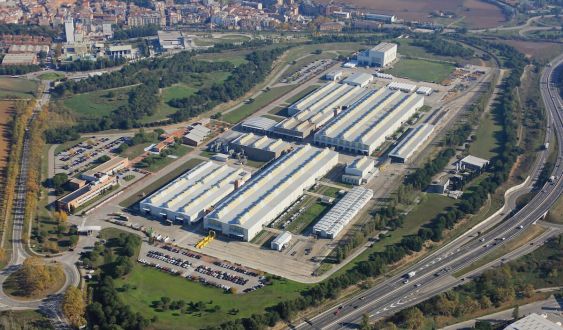
The Alstom factory in Santa Perpètua de Mogoda, one of the largest of the French group, is "at full capacity," its director, Cristina Andériz, emphasizes on more than one occasion. After a complicated period (2006-2016), with the economic slowdown and the fall of the Spanish market, the Barcelona plant has accelerated thanks to the recovery of domestic demand, but also to the consolidation of exports that allowed it to survive the crisis.
Given this scenario, the multinational has decided to undertake a transformation plan for facilities from which some of the trains seen in Barcelona, and also Spain, have come, from the tram and metro that circulates through the Catalan capital, with the launch of the driverless L9 line as a milestone, to the commuter trains ---Civia model---. Alstom's forecast is that the Santa Perpètua plant, among the top five in the group at European level and among the top 15 worldwide, will reach an annual work capacity of 1 million hours between 2025 and 2026. This 2023, it will be at 800,000 hours, a figure that has doubled compared to last year.
The definitive boost to the transformation was given by the award in 2021 of the Renfe contract for the construction of almost 200 new commuter trains. "It will give us a living for the next five years," Andériz remarks, recalling that the train manufacturing process is very long, going through various design and construction phases, in addition to multiple validation tests. The first deliveries are expected for 2025. It will not be until the first three units ---about six cars--- are approved that the production of the entire order will accelerate, taking into account that these first units follow a strict validation process that can last up to a year.
To reach one million annual hours of work in a couple of years, the plant will hire about 190 workers this 2023, covering a wide variety of profiles, from logistics managers and operators to engineers, workers who are increasingly difficult to incorporate. Currently, the workforce stands at 1,200 workers ---about 1,000 own and the rest from subcontracted companies---. This figure has also accelerated in recent years, starting from about 500 employees in 2020. In 2022, about 200 workers were hired.
Taking into account the weight of the Renfe contract, half of the additions will be allocated to the new Commuter trains, which will feature a two-story configuration as a novelty. Renfe will also keep half of the hours worked, that is, about 500,000.
The transformation plan for the Barcelona plant has so far involved an investment of 150 million euros and will add 20 million euros between 2023 and 2024. The disbursed resources are accompanied by an annual maintenance budget of 40 million euros.
A good part of the execution of the 150 million euros began in 2016 when the company began to repurchase land from its plot that it had sold during the crisis, recovering ownership of the 360,000 square meters that make it up and increasing the industrial area by 7,000 square meters. New warehouses, finishing lines, a welding workshop, and a testing area have been built. "We can grow more, but for now we won't," says Andériz, recalling that they are almost at the limit of operational capacity. To maximize the available space, the company has outsourced its warehouse, with an agreement with the French company Daher, which has been responsible for building a 2,000 square meter one in La Llagosta.
To maximize the available space, the company has outsourced its warehouse, moving it to La LlagostaThe investment undertaken has also been allocated to the digitalization of the factory, where not a single piece of paper is seen and new robots have been incorporated, with the forecast of expanding their scope this year, for example, in the paint shop. In this section, the automation of the welding workshop stands out, with a plan, according to Andériz, pioneering in the group and the sector. Likewise, the plant has a center of excellence in additive printing that serves all of Alstom, a technique that, despite being still too incipient for the sector, Santa Perpètua is working to incorporate.
Projects underway
While waiting for Renfe's order to pick up cruising speed, the Barcelona factory is working on a wide variety of projects. Barcelona's public transport is one of the protagonists, with new units for the tram, which will be used for the extension between Glòries and Verdaguer, and for metro lines L1 and L3, a project practically finished with the first wagons of the green line already in operation and the forecast to deliver those of the red line in the coming weeks. In addition, Santa Perpètua is working on the 10 trains that Ferrocarrils de la Generalitat de Catalunya (FGC) will use for the line that will go to Barcelona Airport, with a design that will be based on the future Cercanías trains ordered by Renfe, but adapting it and with differences such as having only one floor.
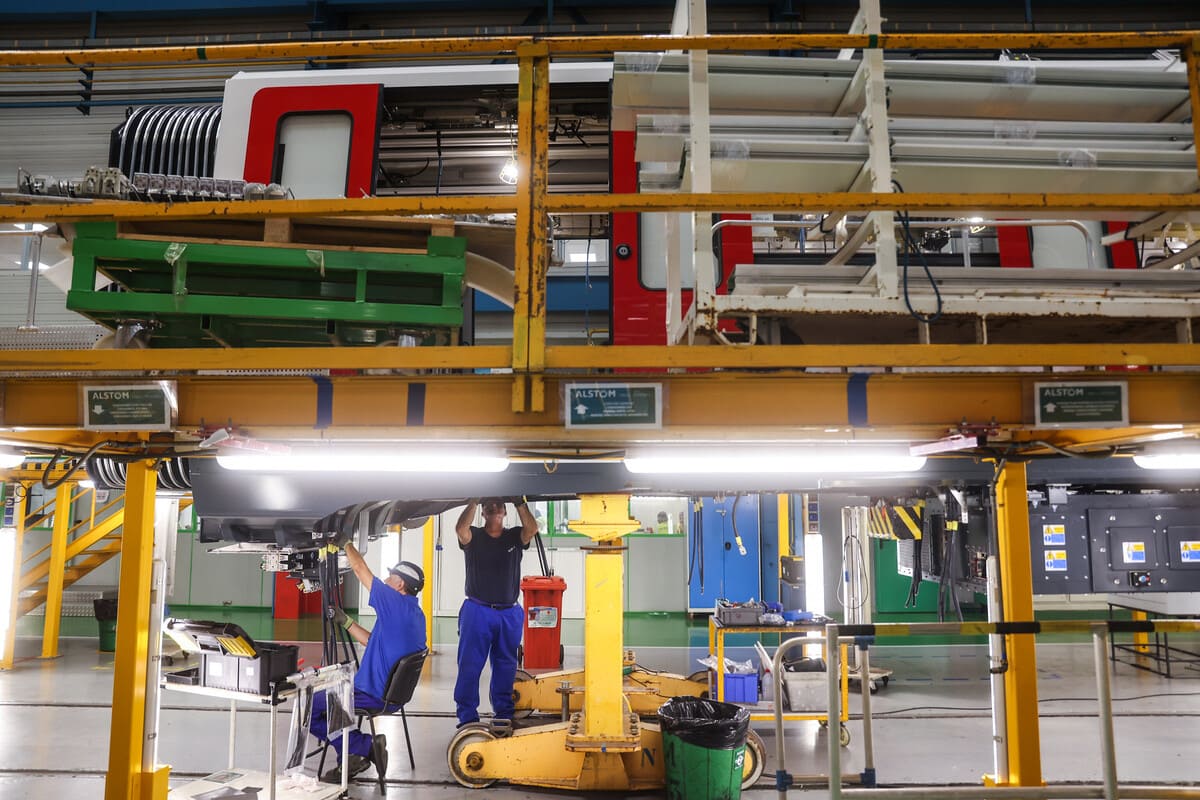
Other projects the plant is working on include trams for Frankfurt, Casablanca, and Cologne; metros for Santo Domingo and Singapore, and regional trains for Luxembourg. The international market was what allowed Santa Perpètua to weather the storm in the last decade, and international exports represent an annual amount of 150 million euros, with the forecast to double it this 2023 with the entry of three new projects. The expansion beyond Spain began with trams made for Algeria, Sydney, Qatar, Nottingham, and Saint Petersburg, and metros for Lima, Guadalajara (Mexico), and Panama.
Alstom traces its origins in the country to the defunct La Maquinista Terrestre y Marítima (MTM), founded in 1855, and Macosa, born just two years later. The French group bought them in 1989 and 1993, respectively, from the Instituto Nacional de Industria (INI). In 1994, the Santa Perpètua factory was inaugurated. According to the latest available data, the company generated 660 million euros in Spain in the 2021 fiscal year.
Add The New Barcelona Post as your preferred Google source for free
Stay informed with the latest news.
