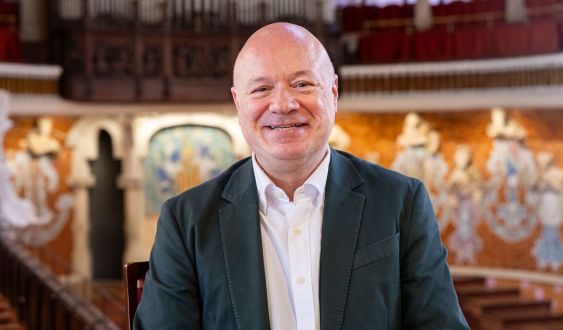
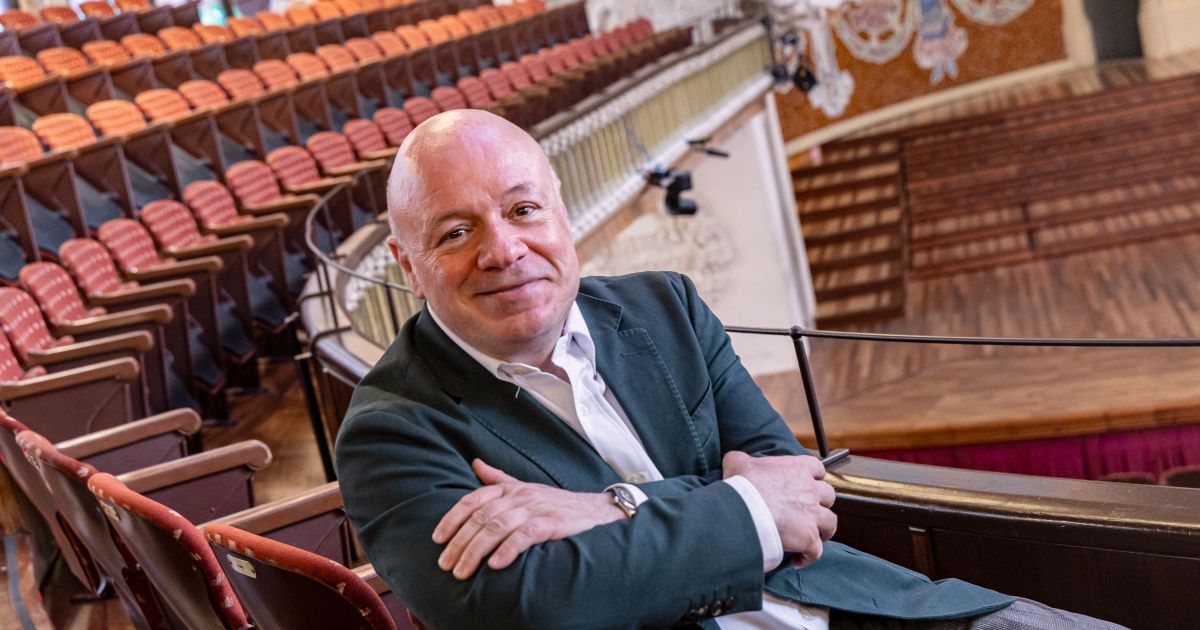
With a big smile and excitement reflected on his face, Albert Guinovart welcomes us to the Palau de la Música Catalana. And it's no wonder: the Catalan composer and pianist is presenting, for the first time in this temple of music, an entirely self-composed repertoire. Under the title Guinovart interprets Guinovart, the artist will take a journey through his most popular creations, such as the 24 Preludes or the award-winning Trio Celebration, a work with which he won the Spanish Music Academy Award.
— The title of the concert on July 15 says it all: Guinovart interprets Guinovart. What does a composer feel when facing his own work alone at the piano on a stage like the Palau de la Música? Is it easier or more daunting than playing music by others?
— I've been playing my own music for years, although at the very beginning I didn't want to mix my two facets as performer and composer. For a long time, I avoided playing my own pieces and focused on interpreting classical repertoire, like Schubert or Brahms. But in recent years, seeing that when I included some of my own pieces the audience reacted very positively, I've been adding more and more. I really like combining it; it's also a way to show that I'm still in shape and at the necessary level to continue performing repertoire.
Although many of my works have premiered at the Palau de la Música and I have played there often, I had never done an entire concert of solo piano works.
On this occasion, since I already have a lot of solo piano work written, we thought it would be a good idea to organize a concert focused exclusively on my production for this instrument. Although many of my works have premiered at the Palau de la Música and I have played there often, I had never done an entire concert of solo piano works. It will be the first, and I am very excited because I always say that the Palau is my musical home. It's where I grew up as a child watching the great figures who passed through there, and I remember being subscribed to the concerts of the old Barcelona City Orchestra (OCB). I feel this house and this stage are very much mine.
— In the program, we see a very intimate repertoire, with your 24 Preludes or the homage works, but also a closing that is sure to get the audience on their feet: selections from Mar i cel and Gaudí. How did you design this musical journey?
— I have put together a repertoire of concert works that I have composed lately and that I have never performed here. In fact, I seem to recall that there isn't a single one I've played before on the Palau stage; therefore, this was a premise when designing the program. For example, I played the entire 24 preludes at the very beginning, but I had never performed them together again. The entire main block consists of pure concert works, but then I thought that if the concert is titled Guinovart interprets Guinovart, there would be a part of the audience that would expect me to play some suite or some song from Mar i cel.
Since we also coincide with Gaudí Year, where we have also done the concert version of the musical Gaudí, I have prepared two small selections from these two musicals. Normally, I leave these pieces for the encore section, but I thought that in July, in a season where the audience might not be as accustomed to the usual concert dynamics, these melodies could work as a good draw to attract attention. I want to make it clear that these selections from the musicals are not pieces originally conceived for solo piano; it's almost like offering an advanced tip. The core and strong repertoire of the concert will be the specific classical work.
These selections from the musicals are not pieces originally conceived for solo piano; it's almost like offering an advanced tip.
— Very recently we experienced Dagoll Dagom's farewell with Mar i cel, but at Christmas the news broke: El Mago Pop has bought the rights and the musical will return to the Teatre Victòria. How have you experienced this plot twist? What do you feel knowing that it will continue sailing, but with a new captain?
— The news makes me very excited because Mar i cel has become a great classic. At first, it bothered me a bit that, with the amount of music and concert works I have written, the main reference to my figure was always Mar i cel. But over time I have reconciled: it has become a classic that is revived every few years, the scores are published, choirs throughout Catalonia sing its choruses, and many soloists perform its themes. To go against that would be absurd. Knowing that the work will have a guaranteed life in the future, and that it will no longer depend only on whether Dagoll Dagom can produce it or not, is a great joy and a hope for continuity.
— In this concert, you premiere a work, the Nocturno Rosa, dedicated to Rosa Sabater, which joins the Nocturno Alicia. How did the idea of evoking the legacy of these two great pianists come about?
— I have a fairly large collection of Nocturnos that I dedicate to different people, sometimes by commission and other times on my own initiative. The case of Alicia de Larrocha arose from her centenary. Although I first premiered it at the Teatre Principal de Sabadell —because I was a resident there—, I composed it thinking of my recital debut at Carnegie Hall in New York. I wanted to pay tribute to her on a stage she had trodden many times and where, curiously, no major recognition had been programmed that year. I was never her student, but I treated and knew her enough through Xavier Montsalvatge and Victòria dels Àngels; she was a person I admired very much.
The case of Rosa Sabater is different because I did not know her personally; she died in a tragic plane crash when I was still very young. Afterwards, I had the pleasure of meeting her daughter, with whom I have a certain friendship. Since her centenary is celebrated next year, I wanted to take advantage of the occasion of this concert at the Palau to get ahead, as I don't think I will play in this cycle again next year. It is a line of particular tributes that I really like to do. For example, I also have a Nocturno dedicated to Pilar Bayona, a very well-known pianist from Zaragoza; when I did a recital there, I took the opportunity to play it. It seems to me a very beautiful way to remember her legacy.
— Many people walk down the street whistling your melodies without knowing, sometimes, that they are yours. It happens with the theme song of Nissaga de Poder, that of El cor de la ciutat or even with the 'Per què he plorat' from Mar i cel. How do you manage this anonymity of popular success? Do you like your music to be part of the collective soundtrack of Catalans?
— It is a true source of pride. It's true that many times people don't just not know who made it, but they have the feeling that that melody made itself, as if it had always existed and there was no composer behind it. But being able to connect with the public in this way is the great objective. What you create in your intimacy, in your home, is born with a will to communicate. That it finally reaches so many people that they can download it in their daily lives and hum it in the street is an enormous satisfaction.
What you create in your intimacy, in your home, is born with a will to communicate.
— Thirty years after the premiere of your first musicals, new generations are still singing them. What is the secret to writing a melody that seems to never expire?
— If I knew the secret, I would always do it! I am very happy with everything I do because I always give my hundred percent, but it is true that some pieces reach more than others. With songs, success depends a lot on the context of the show and whether the story connects with the audience. In Catalonia, for example, Mar i cel has taken root in a brutal way. It must also be taken into account that, when you set music to a dramaturgy, you cannot make big hits in every scene. There are moments made to shine, like the great love ballad, the Pirates' Anthem in Mar i cel or the Anthem to Paral·lel in Flor de Nit. But there are also darker, less flowery passages, where the music must be in accordance with the tension of the story and do background work.
— And how is this symbiosis worked? What is the dynamic of working with the dramatist or librettist?
— Ninety-nine percent of the time I work from already written lyrics. I have been lucky enough to collaborate with great librettists: Joan Lluís Bozzo in Mar i cel, Manuel Vázquez Montalbán in Flor de Nit, or Jordi Galceran in Gaudí i Paradís. First we talk about the type of music or the mood that suits each moment, but they write the lyrics first. As an exception, with Galceran, since we had already done Gaudí, Paradís and some Pastorets, one day he proposed doing it the other way around: "This time you make the music first and I will put the lyrics to it." I would tell him: "But how do you want me to compose music if I don't know what it has to talk about?" He would mark the theme, the mood and the color of the scene, and I would write. He asked for it because fitting lyrics in abstract, making sure that all the accents are perfect and that the text is perfectly understandable and singable, is a job linked to metrics that sometimes costs them a lot.
Despite this experience, I prefer the traditional method. I like music to underscore what is happening on stage, whether in a song, a musical, an opera or a ballet. My priority is to enhance the message, the emotions and to provide artistic support to the story being told.
I like music to underscore what is happening on stage, whether in a song, a musical, an opera or a ballet.
— 2026 has brought you great recognition with the Spanish Music Academy Award for your Trio Celebration. How did you receive the news and what do you think has been valued in a piece that so clearly bets on optimism?
— The work was commissioned by the Tempus Trio to celebrate their fifth anniversary. The three members are fantastic musicians and great friends; in fact, with the violinist and violist we have often shared the stage playing together, and with the pianist, Ricard Rovirosa, we have coincided in various tributes. For professional musicians to commission a work expressly for them is the greatest possible recognition, because you know that they will defend it with passion and that they really want to play your music. The only condition they set for me was that it be a long work to complete an album, so I structured a classic four-movement trio in a romantic style.
The truth is that the resolution of the award caught me totally by surprise. I knew I was nominated because it had reached me indirectly, but no one from the organization notified me of anything or asked me to go. Since in these contests they usually invite you if you are going to win, I gave the award up for lost. I left a meeting, looked at my phone and saw a message from the record company that said: "Congratulations on the award." I felt bad for not having been able to go to Madrid to collect it or having been able to delegate to someone, but the surprise was huge. Receiving this recognition from the Academy means that it is your own professional colleagues who value your work, and that, added to the joy of the musicians who commissioned it, makes it a very beautiful moment. To top it off, that same week I was made a member of the Catalan Film Academy. It was a week of a lot of overexposure, but very happy.
The truth is that the resolution of the award caught me totally by surprise.
— Your 24 preludes from Poems Without Words were born during the pandemic and have swept streaming platforms. Did you expect that solo piano music, born in such a dark moment, would connect with more than 100,000 people on Spotify?
— When I create a work, I always do it with the intention of making it known. There is a phrase by Mozart with which, saving all obvious distances, I feel very identified: "I make music to feel loved." When I compose, what I want is to give these notes as a gift and for people to receive them well. Whether it's one hundred thousand anonymous people through a screen or fifty in a concert hall, I appreciate it exactly the same.
It is true that these poetic preludes that I recorded with Sony have had a great echo, as has the Nocturno a Chloé. Curiously, on digital platforms I have many more reproductions of these solo piano albums than of the entire Mar i cel musical. Mar i cel is a very powerful cultural phenomenon, but very linked to our land, while solo piano has an absolutely universal language that travels without borders.
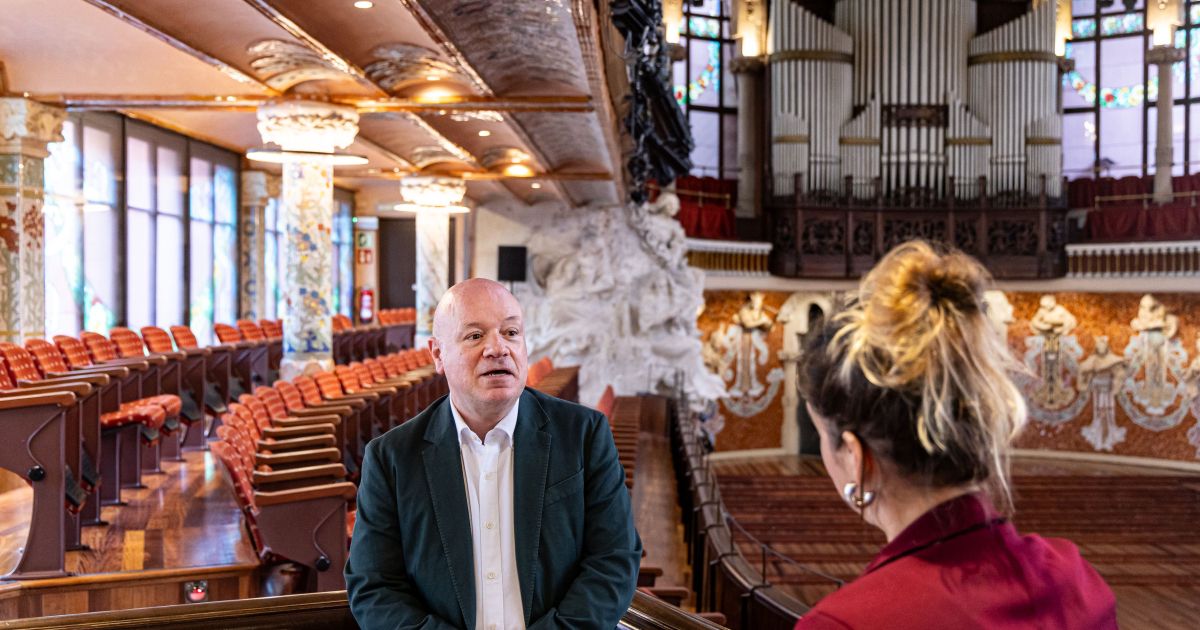
— Cinema, opera, musicals, ballet, teaching... You touch practically all areas of creation. Looking at this map, in which of these fields do you enjoy composing the most and where do you feel most exposed to the public?
— You feel the maximum exposure when you go on stage in a concert hall, because there you are the absolute protagonist. But, for this very reason, it is also where you receive the most direct satisfaction. I love collaborative work, like making musicals or soundtracks, but you have to assume that you are just one more piece within a very large gear. On television, for example, you are a small piece and can decide very few things about the final result. In musicals, you are already at the same level as the librettist or the stage director, and in an opera, music has even more weight. But concert music is absolute freedom: it's you in front of the paper and the performer in front of the audience. It implies more responsibility, but you don't depend on anyone.
This does not mean that the collective work of the theater enriches me greatly and forces me to do things I would never have done alone. For example, I am a composer with a very intimate style, but when I prepare concert repertoire for piano, I force myself to write more virtuosic and exhibitionist passages to seek the brilliance that the audience of a large hall also appreciates.
I love collaborative work, like making musicals or soundtracks, but you have to assume that you are just one more piece within a very large gear.
— In your biography, a stage that seems like something out of a movie stands out: your recitals around the world with the legendary soprano Victòria dels Àngels. What is the best memory you keep from those years by her side?
— I have thousands of memories, but the best could be summarized in the immense emotion I felt accompanying her. I shared her last ten years of career. She was already an older woman and logically not in the vocal prime of her youth, but she had a unique magic. There was always a specific song in each recital —whether it was a Brahms lied or Montsalvatge's Canción de cuna para dormir a un negrito— that made you turn your head and think: "Just for this instant, the whole journey and the whole tour have been worth it." The conservatory and my teacher in London taught me all the technique up to the stage door, but I learned to step on and master the stage with Victòria. She was an absolute master of communication; her art transcended singing, it was something ultra-musical that made audiences in any country cry with emotion.
We did many tours. I remember an anecdote from the first of the two tours we did in Australia and New Zealand. The first concert was at the emblematic Town Hall in Sydney. She was already over seventy years old. At the moment of going out at halftime towards the dressing rooms, she had to go down a platform with stairs, she tripped and fell. She complained a lot about the pain, but she wanted to do the entire second half of the concert and the encores standing on stage, without moving so that I wouldn't have to be suffering for her. The concert was a brutal success, the audience threw streamers... When it ended and the doctor arrived, we saw that she had broken her ankle. She did half a part and encores with a broken ankle! And the most incredible thing is that she did not suspend the tour; we did it all for two months with her in a cast. That was her great lesson: her life was music and she said that for her it was much better to be working and transmitting to people than not to stay locked at home with a healthy foot.
She was an absolute master of communication; her art transcended singing, it was something ultra-musical that made audiences in any country cry with emotion.
— To finish, what will the audience find in this very personal concert at the Palau de la Música and with what feeling would you like them to go home?
I always think that if people have a good time for a while, musicians have already done a lot. Sometimes artists think we do something transcendental, and deep down our first mission is to entertain. Now, if in addition to entertaining I manage to make people emotional, reflect or let their imagination fly, I will be satisfied. There is a lot of feeling deposited in this music, from the 24 preludes, which reflect the emotions experienced day by day at a very particular moment, to the rest of the pieces. If I can touch the audience's heartstrings I will be very happy, and if they also have fun with the party finale of the musicals, even better.
Now is the time to enjoy Guinovart's compositions live at the Palau de la Música. It will be next July 15 at eight in the evening.
Add The New Barcelona Post as your preferred Google source for free
Stay informed with the latest news.