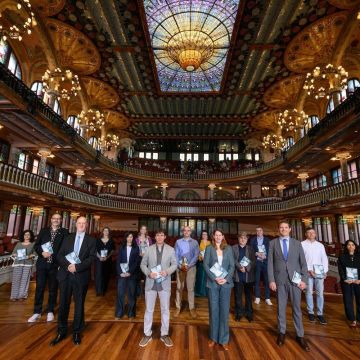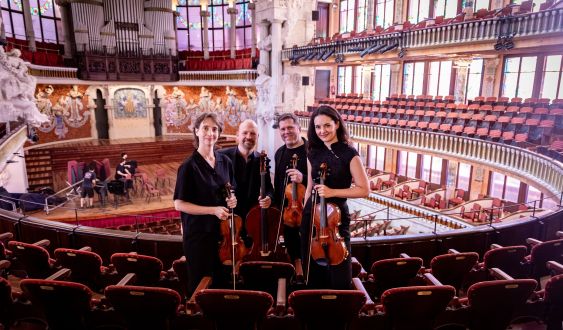
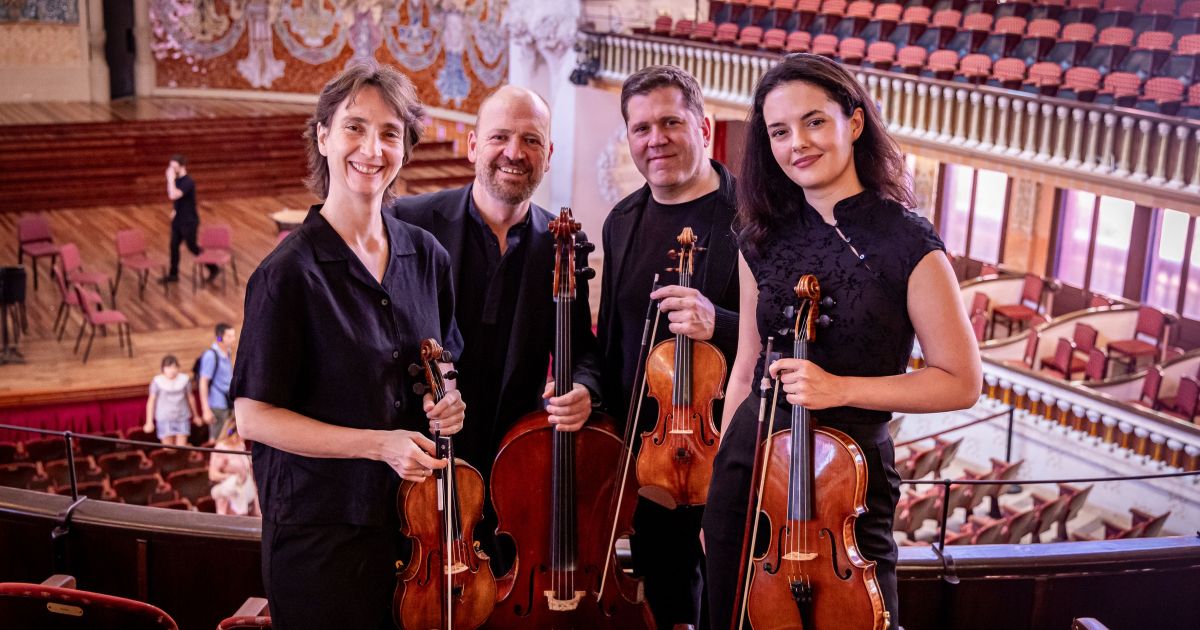
The Quartet Casals was born in 1997 at the Reina Sofía School of Music in Madrid. Its members are Vera Martínez-Mehner, Abel Tomàs, Cristina Cordero, and Arnau Tomàs, artists who have managed to make the quartet one of the international benchmarks in chamber music. In fact, they have been recognized with the National Music Award, the Premi Nacional de Cultura de Catalunya, and the Premi Ciutat de Barcelona.
With almost thirty years of uninterrupted trajectory, we are facing one of the most consolidated and respected ensembles internationally. And, precisely for this reason, they perform in such emblematic venues as Carnegie Hall in New York, the Philharmonie in Berlin, the Musikverein in Vienna, or Suntory Hall in Tokyo. This season, they are presenting the complete Shostakovich quartets, a project they are taking both to recording studios and to the stages of major world capitals and which, next June 9, we will be able to enjoy at home: at the Palau de la Música Catalana.
We had the opportunity to speak with its members to discover all the details of the concert they will bring to Barcelona with Alexander Melnikov and analyze the secrets of their complicity after 30 years of career.
—Playing at home, and even more so at the Palau de la Música, does it still impress you after almost 30 years of career, or do you already take it as just another concert on the tour?
Arnau Tomàs: More than respect, the word would be satisfaction. Playing here is always an immense pleasure. We feel the Palau is very much ours and, in a good way, it is a stage from which a musician would never want to leave. Even so, I won't deny that playing in front of your audience is always moving.
—This concert is part of the Diada Pau Casals-Barcelona, celebrating the 150th anniversary of his birth. For you, what is special about this direct link with the figure of the maestro?
Vera Martínez-Mehner: Our name, obviously, comes from Pau Casals. So, apart from holding him in high esteem not only as a musician but also as a person, we feel very connected to the values he represented and continues to represent. We have a very direct link with his philosophy, both musical and of life: the maestro never stopped searching, working, and finding new ways to understand music. In fact, we have a very beautiful relationship with his widow, Marta Casals. At first, when we started, she wasn't sure if she should let us use the maestro's name, but she heard us and immediately gave us her approval.
Abel Tomàs: Yes, in fact, it's the second time we will play for the Diada de Pau Casals (the first was in 2019). It is an honor and a joy that the Pau Casals Foundation invites us, especially in such a significant year as this 150th anniversary. Doing it here in the Palau and in the maestro's name is a true privilege.
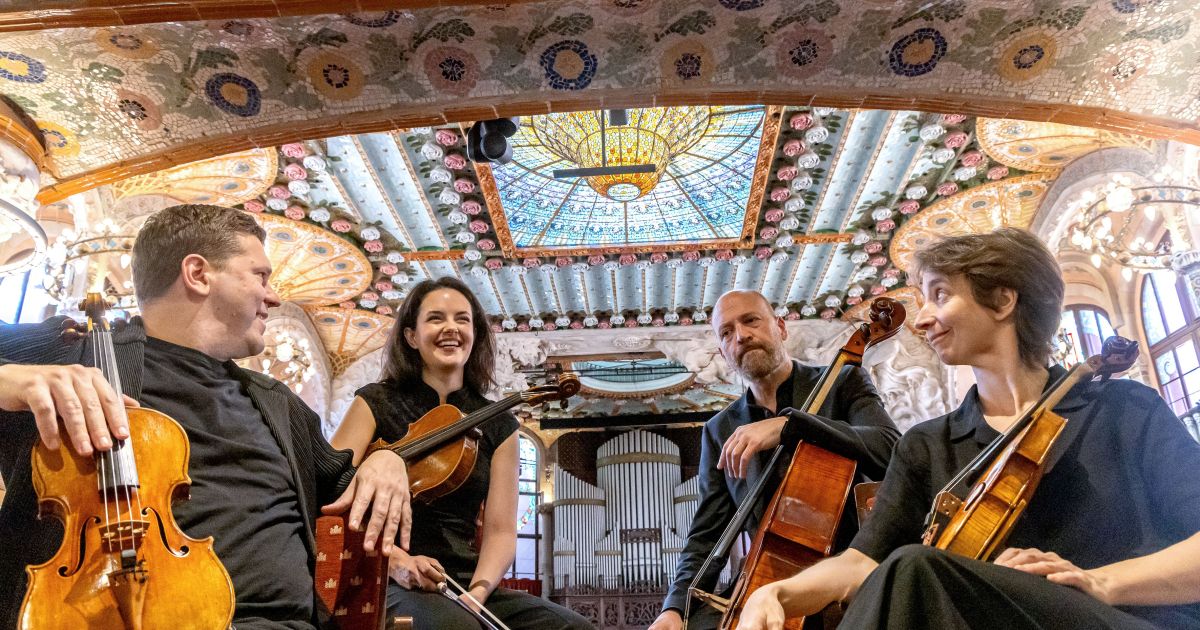
—For the concert, you propose a program of contrasts: Shostakovich's Quartet No. 3 and Brahms's Piano Quintet. What makes this combination an essential event? What will the audience find?
Abel Tomàs: Well, curiously, the program is very much related to Casals's life. The second part, where we play Brahms's Quintet, has a peculiar story: Brahms originally wrote it for two cellos, a formation that strongly recalls Schubert's famous Quintet, which Maestro Casals loved to play so much. As Brahms was not entirely satisfied with the result, he made a version for two pianos and, finally, transformed it into the definitive score we will hear: a quintet for piano and string quartet.
As in our last visit to the Palau we precisely played Schubert's Quintet with two cellos, which is a very kind and beloved work by the maestro, we thought it would be nice to bring now this piece by Brahms, which was spiritually born to imitate Schubert's. In the first part we will perform Shostakovich's Quartet No. 3. This year we are completely immersed in his complete works, and this piece has a brutal force because it was written just after the end of World War II. It perfectly evokes the great tragedies of the 20th century. Casals ideally fits the message of this quartet, which portrays the wounds of war in Europe. We believe it is a program that very well stages the meaning of this anniversary.
—On the same day of the concert, a few hours before, you will hold an open meeting where people can ask you questions directly. What do these events bring you before going on stage? Do you like to know what the audience thinks or does it make you more nervous?
Arnau Tomàs: Although it is not very common in the classical music sector, we think it is a great idea. We would like it to be done more often. The musical communication that takes place on stage is fantastic, but it is very good to be able to talk to the audience beforehand about the works they will hear, about the lives of the musicians themselves, or about how we dialogue with other arts. It is always enriching to encourage this feedback between performers and music lovers.
—Have you done many such meetings, or is this one of the first times?
Arnau Tomàs: In Germany it is quite common to do it, especially after concerts. That's why when we came back here we were surprised that it wasn't done more often, because it really works very well.
—Three decades together is quickly said, but it's half a lifetime. How does the way of working on a score change over the years? Do you still find yourselves in intense debates or do you already read each other's minds?
Vera Martínez-Mehner: Yes, it's very curious. I still keep and use the same paper scores from 30 years ago, with all my annotations. Abel, on the other hand, prefers to pick up a clean score from time to time and erase everything to start from scratch, as if it were the first time he's seen the work. The most beautiful thing is that we have grown together and have gone through very different musical phases; priorities and searches constantly change, and that means the journey never ends. Every day we rediscover new things. It's true that thanks to the years we know each other so well that sometimes we don't even need to speak: with a small gesture we already know exactly what the other is thinking and where the music will go.
Abel Tomàs: Efficiency in rehearsing has improved a lot, but the way of approaching music remains a constant challenge. Recently, we were rehearsing a Schubert quartet that we've played since our beginnings, three decades ago. Well, we found ourselves rethinking the musical proposal measure by measure, looking for a completely different approach to what we had done until now. This is only given to you by the perspective of time and each person's personal evolution.
"Playing here is always an immense pleasure. We feel the Palau is very much ours and, in a good way, it's a stage from which a musician would never want to leave."
—This season you are fully immersed in the complete Shostakovich cycle. It is very demanding, dark music, full of fear and pain. How do you manage this emotionally? Is it easy to disconnect when you finish working?
Abel Tomàs: That's a great question, because empathy with the composer depends on each person. For me, personally, it affects me a lot emotionally, it's something I didn't expect. There are different dynamics within the group; for example, Cristina saved herself the studio recording process of the entire block, but she has endured the entire live tour. It impacted me a lot when we had to learn quartets number 12, 13, and 14, which were the ones we needed to close the cycle of the 15 Shostakovich wrote. They are three profoundly depressive pieces. And yes, I admit that it affected my soul; perhaps personal things of mine also came together, but I remember learning those quartets as a very dark period. It's music that leaves you with a residue of sadness.
Cristina Cordero: Totally agree. It's very tough music. When we rehearse traditional repertoire (Beethoven, Haydn, Mozart, or Brahms) the structure is more predictable, you know where it's going. But Shostakovich remains brutally avant-garde. Although he is already a 20th-century classic, his language is a true enigma. You finish rehearsals exhausted and with a feeling of sadness that comes from the mental effort of trying to decipher what is behind the score. That said: the result is very much worth it.
—Quartet No. 3, which you will play at the Palau, was written just after World War II, but you listen to it today and it hits you exactly the same way. Why do you think it remains so relevant in mid-2026?
Arnau Tomàs: Because the world doesn't learn: we are constantly experiencing wars, genocides, and misfortunes. But there is also an artistic reason: it is music that goes from the most absolute dramatism to moments of great romantic lyricism in a matter of seconds. These contrasts between darkness and light are universal. Human beings can change customs, culture, or technology, but our emotional essence remains the same as a century ago. That's why Shostakovich connects with us so directly and currently.
—You play a very interesting game: you change bows (baroque, classical...) according to the composer's era, but at the same time you premiere contemporary works. How do you combine this demanding historical research with dialogue with today's living creators?
Vera Martínez-Mehner: It is approached with exactly the same respect. With the same rigor with which we look at a score by Bach, Mozart, or Beethoven, we try to decipher the new language of a contemporary composer. With a big difference and a great advantage: with today's composers, we can talk, debate, and they can explain their vision of the score face to face.
—You bear the name of Pau Casals, a musician who brought classical music down from its pedestal to make it more human. Today, living in an era where everything sounds so precise, clean, and perfect in platform recordings, how do you keep this spirit of Casals alive from the stage?
Arnau Tomàs: For me, the Casals spirit has nothing to do with seeking an acoustically impeccable or cold execution, but with honesty before the score. He was one of the first musicians who, in an era dominated by the myth of the romantic virtuoso (where who played mattered more than what was played), dispensed with comedy and theater to focus on the rigor of the work. He sought a purer, more austere, rhythmically regular interpretation, without excesses for the gallery. The maestro did not like empty spectacle at all. If you watch videos of the maestro playing, you will see that he does just enough theater: the gestures are exactly what is necessary to get the best sound from the instrument. The important thing is the sound, not the staging. And this message has not lost an ounce of validity.
—And finally: the Palau de la Música is a space with a very particular acoustic and the audience very close. What is different about playing Shostakovich here compared to any other hall on the tour?
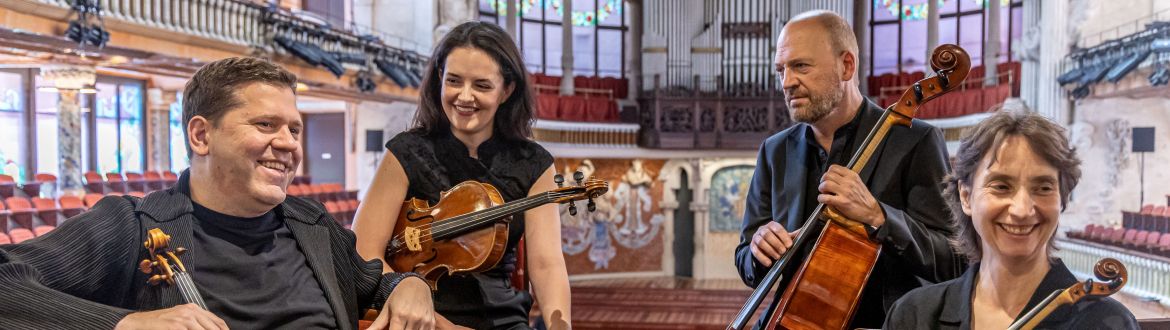
Cristina Cordero: It is an inspiring hall like few others. It has a very curious particularity: it is a large space, but the audience feels very close to the stage. We don't know the exact acoustic explanation for this phenomenon, but it is magical. Every minimal detail is captured, both from the stalls and from the stage.
Arnau Tomàs: Yes, it has a very human character. These are historic halls that preserve a warmth and spirit that modern, cold auditoriums do not have. And furthermore, every corner of this stage has an incredible story. Pau Casals was caught on the day of the military uprising of the Civil War, in July 1936, rehearsing precisely here with his orchestra. Someone ran into the hall to warn that the war had broken out and the maestro had to interrupt the rehearsal. Before leaving, he addressed the musicians and told them: "Gentlemen, we do not know when we will be able to see each other again or if we will ever play together again. I ask you to play, as a farewell, the last movement of Beethoven's Ninth Symphony." And they played it. It was the last time the maestro was on this stage.
"It is music that goes from the most absolute dramatism to moments of great romantic lyricism in a matter of seconds."
A concert that is part of the celebration of Pau Casals' 150th anniversary
The Quartet Casals concert is part of the commemoration that the Palau de la Música is holding for the 150th anniversary of Pau Casals' birth. The "mestre del Vendrell" is considered one of the best cellists of all time. He revolutionized the instrument's technique with organic and natural movements, and rescued Johann Sebastian Bach's Cello Suites from oblivion.
But Casals did not understand music separated from life or social commitment. He was a promoter of the Associació Obrera de Concerts (which precisely held its concerts at the Palau to bring music closer to the working classes) and became one of the great world symbols of the struggle for peace, democracy, and freedom. His activism and opposition to totalitarianism led him to refuse to play in Hitler's Germany or Soviet Russia due to the lack of freedoms; ideals that, finally, led him to live in exile.
Among his most notable compositions, the composition of the United Nations Anthem (or Anthem of Peace) stands out, as does his interpretation of El cant dels ocells at the UN headquarters in 1971, where he received the Peace Medal and delivered an acclaimed speech in English and Catalan proclaiming his identity and Catalonia's democratic past to the world.
Next June 9, the notes of Shostakovich and Brahms will sound at the Palau de la Música, the same tiles where Pau Casals made music an act of resistance. And they will do so at the hands of the Quartet Casals, which returns home to demonstrate that rigor, honesty, and the warmth of live performance are the only way to keep the master's soul alive
Add The New Barcelona Post as your preferred Google source for free
Stay informed with the latest news.