The Gran Teatre del Liceu, L'Auditori, and the Palau de la Música Catalana join forces, one more summer, to offer a new edition of Clàssica a la Platja. On July 8 and 9, at 9 p.m., Sant Sebastià beach will host this free event whose main objective is to bring symphonic music to the general public.
The cycle will kick off on Wednesday, July 8, with the Orquestra del Gran Teatre del Liceu, conducted by Josep Pons, which will offer the concert Liceu Simfònic, música per a tothom, where some of the most well-known and emblematic works will be reviewed. The following day, Thursday, July 9, it will be the turn of the Orquestra Simfònica de Barcelona i Nacional de Catalunya (OBC), conducted by Ludovic Morlot, who will present Una simfonia imaginària, with themes by Rakhmaninov, Dvořák, or Tchaikovsky.
A deployment for 22,000 people
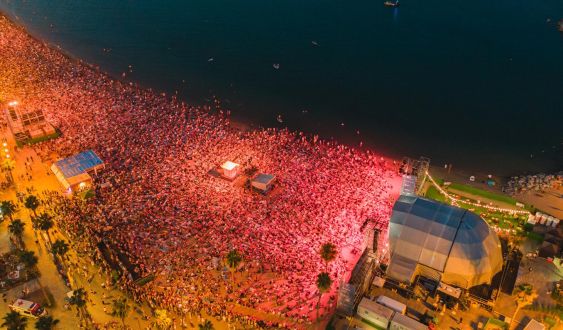
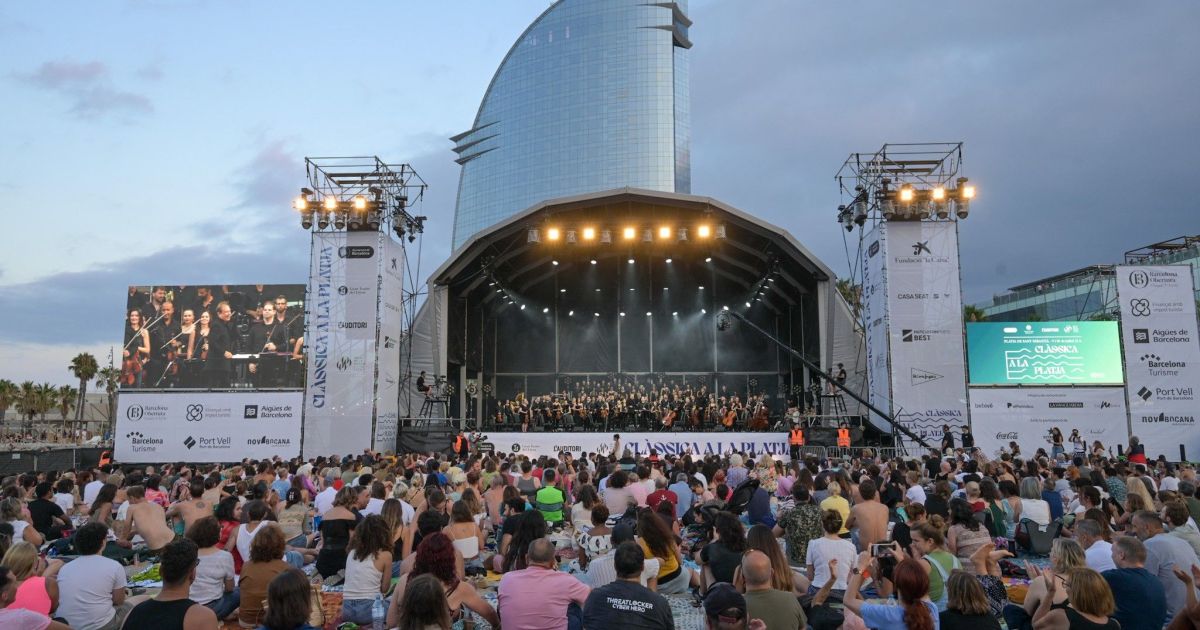
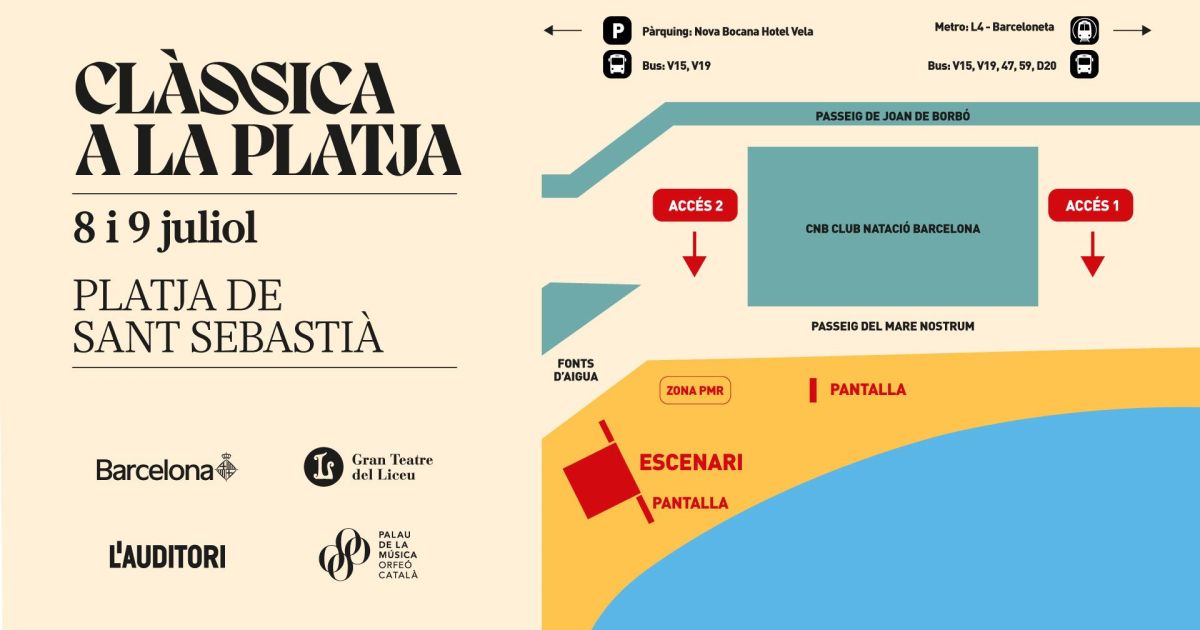
Setting up an open-air classical music concert, in front of the sea, with the breeze and with an audience of thousands of people is not easy at all. For this reason, the technical deployment prepared on Sant Sebastià beach is more akin to that of a large rock festival than to a traditional chamber concert. The organization expects to receive about 22,000 people each night, who will be able to enter through two accesses: one located between the Club Natació Atlètic Barceloneta and the Club Natació Barcelona (CNB), and the other just along the side of the CNB at the height of the stage itself.
The stage will have monumental dimensions, with 20 meters wide by 22 meters deep, and will be crowned by an orbit-type dome that will be completely illuminated in front of the sea during nighttime hours. And so that no one misses the details of the pianists' hands or the conductors' expressions, two giant video screens connected to a Betevé mobile unit will be set up: one measuring 8 x 4.5 meters next to the stage and another measuring 6 x 3.5 meters right in the middle of the beach.
The Orquestra del Liceu evokes the great universal repertoire with Josep Pons on July 8
The starting signal will be given on the night of Wednesday, July 8, by the Orchestra of the Gran Teatre del Liceu, which will be led by its principal conductor, maestro Josep Pons. Under the title Liceu Simfònic, music for everyone, the Liceu has prepared a very dynamic, energetic, and nuanced concert to celebrate a very special milestone: the 25th anniversary of the Petit Liceu. For this reason, the repertoire is a collection of "greatest hits" from the history of music, those melodies that have been part of movies, commercials, or cartoons and are recognizable from the first note.
The concert will feature Brahms's Hungarian Dances and the elegance of Dvořák's Slavic Dances. There will also be space for the fantasy of Tchaikovsky's The Nutcracker, Borodin's Polovtsian Dances, and the flamenco passion of Manuel de Falla's El amor brujo. As if that weren't enough, the ensemble will also present Ginastera's Estancia, and will save as a grand finale one of the most anticipated moments of the night: Maurice Ravel's celebrated and sensual Boléro.
The OBC and Ludovic Morlot give us a dream symphony on July 9
The next day, Thursday, July 9, the Barcelona Symphony and Catalonia National Orchestra (OBC) will take over on the beach with a proposal that will take us on a journey through European tradition. Its principal conductor, the Frenchman Ludovic Morlot, will lead the ensemble to bring to life An Imaginary Symphony, a program conceived as a fascinating journey through some of the best symphonic movements of European romanticism and drama. The idea is to play with contrasts, atmospheres, and the expressive capacity that only a large orchestra of 100 instruments can transmit outdoors.
The evening will begin with the first movement of Borodin's Symphony No. 2, a piece of almost cinematic epic character. Immediately after, the OBC will immerse us in the most passionate romanticism with "Allegro molto" from Rachmaninoff's Symphony No. 2, to then relax the pulse with the delicate, intimate, and famous "Poco allegretto" from Brahms's Symphony No. 3 (one of those melodies that give you goosebumps).
The concert will take on a more festive tone with the dancing spirit of Dvořák's Symphony No. 8 and will culminate with a display of orchestral power: "Finale" from Tchaikovsky's Symphony No. 4, an exciting and artistic grand finale.
Social commitment, accessibility, and environmental sustainability
Beyond the musical section, the Clásica en la Playa cycle has an inclusive soul and a great social commitment. One of the big headlines for this 2026 is the total commitment to accessibility. The organization has reserved a special area for people with reduced mobility on the Mare Nostrum promenade (at number 15, just in front of the Desigual building), where a 12 x 4 meter platform will be set up to guarantee perfect visibility of everything happening on stage.
But the big novelty is for deaf or hard of hearing people: thanks to the Immersive Live system, there will be vibrating backpacks that transform the orchestra's frequencies into tactile stimuli on the back or chest, in addition to individual induction loops and a professional Catalan Sign Language (LSC) interpreter. A technological commitment so that everyone can "feel" the music.
In addition, classical music will also travel to those groups who, for health reasons, cannot go to the beach. The choirs of the Escuela Coral del Orfeó Català will carry out the fourth edition of a social performance program: the Cor Petits and the Cor Mitjans will offer interactive concert-workshops in the Grup Assistencial Evangèlic and Augusta Park elderly residences, with a repertoire ranging from pieces by Jordi Domènech to traditional songs from Hawaii or the Congo. For its part, the Cor Jove will offer a very special recital on Monday, June 15 at the Hospital del Mar for patients, family members and healthcare staff, performing works by current composers and popular classics such as the Irish song Danny Boy.
And since a massive event on the beach must be taken care of so as not to harm our environment, this year a firm step is taken towards sustainability. Thanks to the collaboration of Aigües de Barcelona, six drinking water fountains will be installed for the entire team of workers, technicians and artists, a measure that will avoid the consumption and waste of more than 6,000 single-use plastic bottles.
Classical music, beach, sustainability and accessibility. Is there a better plan to start July nights in Barcelona? Spread out your towel and enjoy the music in front of the sea!
Add The New Barcelona Post as your preferred Google source for free
Stay informed with the latest news.