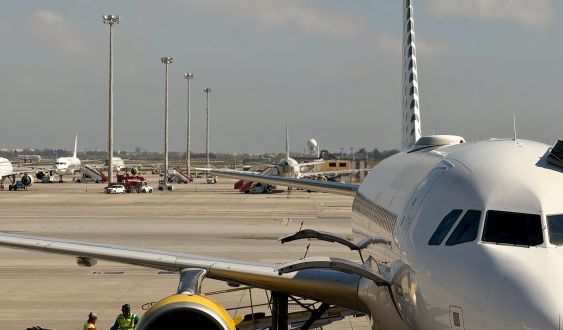
The expansion of Aeroport del Prat is once again on everyone's lips. Five years ago, Aena's plan to expand the facility sparked fierce public debate. The push to make it more sustainable, larger, and modern enough to handle the rise in passenger traffic – tourists and business travellers alike – set off alarm bells among civil society groups concerned about potential environmental harm and the impact on the Catalan capital. This year, the airport is back in the headlines after the Spanish government gave the green light to a first phase of works that temporarily puts the brakes on the grand, and most controversial, expansion until 2032. The move once again pits two sides against each other: while some defend the need to press ahead with an expansion that keeps pace with rising passenger numbers, others respond with an unequivocal no, arguing the benefits do not outweigh the costs.
The Council of Ministers approved DORA III (Airport Regulation Document 2027–2031), which outlines an investment of nearly €13 billion across Aena’s Spanish airport network, with €1.76 billion allocated to El Prat. These are not expansion works in the strict sense, but preparatory upgrades; actions to increase long-haul flights and the satellite terminal will have to wait at least five more years. Specifically, this initial funding tranche is designated for refurbishing terminals T1 and T2, upgrading T2 and its car parks, and undertaking works on the airfield and apron. "We have arrived late to the agreed expansion," says Àngel Hermosilla, secretary general of the Col·legi d'Economistes de Catalunya. Speaking to The New Barcelona Post, the expert maintains that the political accords are already in place, but that due to so much controversy, the scheme has failed to materialise. Even so, the professional association insists that "it will go ahead."
Jaume Osete, spokesperson for the Zeroport platform – set up exclusively to oppose the expansion – takes an entirely different view. Also speaking to this paper, Osete asserts that the repeated delays and the platform's public campaign suggest that "in 2032 there will be no expansion." For the group, the plan merely serves to inflate tourism numbers and make daily life in the Catalan capital increasingly unsustainable. They also argue that the detrimental toll on local biodiversity and public health in municipalities surrounding the airport is unacceptably high. The Col·legi sees things differently, arguing there is a clear appetite to strike the deals needed to resolve the impasse: "We have always been a land of consensus," Hermosilla notes.
Àngel Hermosilla (Col·legi d'Economistes de Catalunya): "We have always been a land of consensus"
Unpicking this perennial debate is no simple task. From the outset, both sides share a common premise, albeit from opposite viewpoints: the rise in visitor numbers. When an expansion of El Prat was first tabled, it responded to the need to accommodate travellers arriving in the country, especially in the Catalan capital. Overcrowding is what worries Aena most, along with the prospect of the airport eventually running out of capacity in its current configuration. Hence the clear push to upgrade and expand facilities to absorb more visitors. The goal is also to develop an international hub – a space where business travel takes precedence and connectivity is seamless. A satellite terminal and lengthening one of the runways to accommodate long-haul flights are central to that vision.
Zeroport, however, maintains that these enhancements will only ensure that "there are more and more tourists in Barcelona," Osete stresses. In 2025, the Catalan capital recorded the highest concentration of visitors per square kilometre in the world. A predicament that – in Osete’s view – would only worsen if the proposed expansion goes ahead. "Barcelona is on the verge of dying of success," warns the platform's spokesperson, reiterating that no matter how sustainable the new facilities may claim to be, an expansion will not resolve the "tourism crisis we are living through." By contrast, Hermosilla, speaking for the Col·legi, insists that the expansion could draw high-value visitors, boost Barcelona’s global standing, and fuel the wider economy: "There is immense leisure and business potential in this expansion."
Jaume Osete (Zeroport platform): "Barcelona is on the verge of dying of success"
The other pivotal battleground is local biodiversity and the surrounding ecosystem, alongside the health and well-being of residents. On one side lies La Ricarda, the protected lagoon in the Llobregat delta within the Natura 2000 network, which would be directly affected by extending the runway closest to the sea. Zeroport insists there is no justification for "jeopardising Catalan biodiversity," says Osete. Meanwhile, Aena proposes offsetting the loss by creating a new artificial lagoon on nearby agricultural land (covering up to ten times the affected surface area). It is an ongoing debate that has long transcended Catalonia. The dispute has reached the European Commission, where organisations like DEPANA and SEO/BirdLife have submitted evidence questioning the efficacy of Aena's proposed environmental offsets, given that La Ricarda is shielded by EU directives that could ultimately halt the initiative.
While Europe's scrutiny has zeroed in on La Ricarda, advocates for the expansion stress that sustainability and environmental stewardship are integral to the project, which aims to make the airport more sustainable overall. In any case, the Col·legi maintains that "the Catalan economy requires these infrastructure projects to preserve its competitiveness and continue growing in a shifting, increasingly competitive global landscape."
Governmental divides
The expansion of El Prat was already high on the political agenda in 2021 and remains so today. Over the years, however, political party stances have shifted. For Zeroport's spokesperson, this evolution is a sign that "opposition to the project has continued to mount." From the other camp, Hermosilla argues they simply "have not reached an agreement," adding that "the political will is there." In truth, there is merit to both assertions. Within the Catalan Parliament, lines of support and opposition have remained steadfast in some quarters: the PP and PSC remain staunchly in favour of the expansion, while the CUP and Comuns urge that it be shelved. ERC remains opposed, though its objections centre more on airport management rather than the environmental friction raised by other parties. The most notable shift, however, comes from Junts. The party championed the expansion in 2021, but now prioritises reconfiguring flight operations on the existing runways first, treating physical expansion as a secondary resort.
Ultimately, any expansion of El Prat is not expected before 2031, leading some to question whether it will ever happen. The project lacks clear consensus, across both political and civic spheres: while certain sectors defend it as an engine for the Catalan economy and a way to bolster Barcelona’s international standing, others resist on environmental and territorial grounds. The final outcome will rest on how – or indeed if – these competing priorities are reconciled.
Add The New Barcelona Post as your preferred Google source for free
Stay informed with the latest news.