The statement may seem very laughable but, if the reader were to enter the time machine back to the outbreak of the pandemic in 2020, they would remember a thousand and one gatherings where the apprentice philosophers said that this COVID thing would help us rethink our relationship with public space. While contemplating the empty streets and expressing the anguish of the multitudes locked at home reading Kierkegaard or playing on the Play, the sect of optimists (very dangerous people who confuse desires with facts, I clarify) lectured everyone, stating that, once the Wuhan bug was dead, Westerners would once again appreciate the privilege of walking along our ramblas and re-appropriating the terraces. Reality disproves the naive, and we can see how, after confinement, the first-world citizen enjoys the schizophrenia of living engrossed at home in front of the screen or, if they do leave their cave, enjoys like a junkie being just another particle of the massive tourism that clogs cities.
All this conceptual nonsense comes to mind because this year marks five years of the campaign ¡Volem jugar! (We want to play!), a laudable citizen initiative from pandemic times in which some parents from the Barri Gòtic demanded leisure spaces so that their offspring could play in the street. If you continue looking to the past, you will remember that children across the country were perhaps the great victims of the restrictive measures of the lockdown, some of which (remember that we even greeted each other with elbows and some neighbors even denounced poor autistic children when their parents freed them from the prison of being home all day long) we can now say, without entering into conspiracy theories, dangerously bordered on the strictest authoritarianism. Well, five years later, things have not improved, and parents and children in the neighborhood insist on their desperation with the campaign ¡Volem continuar jugant! (We want to keep playing!), and their reasons are still just as reasonable.
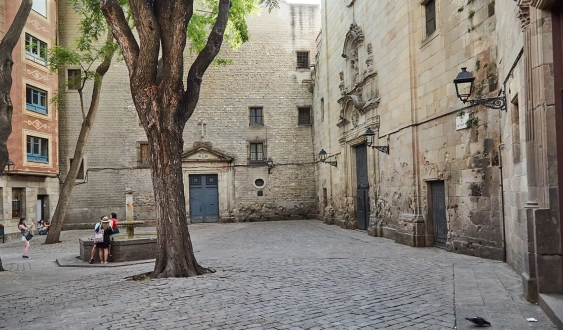
If five years ago the problem was anxiety due to restriction, now our little ones complain about having to play in places like Plaça de la Catedral in absurdly imperfect conditions, having to surf an authentically infected herd of tourists, to which one would have to add the most nefarious balloon sellers and even more nauseating souvenirs. I make my own the words of one of the children's parents, the fellow resident Josep Maria Boronat; the other day he maintained in La Nostra that a Barcelona unfriendly to children "is a dead city." In fact, one of the greatest fortunes of living next to Plaça de Sant Felip Neri is seeing how -in mid-morning- the children leave the school in the square and mitigate the pain of the shrapnel hidden in its walls by playing soccer and singing songs that, due to age, I don't know. The shouting of the children is like an orchestra tuning, a communion of all the pheromones that will soon sprout in them.
As a kid and as an adult, I always found the playground hour supremely boring, an intrascendent break that I used to distract myself in the strictest solitude or to accompany the class outcasts, a very Christian thing. This sweating, getting my clothes dirty with playground dust, and running like crazy after a ball, produced an instant repugnance in me that I still have difficulty transcribing. But I, in general, am a depressive imbecile who has ended up having tranquimazin for breakfast, so don't pay attention to me and embrace the clamor of little ones for whom their neighborhood is their natural playground, a place they love and see prostituted as an Instagram stage where tourists pout for the camera and compulsively photograph themselves acting like idiots. We want to play! is a fantastic slogan, short and clear, that certifies childish clairvoyance compared to supposedly adult foolishness.
With a certain communist vocation, the City Council has promoted programs such as Juguem a les places where, during very specific hours and in areas frequented by guiris, it proposes what in administrative idiolect is defined as "specific actions that promote public space as an educational space and one that favors the comprehensive and healthy development of children and adolescents in the city" (public officials, please do the damn favor of writing normally and, if possible, well). I celebrate that the administration detects the problem but, from what I have seen, this is the typical initiative where four board games are distributed and a minimal space is reserved for the offspring to distract themselves for a while. Here we are talking about something much deeper; namely, that children can have a spontaneous and unmediated relationship with their streets. Because the streets, and forgive me if it sounds racist, are ours.
As I write this Stab, I hear in the background the kids from Can Neri, excited, colonizing their square. Now I will take a look at the place, especially to see how it would be worth going back and becoming a normal child. Let them play, dear public administrators; otherwise, they will end up like me, a chronic mental pandemic.
Add The New Barcelona Post as your preferred Google source for free
Stay informed with the latest news.
