
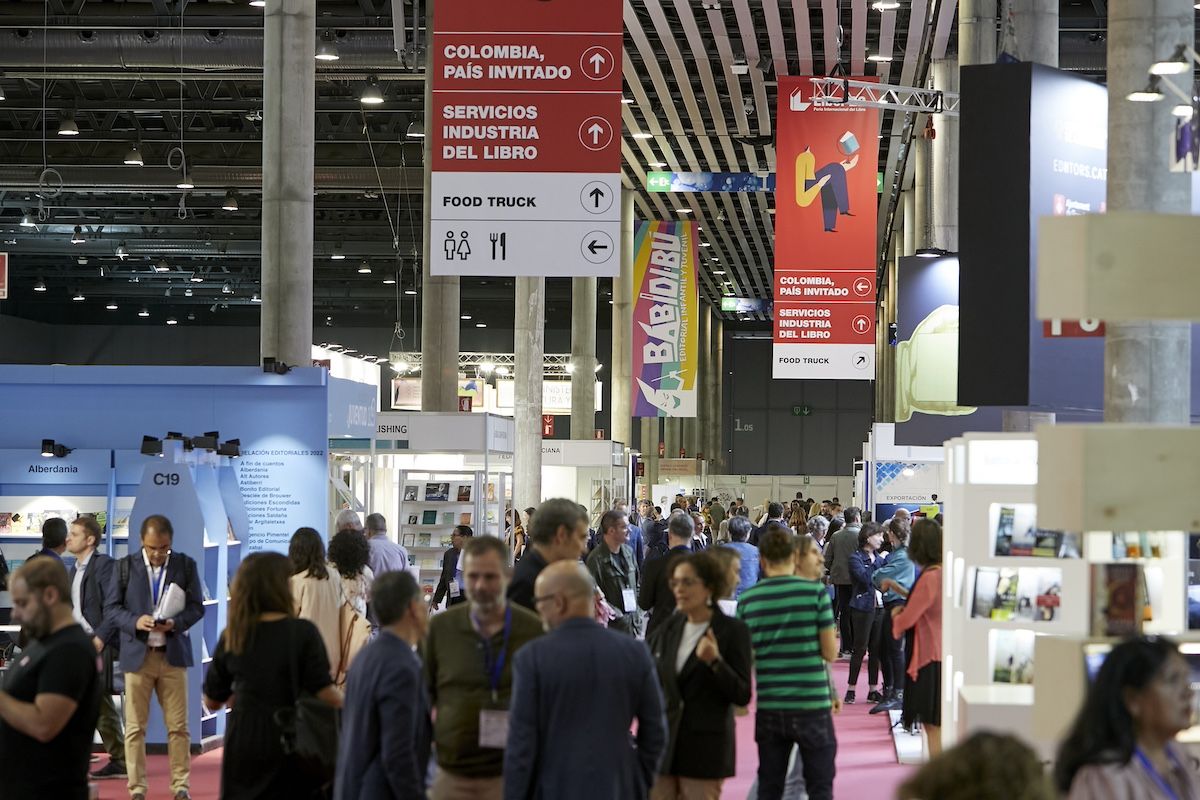
Spain is one of the 10 countries in the world that exports the most books, and a third of the international sales in this sector are generated at the International Book Fair (Liber), a professional fair held annually, alternating between Barcelona and Madrid. This week it returns to the Catalan capital, where it expects to gather some 7,000 professionals, 40% of whom will be international, and facilitate more than 3,500 business meetings. For the first time, it will coincide with Graphispag, a fair for the graphic industry and visual communication, considering that paper books represent 95% of the business and any advances in printing techniques are of interest to its attendees, who will be able to move freely between both events.
Publishers, booksellers, distributors, literary agents, and institutions will fill the Gran Via venue for three days, with a total of 250 exhibitors from 12 countries spread over an area of 8,000 square meters. Organized by Fira de Barcelona and promoted by the Federation of Publishers' Guilds of Spain (FGGE), Liber brings together a sector that maintains the good momentum that began during the pandemic, when many reconnected with books, with an accumulated growth of 17% since 2020, placing its turnover at more than 2.8 billion euros in 2023. The fair, led by the president of the FGGE, Daniel Fernández, will complement its program with 75 conferences where much will be discussed about artificial intelligence (AI).
--- At Liber, as at all fairs, agreements are closed.
--- The main objective of the fair is the export of books, but new literary works are also presented, and foreign agents and publishers come to buy and sell rights. Those we call packagers also attend, who sell you the complete package, the rights and the book, publishing it simultaneously in several languages. That is to say, a variety of professional meetings take place here, among which we must add translators who try to meet with publishers and, of course, booksellers who want to know the latest news before they are published. We must not forget that there are always some authors who dedicate themselves to knocking on the editor's door and saying, "I have a very interesting book," it's part of our world.
--- How does Barcelona's publishing differ from Madrid's?
--- We organize conferences where the current situation and especially the future of the sector are debated. In Barcelona, this is usually quite significant. Perhaps because Fira de Barcelona, as it hosts the Mobile World Congress (MWC), is very attentive to technological innovations, and that is something that usually defines the characteristics of Liber in Barcelona. This year, it is inevitable that the topic of artificial intelligence (AI) will appear in the debates.
--- Is it already a reality for the publishing sector?
--- It is a clear trend, although its future is not very clear. There are publishers who believe that it will allow us to improve some of our book production processes. What we do think is that AI needs clear regulation and, in that sense, we are in line with the European Parliament.
--- Any other trends?
--- Things we saw at last year's Liber in Madrid and previous editions are consolidating. One of them is the emergence of the audiobook as another form of reading, with a growing market. Sales to countries like the United States are also increasing, practically a classic now and accounting for 10% of global exports, but there is also the arrival of Chinese buyers, a novelty in recent years. Indeed, Spanish is becoming a reference as a language for possible global communication, and its teaching is growing in many parts of the world. Even, exports to India and Turkey have started to appear, very incipiently.
--- The main market for the Spanish publishing sector is Latin America.
--- The business volume we have with Latin America must be between 1,200 and 1,500 million euros. It is not only the export of pure books, but the Spanish publishing industry has more than 200 subsidiaries there, which are counted as national production. If we add both, Latin America accounts for 80% or 85% of our foreign market.
"Sales to countries like the United States are increasing, practically a classic, but there is also the arrival of Chinese buyers"--- The main novelty this year is the coincidence in the calendar of Liber with Graphispag.
--- The emergence of new printing technologies is taking hold, evolving rapidly and clearly. They are part of Graphispag, a graphic arts exhibition also organized by Fira de Barcelona. This implies that we are on the path to changing the way books are printed because we have always relied on economies of scale, and for publishers, being able to print a few copies of books with little movement and low rotation is extremely interesting. This is something that new technologies like print-on-demand can provide. For all these reasons, this year we have committed to starting to establish routes and bridges of collaboration with Graphispag so that both congresses are very close to each other. We hope they will bear fruit in 2026, when it is possible that part of the programming of both exhibitions will be shared or we will merge the two fairs into one.
--- Is there any other congress held in the city with which you could forge alliances?
--- The MWC also begins to have a part dedicated to looking at content. That is one of the themes of big tech companies, which have moved towards cultural content, and the big producers have always been publishers. Most movies start from a book, at least from a script, therefore, from the written word. It is something very incipient, but we have sometimes commented with Fira that perhaps we should also think about some kind of meeting or forum between Mobile and the publishing world.
Add The New Barcelona Post as your preferred Google source for free
Stay informed with the latest news.
