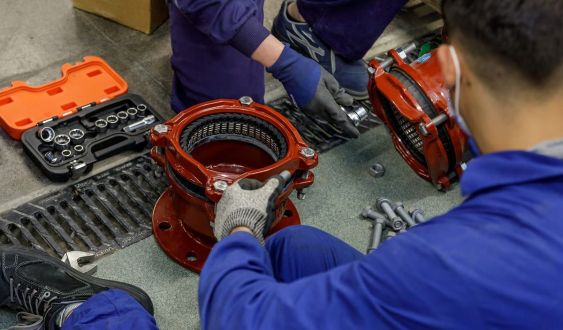
Finding, channeling, making potable, and safeguarding water as the vital treasure it is for humanity is one of the great future challenges worldwide. With the aim of sharing its knowledge on the management of this much-needed resource, 10 years ago the Water School was created, to train professionals in the sector. In addition to the programs that the Water School offers through master's and postgraduate degrees with the UPC and the UPF-Barcelona School of Management, which allows management and executive levels to learn to develop technical water management and sustainable business development, the Dual Vocational Training project was boosted. "Our commitment to Dual VET was very clear from the outset, as it is one of the three pillars to guarantee the qualification of professionals in the sector," says Lluc Pejó, director of the Water School.
The other two pillars to which Pejó refers are continuous training in companies (lifelong learning) and the recognition of the competencies that workers have acquired throughout their careers. And, in parallel to all this, from the Water School, an important task of social awareness is also carried out because, after all, all citizens are involved in making good use and achieving optimal water management.
Creation of the first VET cycles on water
In 2012, as Lluc Pejó explains, there were no specific training cycles on water, and the dual modality was in an incipient moment at the state level. "We helped the administration define the water training cycles, and the proposal culminated in the creation of two cycles and the commitment to teach them in dual modality in different parts of Spain."
"Dual VET allows combining studies at the educational center and in the company. I would recommend it to anyone who wants to work and learn at the same time, also because, compared to other sectors, the water sector has many opportunities. I would like to manage teams, and I know I can do it with this training," says Óscar Delgado, one of the 700 students of the water cycles currently taught in fifteen institutes throughout Spain. Delgado is in his second year of the Intermediate Grade Training Cycle in Water Networks and Stations at the Institut Municipal del Treball de Granollers.
Óscar Delgado (student): "Dual VET allows combining studies at the educational center and in the company. I would recommend it to anyone who wants to work and learn at the same time, also because, compared to other sectors, the water sector has many opportunities"Today, the dual modality is a recognized system applied in many places, but with the definition of the first training cycles on water management, the Water School was being a pioneer and, with the essential characteristic that "from minute zero, we opted to do a paid dual training, in the form of salary scholarships", Pejó points out.
The first institute
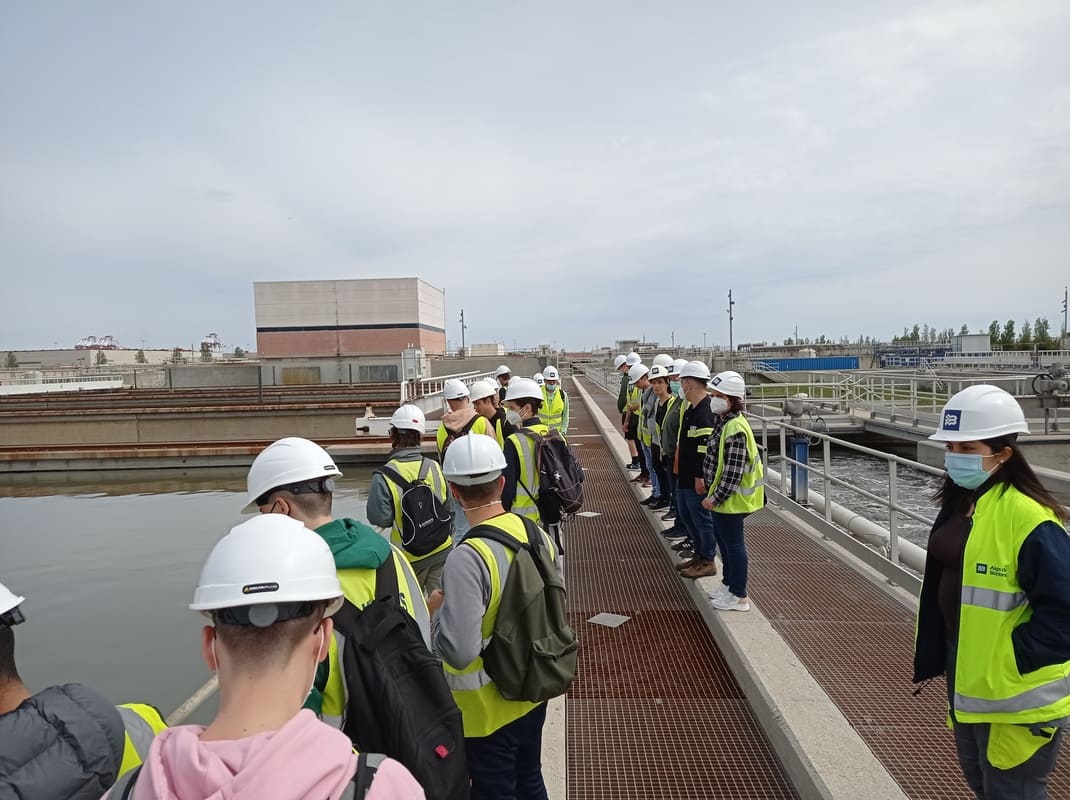
In 2014, the IES Pere Martell in Tarragona was the first in Spain to offer Dual Vocational Training in a mid-level water cycle. It did so with a qualification created by the Generalitat, with the guidance, also, of the Water School which, even today, trains teachers and company tutors, collaborates in equipping the workshop-classrooms and organizes training visits to facilities and thematic workshops for students.
According to the Water School itself, the success of its model "is based on public-private collaboration with institutions and educational centers, to unite employment, talent and productivity." In this sense, 20 companies from the Agbar group and 15 institutes spread across eight autonomous communities are involved in the program, with more than 730 students participating in different training cycles.
The first pilot was implemented at IES Pere Martell, in Tarragona, while the Instituto Escola Municipal de Treball de Granollers and the Centro Integrado de Formación Profesional de Santiago de Compostela were the first two centers to launch the official state-level cycles, which were approved in 2017. Since then, 115 students have graduated from this dual training, of whom 52% have achieved direct employment in one of the Agbar group companies.
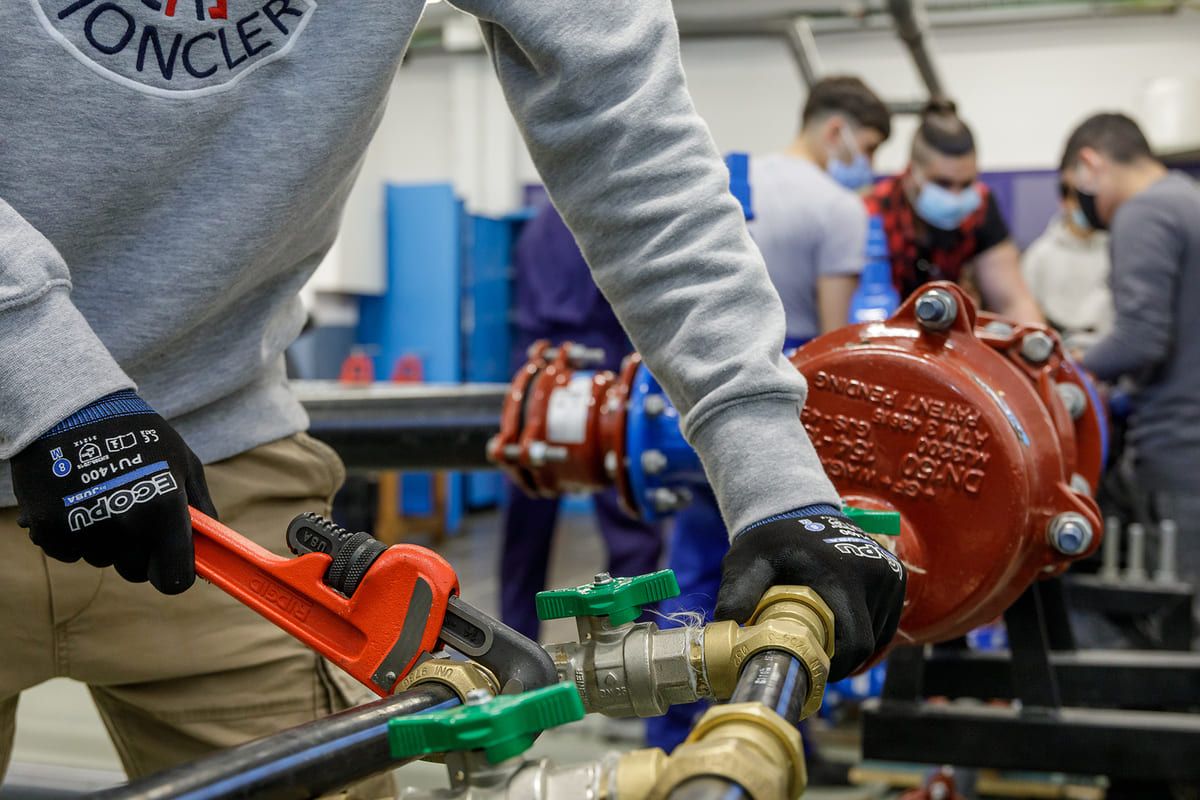
Although students of any age, not just young people, can enroll in Dual Vocational Training, in general the intermediate and higher levels of these studies are part of the regulated education system, which is naturally aimed at young people who have completed compulsory education. In this sense, the Water School is committed to young people who, with this training, can join the sector as new professionals. Because at the base of the subjects taught and the real work in companies, while studying, are the referential frameworks of the professional qualifications already established in the labor world. That is, those who train acquire knowledge, but also recognition in expertise in the work to be developed.
"It seems very interesting to me and I think a lot of benefit can be gained from it," says María Manuela García, a student of the Intermediate Grade Training Cycle in Water Networks and Stations at the Institut Escola Municipal del Treball de Granollers. "The labor field in the water sector is broad. There's the part of making water potable, regenerating it, desalination plants...", she argues. "I like everything that is the underground part," she adds.
And, at a time like the one we are going through on a planetary level, of water scarcity, learning to manage this resource well, from when it arrives from the sky, to consumption and reuse, the control of its entire cycle and the tools that make its management more efficient, these studies are a necessary career path, at the same time generous and hopeful, for the students themselves and for society as a whole. Like May water, as we would say using the expression from the countryside, learning to manage water is a contribution to the common good.
Where to study training cycles on water management
In Barcelona and its metropolitan area, training cycles on water management can be studied in dual mode at the Rubió i Tudurí institutes in Barcelona, and at the IES Esteve Terradas i Illa, in Cornellà de Llobregat. And those in the rest of Catalonia are the Pere Martell Institute in Tarragona, the Escola Municipal de Treball de Granollers and the IES Alfons Costafreda in Tàrrega.
In all these centers and in others located outside Catalonia, the professionals of the Water School prepare the dualization of the curriculum in each place where it is implemented. That is, "what part of knowledge, of content that is taught, is done in nearby water facilities and which in the educational center. This is adapted according to the equipment available in each place," specifies the director of the Water School, Lluc Pejó.
The School also offers training to teachers who teach technical subjects. On the other hand, the company facilitates the acquisition of necessary materials for training, such as pipes, pumps, valves or small machines to experiment in the workshop classroom of the educational center.
In recent years, as they explain, total enrollment has been increasing, due to the interest the subject arouses and also because more centers have been added. The growth ---Pejó points out--- is sought to be planned according to sector demand. Precisely, one of the advantages of dual training is its connection with the real needs of the labor market. It is also more attractive for students to practice in real situations and alongside expert active workers.
Experience in a real work context also contributes greatly to improving hiring. As Lluc Pejó explains, "you get a more direct and concrete knowledge of what is done in companies and the employees themselves already see how you work. And, when there is professional demand, companies want to retain talent."
Vision of the future
These are cycles that respond to water management, a key issue now that we are experiencing the scarcity of this natural resource in a very worrying way. "All climate change indicators mark the trend according to which extreme episodes, whether of drought or torrential rains, will be increasingly frequent. Therefore, everything that has to do with water care, adding digitalization, requires us to have professionals passionate about water and very well prepared," says the director of the Water School.
"We are very focused on the professionalization of the sector in an integral way, both of management teams, and of technical profiles and operators. Our vision for the coming years is to work very thoroughly on the necessary competencies to face the challenges of water management in a European and global context of ecological and digital transition, and to be an active agent in the design of advanced training proposals and in the configuration of centers of excellence for professional qualification," adds Pejó.
Being able to generate personalized training itineraries based on the needs for improvement and acquisition of new competencies, with the help of intelligent technologies that may appear, are objectives of the Water School. That technology is important in water management is also known by the students themselves, "because the water sector is very complex, and technology allows us to face the challenges it poses to us," reasons María Manuela García.
Lluc Pejó, director of the Water School: "Everything that has to do with water care, adding digitalization, requires us to have professionals passionate about water and very well prepared"And, although the Water School deals with water management and most of its professionals are from the scientific-technical field, work is being done on the incorporation of artistic and humanistic competencies to broaden their professional capabilities. "For example, in our program Aquaseminar, thematically centered on the climate crisis and digital transformation, elements typical of the arts are incorporated, such as music or literature. We are also finishing a new program for Agbar employees, in collaboration with four cultural institutions, which will allow connecting various artistic disciplines with their professional practice," explains the director of the Water School. And may art flow, like water, into the integral consciousness of the person.
Awareness for everyone
Water, as a vital element for people's health, in the sanitary and hygienic fields, for quality of life and as a regulating element of the environment, is, in the hands of the Water School, the protagonist of awareness campaigns for the school public and for citizens in general, through activities taught at the school itself, or by managing environmental education programs for various companies and public administrations. As Lluc Pejó explains, "we go beyond sector professionals to impact society as a whole, addressing the various interest groups involved in water governance, which ultimately appeals to and includes everyone."
Add The New Barcelona Post as your preferred Google source for free
Stay informed with the latest news.
