One day after the Government's announcement of the mobilization of 24,000 million euros to boost electric cars, Volkswagen has given another signal about its intention to locate a battery plant in Spain, the third gigafactory of the automotive group in Europe, after those in Germany and Sweden. A few months ago, the multinational spoke of locating it in Spain, Portugal or the south of France, and now it has narrowed down its destination somewhat more. Official confirmation of this investment is still pending, as well as knowing exactly where this factory will be installed and whether it will be in Catalonia or another autonomous community.
"Spain could become a strategic pillar of our electric strategy. We are willing to establish the entire value chain of electric mobility in the country, including the production of electric vehicles, as well as their components and a new battery factory," said Volkswagen CEO Herbert Diess, at the presentation of the group's roadmap for the coming years.
This factory will guarantee the necessary supply for the production of electric vehicles in Spain, reaching an annual capacity of 40 gigawatts/hour by 2030. Like the other two, it will have to be built with a strategic partner specialized in battery manufacturing, for now, unknown.
The president of the Seat works council and member of the Volkswagen Supervisory Board, Matías Carnero, sees in Tuesday's announcement "an important commitment" by the group to Spain. "We are on the right track," Carnero remarked. The unionist points out that everything will be finalized between now and November.
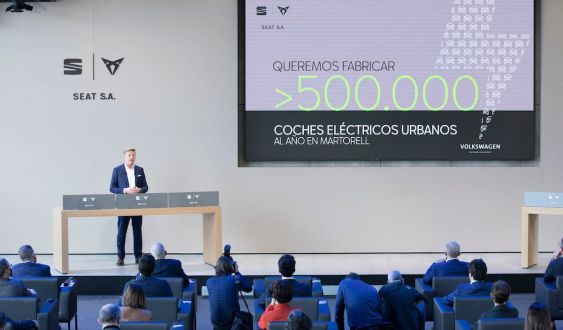
Diess has also ratified Volkswagen's willingness to start manufacturing the group's family of small electric urban cars, known as Small BEV, at the Martorell plant starting in 2025. These vehicles are expected to play "a key role in the democratization of electric mobility in Europe," with prices ranging from 20,000 to 25,000 euros. Seat estimates that it could manufacture 500,000 electric cars annually within four years, after investing 5,000 million euros in the Baix Llobregat factory to adapt it to the new production.
To do so, the German group will ask to participate in the Strategic Project for Economic Recovery and Transformation (PERTE) that President Pedro Sánchez presented on Monday and was approved this Tuesday by the Council of Ministers. "Our goal is to cooperate with the Government to transform the country into a European electric electromobility hub and the Seat production plant in Martorell into a 100% electric vehicle factory," defended the CEO of Seat and Cupra, Wayne Griffiths, who has long been asking for clear public support to facilitate the automaker's commitment to transforming its production.
"Our goal is to cooperate with the Government to transform the country into a hub europeo de electromovilidad eléctrica y la planta de producción de Seat en Martorell en una fábrica de vehículos 100% eléctricos", ha defendido Wayne GriffithsWith this PERTE, Sánchez's executive plans to allocate 4,295 million euros between 2021 and 2023, mainly financed by the Next Generation EU funds. This public investment will be joined by a private investment of 19,700 million euros. These resources will be allocated to foster the production of electric vehicles and to facilitate consumer adoption.The sector is expected to increase its weight in GDP by up to 15% by 2030 and create 140,000 jobs.
Griffiths attended the presentation of the PERTE at Moncloa. On behalf of the Generalitat, the Secretary of Business and Competitiveness, Albert Castellanos, participated. Extremadura, which also claims to locate the battery plant in its community, sent its president, Guillermo Fernández Vara, whom Sánchez mentioned more than once in his speech.
Add The New Barcelona Post as your preferred Google source for free
Stay informed with the latest news.
