
When the name Vicens Vives is mentioned, many will surely get the flashback of the hours and hours they spent in front of their books, reading, underlining, memorizing, making summaries, reviewing the lesson... Surely more years have passed since those moments than anyone is willing to admit, so it will surely surprise them if someone tells them that textbooks are no longer what they used to be. First, because there are schools that prefer digital books over paper ones and, then, because artificial intelligence (AI) can be used to learn, even though this technology has been demonized and everyone has been asked if their job was going to disappear.
The Barcelona-based publishing house has long been moving towards this scenario, without forgetting where it comes from. "We have always had a progressive approach, useful for teaching and very focused on innovation. My grandfather (Jaume Vicens Vives), is always remembered for geography and history. But I believe that his most important characteristics were his capacity for innovation and communication. This is really the essence of Vicens Vives and also of the change we want to accelerate," explains Jaume Vicens, CEO of the family business.
The project that best represents the new stage is the AI tool they have developed for teachers. "It is an educational and curricular artificial intelligence, verified in a safe and controlled environment," says Jaume Vicens, "AI is here to stay, but you can't let it act on its own, you have to parameterize it within a humanistic ecosystem." The executive gives as an example other similar platforms such as ChatGPT and points out that they have drawn from all the sources the internet offered, without discerning whether they were good or not, simply swallowing everything they found. Aware of this, the publishing house has created its own technology and has made it feed on the universe of knowledge that the publisher has been accumulating for more than 60 years.
Vicens Vives began digitizing its collection a few years ago, labeling the thematic units and organizing them, being able to classify them by content and the age of the students they were aimed at. But they have not only done that. Jaume Vicens turns to Ferran Adrià to clarify it. "He deconstructs food from its basic elements. To simplify, he puts the potato omelet in a glass, with the egg on one side and the potato on the other. Then, you drink it and reconstruct the dish. What do we do? Instead of directly giving the potato omelet as was traditionally done, that is, the textbook, what we do is deconstruct its contents and index them. Then, through the new platform, teachers can reconstruct the learning elements into basic units and personalized itineraries for each student," he explains.
Knowing that it is not easy to understand, he proposes a practical exercise. One must imagine that a teacher wants to give a class about the Roman Empire in the 2nd century BC for third-year ESO students. The platform will search all the information it has about this content in its database, offering text and exercises, but also images, graphics, and related videos. This represents a basic learning unit, which can be interwoven with others, whether the rest of the stages of the Roman Empire, what was happening in other parts of the world, or a selection of emperors that have existed throughout history. In addition to content, the Vicens Vives platform will offer activities to do in class, mnemonic tricks or exam models, being able to adapt them to the different student profiles that may be in a class, both for those who are more advanced and those who are not. All this without having to spend hours searching on the internet, with scattered and unverified content.
The new AI platform will be available starting this week and will be included in the resources offered to teachers when they acquire the material, whether they choose the textbook in paper format or its digital version, both with a license that will give them access to the tool. According to its CEO, Vicens Vives will be the first Spanish publisher to offer a solution like this. "The mission is to accompany teachers, the great forgotten ones. Many times in these big tenders that are called, a huge allocation is made to buy electronic devices and only a very small part is allocated to training. We are here to accompany them," he defends.
A team of about 40 workers has been dedicated to its design and implementation. The accumulated investment stands at 14 million euros, covering all the work that has been done since 2010 to start digitizing content and the launch of the Edubook platform.
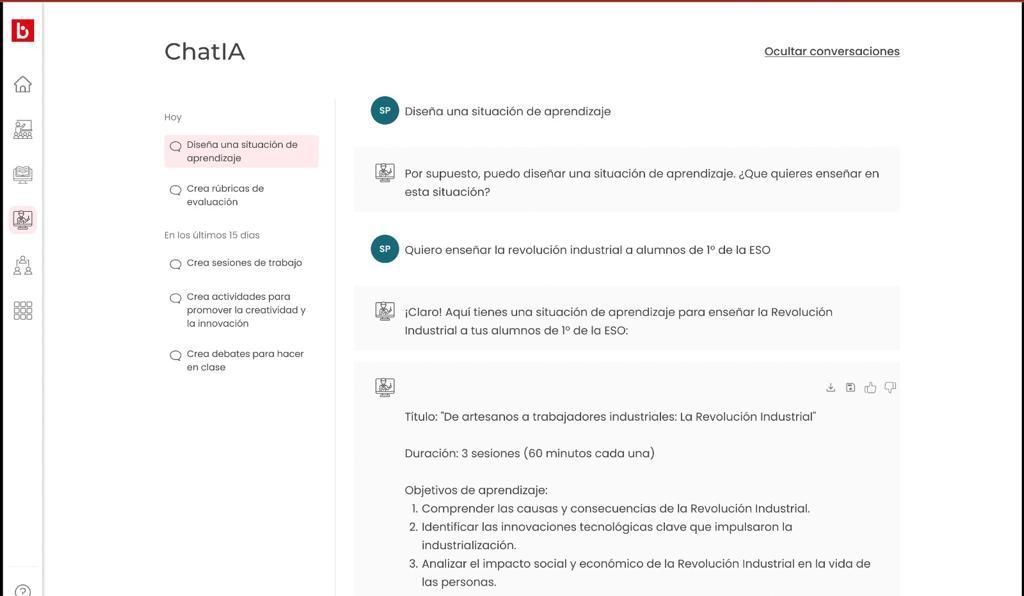
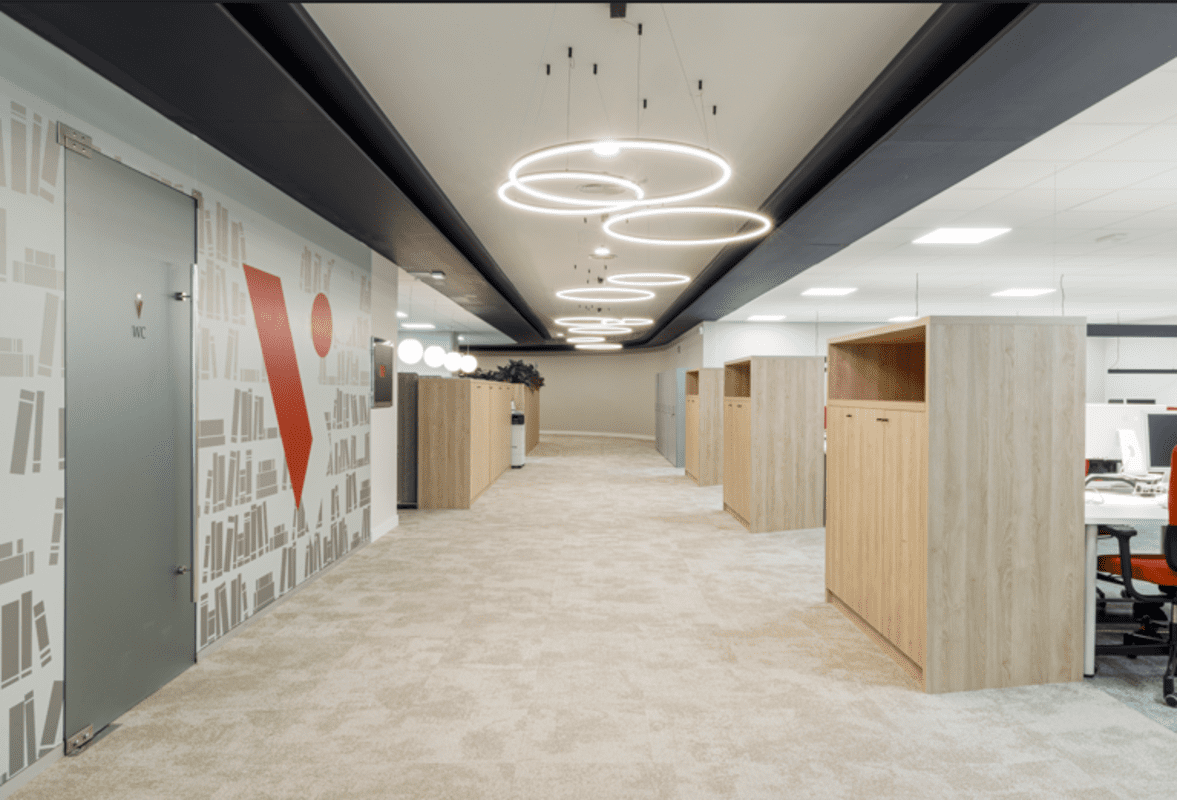
"We are transforming a traditional textbook publisher from the last century into an educational technology company, where technology is linked to humanism, that is, to ethics and values," summarizes Jaume Vicens. The new stage is crystallized in the headquarters they have just inaugurated on Via Augusta, at the intersection with General Mitre, where they have reserved a space for teachers to come and get to know their latest proposals firsthand. In addition to the artificial intelligence platform, the publisher will launch in September mini digital learning courses (NOOCS), to facilitate students' access to digital competitions, as well as curricular content. They will be available in Spanish, Catalan, and English, with examples such as Els 4 gats: la bohemia modernista, Sobre el Guernica, Un Quijote con arte, Diseña una smart city or El aire que respiramos.
After the blow dealt by the pandemic, the company billed 30 million euros in 2022 and expects to grow by 25% this year. Paper continues to represent 70% of the income, with the remaining 30% for schools that only purchase the digital licenses of the books. The publishing house is not linked to large international groups nor to the Church, unlike others such as Santillana (bought by the Finnish group Sanoma) or Edebé (of the Salesian congregation). The capital of Vicens Vives is shared only by Jaume Vicens and his father, Pere Vicens, co-founder of the company. The independent publishing house is a leader in Geography and History, with between 30% and 40% of the market share throughout Spain, then comes Philosophy and they are growing in Language and Literature. Precisely, they are leaders in the reading books of Hispanic classics.
Add The New Barcelona Post as your preferred Google source for free
Stay informed with the latest news.
