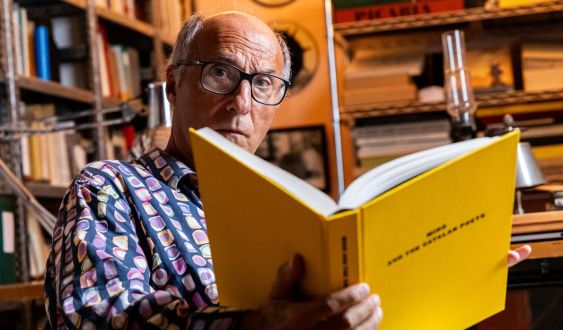
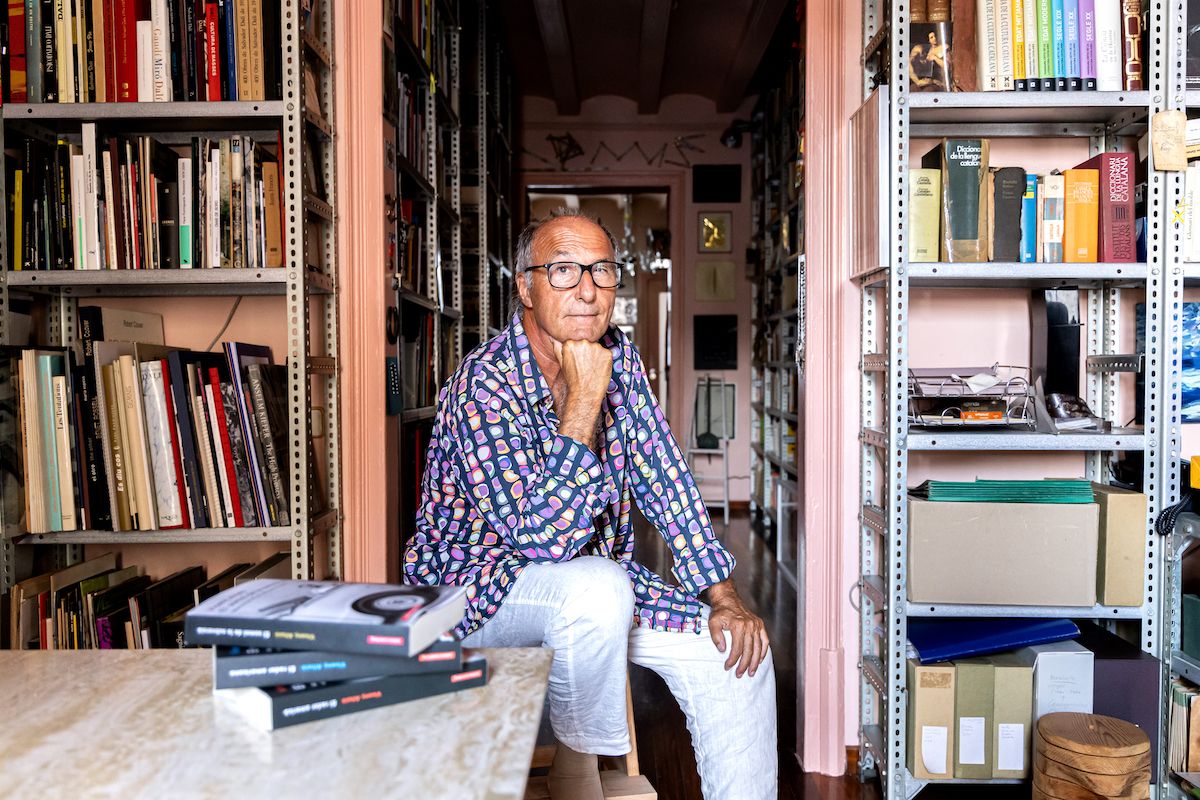
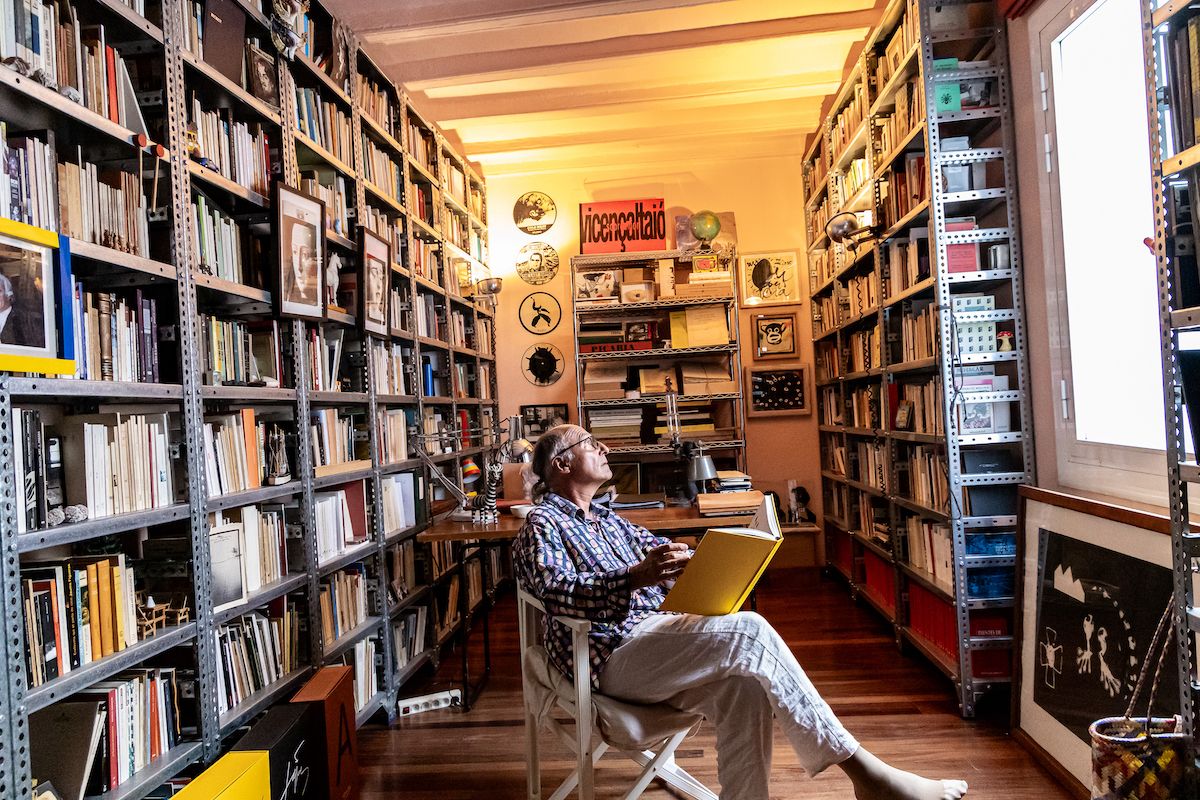
Vicenç Altaió is one of the Barcelonians with the greatest capacity to critically observe the evolution of the city, and the country, from the 70s to today in cultural, social, and philosophical terms. A trafficker of ideas for fifty years, he refuses to let the current traffic of ideas fall into the hands of artificial intelligence and denounces the submission to a dynamic that replaces the citizen with the user.
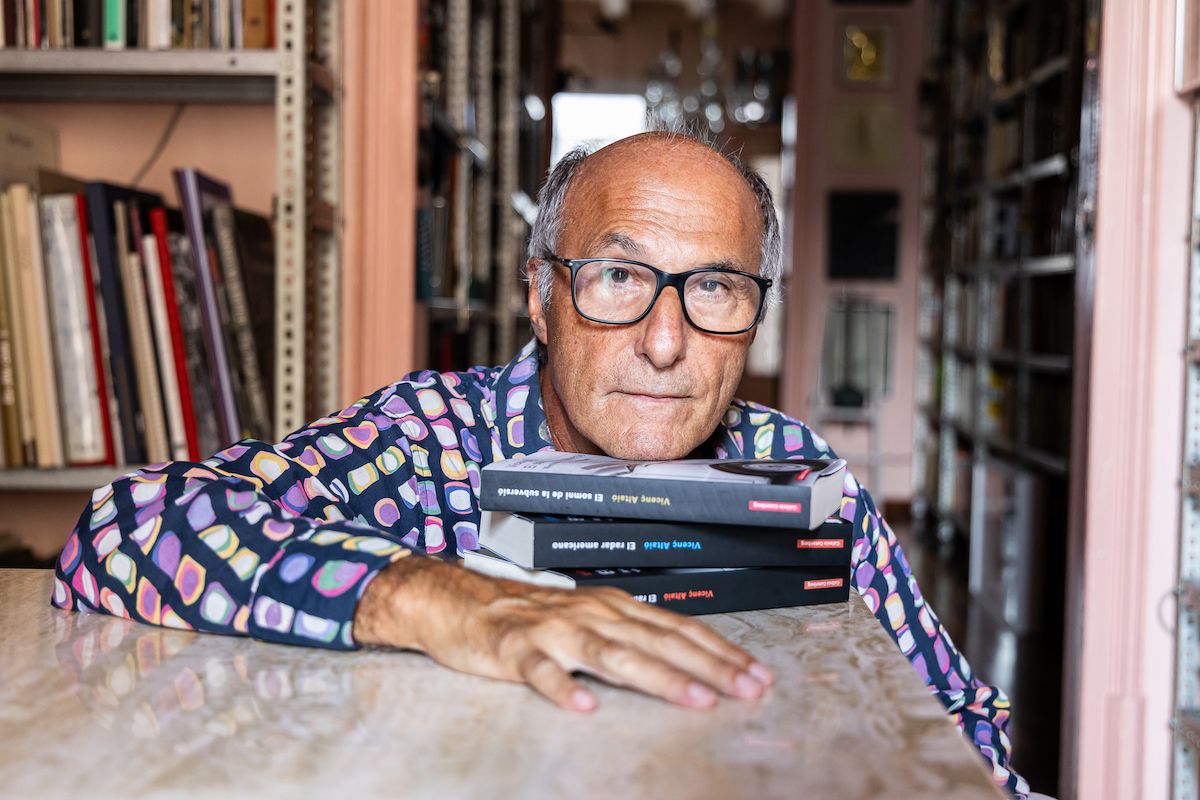
He has just published El sueño de la subversión / Memorias de un traficante de ideas (Galaxia Gutenberg) and in this conversation he describes, provokes, and, above all, creates. Altaió is incapable of being just an observer: in him, every word is an action.
--- How does a subversor, a transgressor, a trafficker, see the current artistic and cultural landscape compared to the 70s?
--- It is completely different. Bearing in mind that there is always something in human substance that is permanent, of course… But yes, it is very different. Everything moves at a dizzying speed and now the landscape has nothing to do with late Francoism, with those links we were able to establish with what was the avant-garde generation, the exile generation, and even the entire aesthetic stance in favor of imagination. Everything we changed —the complete absence of theaters outside of cooperatives and alternatives, the absence of exhibition spaces beyond what would later be the Fundació Miró and experimental spaces— has absolutely nothing to do with it anymore.
--- What has changed, above all?
--- At that time, something new was being constituted, which had a positive and communal value. In contrast, now we clearly find ourselves with the difficulty of sustaining a knowledge society with predation, added to the ease and the global world, with a massification of everything, even of what was the culture of memories. I am not saying that today is a decadent landscape compared to that inaugural moment, but we are in a transition that, until this chaos is harmonized again, we will live with precariousness.
--- If then subversion demanded cultural facilities, do you think now we have too much facilities policy, too much order, in short, too much system?
--- No doubt. Already in the 80s we warned that there was unsustainable growth, both from a demographic point of view and from the necessary consumption, even of the socialization of knowledge. I remember that in the 90s, at the core of KRTU, we held an exhibition at the Fundació Miró dedicated to the culture of sustainability. That today this has been assumed as a priority policy on a global scale means that they have turned it into a form of market. When at that time it was a critical warning. It is impossible for the created facilities to absorb the avalanche of artists, plays, etc. The system we created at that time must be modified. There is no doubt that technology can help us solve the problem of global and mass communication.
--- Would the "idea dealer" today be artificial intelligence?
--- The idea dealer was artificial intelligence. It was a desire for the intellectual to stop being a "micro" analyst in the formality of their specialty to be someone with an interdisciplinary perspective who made enlightened bets. At a certain point, it seemed to us that this figure of the intellectual who had always existed in critical thought could no longer keep reading. It was a mistake. It is an ethical responsibility to keep reading. Especially now, that we have a centralized and authoritarian system that governs everything that is public good. As classics and avant-gardists at the same time, we must have the capacity to read above the antinomies that everyone seeks.
--- Could we have reached a point where we find ourselves with a "democratic authoritarianism"?
--- This is already written in history: we knew that condescension to populism implied a perversion and that, therefore, those who act as a hinge (such as social democracy in Spain) would be those who would provoke the rise of the extreme right, as happened in Germany with fascism. It is very easy to accuse and say that the democratic demand of October 1st was what "woke up the beasts." The Spanish counter-reformation has always existed.
"The law of the market is a savage law: although it has a regulatory intention, it cannot reach everything"--- And then, what happened?
--- The problem is that some elements of progressive culture are absolutely old-fashioned, and did not accept an advanced model that proposed a pacifist, democratic, and even postmodern collective voice.
--- Was the procés the last subversion, then?
--- The last subversion in Europe was this one, just as the popular and republican stance taken by the Basque movement was in its time.
--- At a more city level, that effervescence, that popular street creativity that emerged in the 70s and 80s, do you think it has been completely lost or do you still detect green shoots in the city?
--- As I said, each era is essentially different. The law of the market is a savage law: although it has a regulatory intention, it cannot reach everything. Finally, the tax model ends up creating large pyramids whose apex is the political establishment, ranging from the monarchy to the state government, parliamentarians, the growing number of civil servants... You realize that, in the end, money is not what should organize society. Everyone has the right to seek what is their own. We, who are people of culture, must once again give value to memory and the knowledge of sensibility. In the same way that there is the religious establishment that ensures that souls have a paradise, more real or less.
"When the economy is the priority, politics ends up being subsidiary. The great loser is culture, and the winner is predatory consumption."--- A capital sold to the market, to understand each other?
--- When politics becomes just another system, there is no longer a regulatory element. And when the economy is the priority, politics ends up being subsidiary. With that, the great loser is culture, and the winner is predatory consumption.
--- The avant-garde, Miró, Tàpies… has all that disappeared?
--- This has been disappearing along the way. There have been many solutions, for example at the time of dialogue in the political transition. I had the luck and privilege to work on a table of independents close to the Department of Culture and make observations on cultural mutation. The fact that this was approached in the form of dialogue and with total freedom generated positive elements. We believed that a dynamic and networked culture should be created, for the same reason we opposed the construction of the Sagrada Familia emblem as a resolution of a permanent construction and we valued, in that case, heritage.
--- Heritage cannot only be preserved: it can be created.
---- The fact is that now the place of consensus among the various political options is the one that built all these infrastructures, this model, which is the culture of stone. We, on the other hand, were in favor of a liquid culture, and it seems that technology has proven us right, because mass tourism has also reinforced the emblem of the Sagrada Familia as an industrial model.
--- Large facilities do not solve the creativity of sectors.
--- They become places of high consumption. The most positive thing about that moment was that the three verb tenses acted at the same time: the past, which is often considered decadent, for us was a value, even if the new generation created the future.
--- Is genius more alone today?
--- Creative genius is recognized, but the necessary structures for communication between minority and popular culture to interrelate do not exist. At that time, both grew simultaneously. Miró championed the rural world, as Perejaume does.
--- How would you define the avant-garde at this moment and in this country?
--- Antoni Muntadas would be an example. An artist who in his youth went to New York and who continues to maintain a full relationship with Catalonia. This artist plays the same role that Miró symbolically could have played in our generation, but that Miró worked in the ultra-local and in an international field while Muntadas works in the global sphere and with particular actions. We, for example, have just done an exhibition at the Cadaqués Gallery, with a very particular title.
--- Sadomasoqués.
--- Exactly. To define the difficulty that the town of Cadaqués has in counteracting the standard advertising image of a beautiful place. It is, but we say that it has stones on the beach, that access is difficult, that there are housing problems… We invited artists who live in or know Cadaqués, as international as they are local, and a hundred have participated in this project. We interrelate a plurality of artistic trends and materials: photo, video, objects, even a performance.
"Catalan cannot be merely instrumental, like Spanish or English: it must have a positive value. It must be associated, for example, with freedom"--- What do you tell me about immersive digital art projects?
--- All this about immersive experiences is fashionable and, as you well know, it is very superficial, although technologically very attractive. It is completely superficial in its ability to create narratives and interpellation.
--- What is worthwhile, then, now?
--- For example, the latest exhibition at MACBA dedicated monographically to the artist Jordi Colomer. Or the artists we can see in the new Trafalgar core, at the Bombon gallery. Enric Ferrés and other poets like Gabriel Ventura, who has just published a new book. I will also tell you that the world of social networks permanently takes and elevates people as generational referents and, at the same time, burns them, but this is a rotating element.
--- Therefore, where is the problem?
--- The problem is value. If no value is provided, it is useless. Let's take Catalan as an example: at that time, it suddenly became a positive value, and that made everyone (even economic sectors like La Caixa) play in its favor. For example, the publication of the best works of Catalan literature, or of universal literature, which could be bought through La Caixa. Today that is read negatively. Everything that was an advance is now touched by the new phenomenon of global migration. If we do not build a positive discourse, of integration, but also of value, we are lost. Catalan cannot be merely instrumental, like Spanish or English: it must have a positive value. It must be associated, for example, with freedom.
--- Do you want to talk about your experience this August in Latvia with Albert Serra?
--- Let's see, I am Albert's friend. An artist I knew how to see at the time, who had an exceptionality and who, by generation, had a revolutionary machine which was video (a light, prêt-à-porter tool that everyone can practice). At the same time, he was a classic "impel·latual". This conjunction meant that in the transfer from the humanistic-literary world to the visual language in which we are at the moment... I can say little more. I will only say that he has made a spectacular leap.
Add The New Barcelona Post as your preferred Google source for free
Stay informed with the latest news.
