
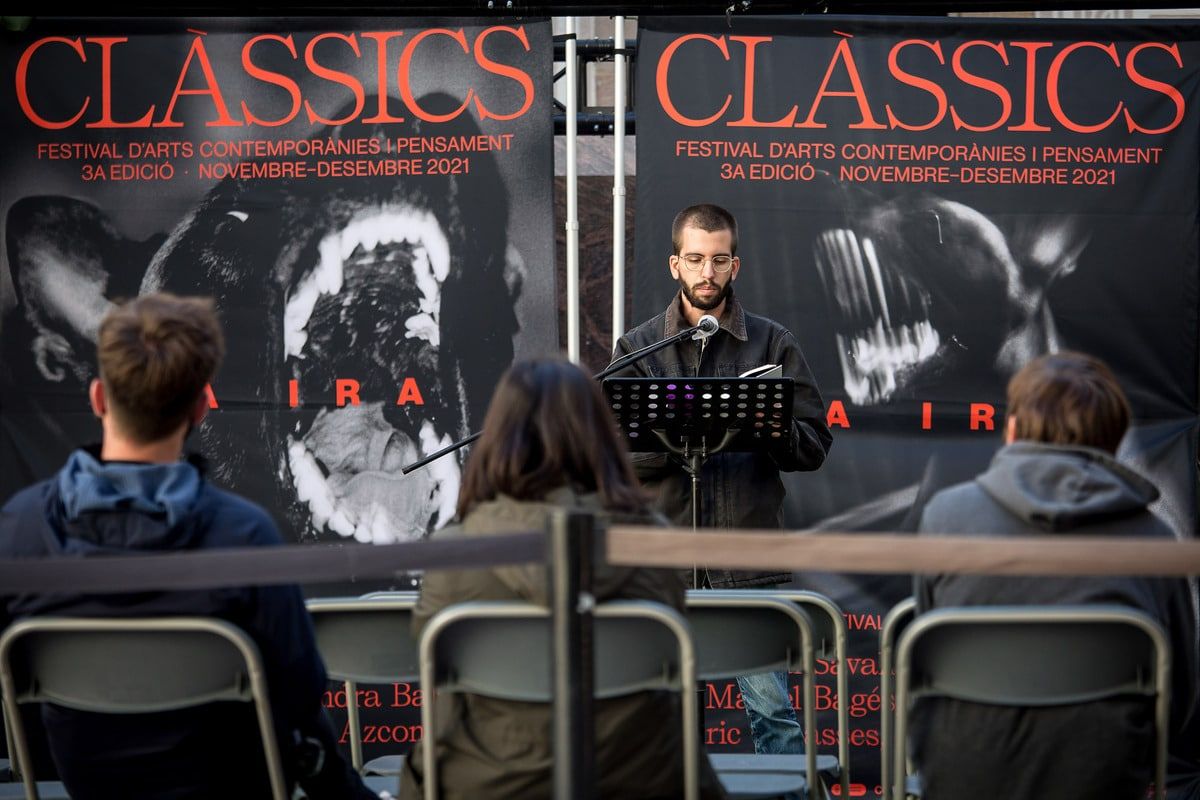
Anger, and therefore violence, is the emotion that founds the literary and political imaginary of the West. "The wrath, sing, goddess, the fateful wrath of Achilles, son of Peleus, which brought countless sorrows to the Achaeans". Thus begins the Iliad, the foundational text of human rage, of the power of offense and of the love of conflict, in the impressive Catalan version by Pau Sabaté published two years ago by Bernat Metge Universal in collaboration with La Casa dels Clàssics, a literary project that has mutated into a contemporary art and thought festival.
This edition's Clàssics is precisely dedicated to anger, and the choice could not be more opportune, not only because in recent times we have seen it erupt in North Africa, Urquinaona, Hong Kong and Wall Street, also embodied in the faces of youth who have found in climate change the excuse to rebel against their parents, but also because the post-pandemic will force us to think about this ancient idea in an enclosed and much more nebulous version.
The contingency of anniversaries has caused this Festival Clàssics to coincide with the 250th anniversary of the birth of Fyodor Dostoevsky. The publishing house itself gave us a new and enormous translation of Crime and Punishment last year, brought forth by the Russian writer's ambassador in Catalonia, Miquel Cabal. Thinking about individual and collective violence today requires rereading these two venerable books and understanding them anew, radically. Let's keep it brief and get to the point. The Iliad represents an organic notion of the feeling of rage. Achilles gets angry with Agamemnon because the latter has stolen Briseis from him, a young woman he had won as war booty and, from that offense that breaks the rules of good fighting, the resulting bad temper makes all the moral structures of the tribe tremble. On the contrary, in Crime and Punishment, Dostoevsky brilliantly intuits that contemporary anger will fall on beggars like Raskolnikov, the murderer of a pawnbroker and her niece, whom he kills without a transcendent motive.
This is not just a mental masturbation arising from two great texts. The world of yesterday, which goes from Greek civilization to the Second World War, is the universe of a warrior anger with strong moral content, of factions that send men and women to the battlefield because they intimately believe that by doing so they will do good. Now we are not at that point, and not only because large-scale conflicts have ended and battles resemble a video game where there are no soldiers but drones directed from a military base in Nebraska, but because outbursts of anger (with the exception of jihadism, which is a failed form of war precisely because it has gone out of fashion), are no longer an amendment to the totality of anything, they transit through the liquidity of social networks, they explode just because and in absolutely random places and with protagonists without mystique. The anger of now are the victims of gender violence, the invisible dead of the Mediterranean and murderers like Raskolnikov, impoverished and humiliated.
Post-pandemic reality has taught us that we cannot think of anger without understanding and controlling fear, which is the mechanism by which states control our freedom. Let's descend back to the asphalt and leave metaphysics. We live in Catalonia, a curious place in the world where we have gone from contemplating kids from the Eixample burning containers to protest against a Spanish Supreme Court ruling to seeing how society obeyed spartanly and with exemplary punctuality the constraints and limits to freedom of movement that state and regional governments imposed on us under the excuse of the coronavirus. We have gone, therefore, from an apparently heroic and anarchic (but ultimately useless) anger in the streets to a purely domestic one, which is expressed in the frustration of a contemporary man who must fight again for rights such as freedom of movement, essences that he believed intimate to his being and that, once castrated by power, return us to a rage that can explode in delirious ways.
Post-pandemic reality has taught us that we cannot think of anger without understanding and controlling fear, which is the mechanism by which states control our freedomControlling fear and rethinking anger are practically one and the same thing.This explains that the programmers of theClassics, with great intelligence, have programmed an unprecedented version ofThe Song of the Sibyl (with Maria Arnal and Marcel Bagès at the MNAC and during the shortest night of the year, next December 21; I wouldn't miss it), the oldest liturgical event in Catalan that explicitly refers to the end of times and the beginning of a new world.
Whatever we think, we have gradually assumed that the Covid crisis will not only be a health matter, but will affect the configuration of this new world in a profound way whose scope we do not yet know... nor, above all, how we will channel the anger that results from all of this. The Clàssics has racked its brains to think about it and soon our city will also host the Barcelona Pensa, a magnificent philosophy festival for all audiences. Barcelona wants to get its brain working, and hopefully many more festivals will be born from these.
Think about anger, control fear. The master and lord of this your Punyalada asks you, without any rage.
Add The New Barcelona Post as your preferred Google source for free
Stay informed with the latest news.