
New calendar for the reform of Barcelona's most emblematic promenade. The machinery has been greased and coordinated to shorten the works on La Rambla and reduce their planned duration by half. The 72 months that remained are reduced to 32, with the forecast that the new Rambla will be ready in January 2027, instead of the initially planned date in 2030. The ultimate goal? To get Barcelonians to walk along their Rambla again.
The planned investment for the overall works is around 55.6 million euros. From the urban reform point of view, this will be the most ambitious action of the mandate. With it, the City Council intends for Barcelonians to walk along La Rambla again and for the thoroughfare to become an axis for the neighborhoods of Ciutat Vella. Among the objectives, "the most passionate challenge is something that is not done with stone, nor with tenders, nor with budget, which is to maintain the soul of La Rambla," proclaimed the mayor, Jaume Collboni, at the presentation of the new calendar.
"We could not afford six years of works" on the city's most famous artery, the mayor added. The gears began to move shortly after he was sworn in as mayor, when he met in July with Amics de La Rambla to address this "historic challenge" both technical and coordination to transform the quintessential promenade of the Catalan capital.
The formula to shorten the calendar by half has consisted of planning the parallel development of all pending reform phases, instead of executing them consecutively. Thus, starting in June of next year, work will begin simultaneously on four sections. The works for the section between Colom and Santa Madrona began a year ago, and are expected to finish this summer. The reform will affect traffic, which will only circulate uphill while the works are carried out. Access to homes, shops, and parking lots will be guaranteed, and the works will involve modifications to bus routes.
The change in the calendar does not alter the final picture sought for La Rambla: a single lane of traffic per direction and more space for pedestrians, both on the sides and in the central roadway. The new Rambla will include more resting spaces from which to watch people and time pass, and three new crossings as squares, in Pla de la Boqueria, Pla del Teatre, and Espai Betlem-Moja.
Between flowers and culture
Converting the avenue into a cultural hub is fundamental for citizens to return to La Rambla and also to attract young people. "The post-Olympic generation has no memories of La Rambla because they don't set foot on it, and we have to make them come," defended the president of Amics de La Rambla, Fermín Villar. He warned that the reform is essential and that the improvement of the promenade is above any actor who wants to hinder it. "The works are uncomfortable, but they must be done." In the same vein, the councilor for Ciutat Vella, Albert Batlle, stated that "nothing will stop the calendar." The municipal government is determined to remove any obstacles that may arise in the path of the reform until its completion in 2027.
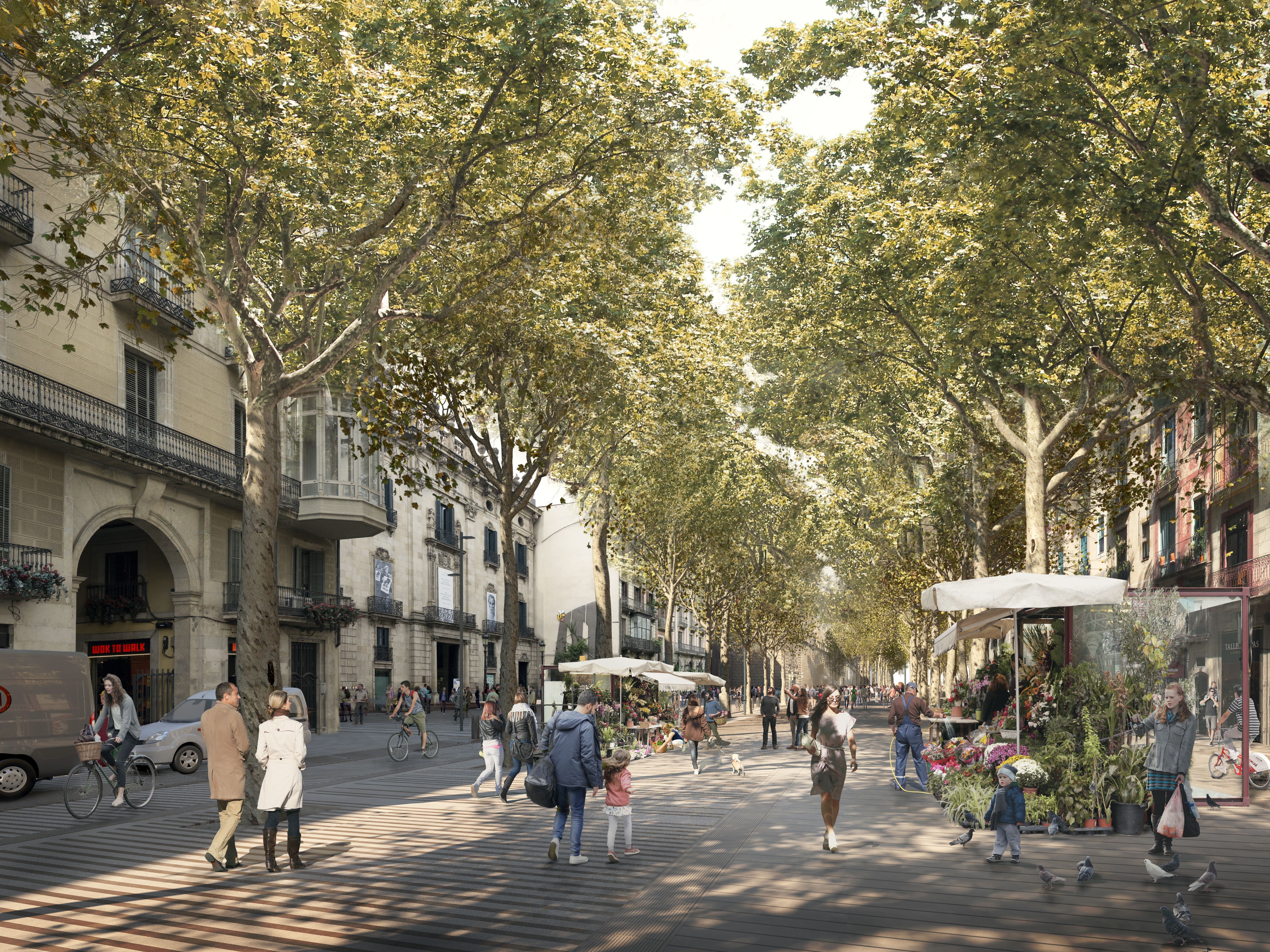
And it will be by traversing this path that the uses of the promenade and the destiny of activities such as that of the florists, who will remain on the promenade as one of the elements of its own and unique identity, will be defined. Different is the case of the old animal kiosks, whose case is judicialized due to their disagreements with the City Council and with the aim of preventing their disappearance.
The activity of the florists will remain on La Rambla as one of the elements of its own identityThe situation ofactivities "that may be uncomfortable," such as businesses linked to cannabis,according to Batlle. He has assured that they will try to make them as little inconvenient as possible, and has not ruled out the possibility of "removing from La Rambla activities that are not proper to it" and that are not part of the green, cultural, and civic promenade that the City Council seeks.
Add The New Barcelona Post as your preferred Google source for free
Stay informed with the latest news.
