On a plane, the palate also travels. Not only because you have breakfast over Milan and land hungry in Singapore. It travels because up there the rules change. The air is drier, the pressure is lower, the noise is constant, and taste ceases to be a certainty to become a negotiation between the body and the environment. Eating on board is not just about nourishing oneself. It's about checking to what extent the brain decides for us what tastes good and what fades away.
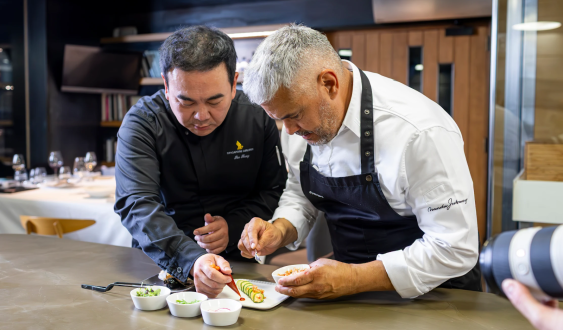
That's why the collaboration that Singapore Airlines has just presented with Nandu Jubany has an interest that goes beyond adding a Michelin-starred chef to the Business menu. More than a gastronomic news item, it raises a fundamental question: What happens to a suquet, a fricandó, or a bacalao a la catalana when they leave the dining room and enter a pressurized cabin?
Scientists have long pointed out that at altitude, taste does not work the same way. Studies by the Fraunhofer Institute have observed that the perception of salt and sugar decreases significantly. Added to this is the low air humidity, which dries out the nose and reduces olfactory capacity, as if we had a cold. In contrast, umami and certain warm spices tend to resist this environment better. That's why ingredients like tomato, soy, mushrooms, or ginger maintain their presence better among the clouds.
There are several reasons why flavor changes. One is physical: the lower cabin pressure reduces the effectiveness of taste and smell receptors, partly because blood oxygen saturation also decreases. But the other is more subtle and perhaps more revealing, as it is psychological. Researcher Andrea Burdack-Freitag summarizes it well: when the environment changes, so does the way we perceive. In the controlled strangeness of a cabin, the brain pays more attention to basic stimuli and less to detail.
And then there's the noise. Charles Spence, an Oxford professor and one of the great names in gastrophysics, has been insisting for years that the experience of taste is multisensory. It depends not only on taste, but also on hearing, sight, memory, and the expectations that context activates even before the first bite. His work on sound in flight suggests that the constant cabin noise reduces the perception of sweetness and can make umami gain prominence.
Perhaps that's why the Bloody Mary makes so much sense at 30,000 feet. Spence has suggested that many passengers choose it almost as a physiological intuition, as if the body seeks a flavor capable of standing its ground when other nuances fade. His hypothesis is suggestive: that tomato, rich in umami, offers one of the few basic flavors relatively less affected by the constant cabin noise. Up there, moreover, this juice is usually perceived as less acidic, rounder, and even with a slightly sweet note, which helps explain why it convinces people in flight who would rarely order it on the ground.
At altitude, taste changes: not only because of what we eat, but because of how the body and environment transform it. The curious thing is that Jubany doesn't seem obsessed with the idea that taste changes radically at altitude. The chef is more concerned with something else, perhaps more concrete and more of a cook's concern than a laboratory's: the actual temperature of the dish and the resilience of a recipe from the moment it leaves the kitchen until it reaches the passenger. It's a less abstract view and, ultimately, just as neurogastronomic. Because the brain doesn't just interpret aromas. It also registers thermal contrasts, altered textures, sauces that have waited too long, and cooking points that are no longer exactly the same.
Singapore Airlines, on the other hand, does emphasize the importance of adapting recipes to the airplane. The company has a simulated airplane cabin recreated on the ground, a space that reproduces the real conditions of pressure, humidity, and onboard service to test how dishes perform before flying. There, recipes, sauces, and seasonings are adjusted to check how they respond to that simulated altitude, in a gesture that is more reminiscent of an episode of The Rehearsal than a typical test kitchen.

This journey from plate to brain connects almost naturally with the publication of Miguel Sánchez Romera's new book. Neurologist, chef, former head of Neurology at Hospital Policlínico del Vallès, and chef who earned a Michelin star with L'Esguard. Now, with Planeta Gastro, he signs Neurogastronomy: The Brain-Kitchen Universe, an essay in which he once again explores the frontier between cooking, perception, pleasure, and emotion.
The neurochef's book is full of curious ideas. For example, that the optimal temperature for a volatile aromatic substance or a taste to be best perceived is body temperature, about 37 degrees; that umami is not exactly a taste, but a flavor; that there is a triangle between the human being, the context, and the food; or that cooking transports both positive and unwanted emotions.
He also explains, and Spence has confirmed it in the laboratory, that color helps to set flavor expectations before tasting. In fact, there is accumulated evidence that the hue and intensity of color in foods and beverages influence the multisensory perception of taste and that these associations between colors and flavors are, to a large extent, learned. It is an idea that the late Comida Codac by Miquel Coulibaly already played with, very consciously.
Perhaps, in the end, all this is about accepting that eating has never been a simple act. Drinking a Bloody Mary among clouds, tasting a fricandó on board, or sitting in a restaurant named in chromatic key are not such different gestures. In all three cases, the flavor finishes being written in an invisible zone. Not only on the plate. Nor entirely on the palate. Rather in that more fragile, more exact, and also more narrative place where the brain converts a sensation into an experience. Neurogastronomy, in essence, does not come to complicate the table. It comes to remind us that it was always more complex than it seemed.
Add The New Barcelona Post as your preferred Google source for free
Stay informed with the latest news.