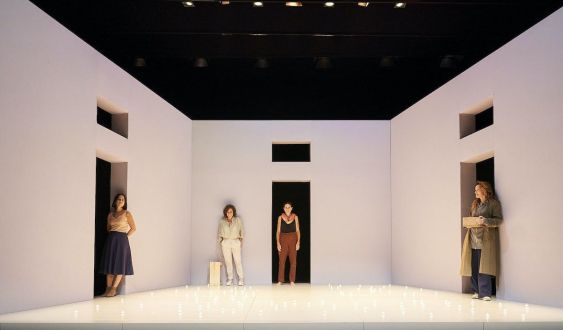
Before the play begins, in the auditorium, someone asks their companion if they have tissues; they've been warned that people cry a lot during La trena. The spectator feels relieved when she confirms they are well-prepared for the show. Tissues are needed, but also foresight to go see a play that is recurrently hanging the Sold Out sign ---more than 500--- at the Goya Theater. The hall is packed, queues form, and it starts later; even the rows of stools on the second floor are occupied, without fear that discomfort will make spectators leave. Premiered in early September, the play, produced by La Perla 29, was scheduled to end in late November, but it has been extended until mid-December due to high demand, as just happened with the musical Golfus de Roma, another success of the season.
When the show begins, Clara Segura appears as a narrator and creator who, in turn, is also a director. The versatile professional accompanies the three protagonists on their journeys, as she also does with the audience. As she acknowledged this Friday at a meeting of the theater company behind La trena with the audience at La Central del Raval, packed to the brim, Segura has a privileged position on stage to observe the spectators and, above all, listen to them. Obviously, she knows when they pull out a tissue. She can even identify when someone silently wipes away tears, perhaps timidly, as is always done in the darkness of a theater.
Segura weaves the story, the braid, letting it flow, without fear of any thread getting lost, knowing that everything eventually returns to its course. She even allows herself to wink at the audience by referencing a very popular serial lately about murders and investigations. In this collective creation, she is accompanied by Smita (Marta Marco), Giulia (Carlota Olcina), and Sarah (Cristina Genebat), three women with different stories who have to overcome what is expected of them. Smita, an untouchable in India, rebels so that her daughter can study and have a better future. Giulia, a young worker in an artisanal wig workshop in Italy, has to take charge of her life through a series of scares. Finally, Sarah, a successful lawyer from Canada and a mother, faces, with much irony and armor, that everything, at some point, falters.
With an agile rhythm, La Trena goes from one end of the world to the other, with a minimalist and well-resolved set that allows the viewer not to lose the thread either. The three stories, with their three protagonists and different secondary characters, are told solely by the three actresses, who cook and eat all the scenes, managing to do whatever is necessary, even if it's a crowd in a procession or on a pilgrimage. So quickly do they travel from one place to another that, in some rehearsals, one of the actresses appeared dressed as Smita's daughter to play Sarah's coworker, confess the members of the theater company.
This week, among the audience at the Goya Theater, was Laetitia Colombani, the writer of the work on which the play is based, La trenza (Salamandra). And the show is being such a success that it is also translating into sales for the publisher, seeing how the novel is placed among the most read in Catalan despite having been published four years ago. Colombani, also present at the theater company's meeting at La Central, revealed some curiosities about the plot, satisfying the doubts of the actresses and the many attending spectators. To avoid spoilers, suffice it to say that the writer wrote the book for a friend who had been diagnosed with cancer, like one of the protagonists, and wanted to give her a story. For those who are left wanting more and have already read the book, don't worry, La trena is going on tour through Catalan theaters in case you want to repeat, and there will also be a movie of the novel. Colombani makes a cameo. Don't forget your tissues when it premieres in cinemas.
Add The New Barcelona Post as your preferred Google source for free
Stay informed with the latest news.
