
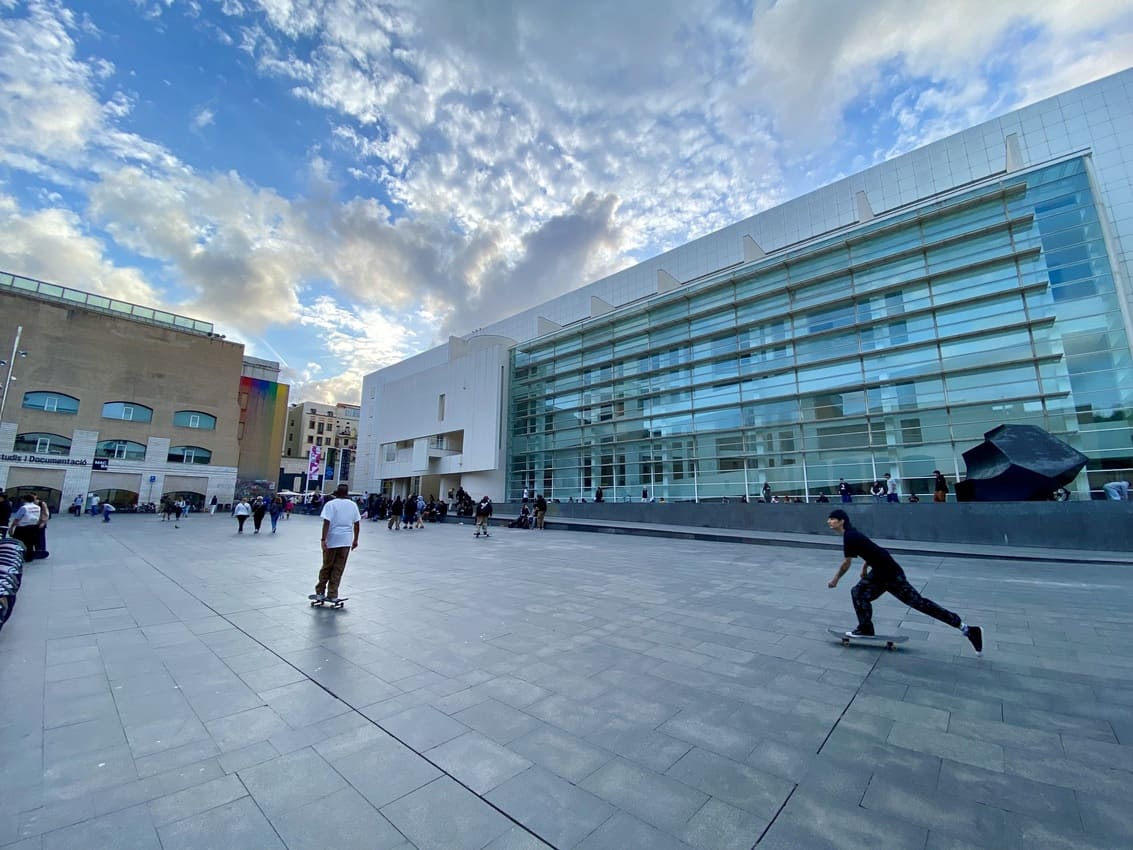
During the eighties we called it Plaza dels Àngels, then we renamed it Plaza del MACBA and, finally, it ended up being Plaza de los Skaters. When we were little, we had never walked there and the place sounded more like a refuge for junkies and drunks. Pasqual's Olympic joy –and the conversion of Barcelona into a tourist attraction through hard plazas with the will to weave large recreational spaces in the New York style; namely, around a cultural nerve center of reference, in this case the MACBA– turned the old square into one of the coolest places in the new city. Thus, the Raval began to be reclaimed through a typically Xer concept that is still exemplified in one of the oldest graffiti in the neighborhood: ravalejar, that is, acting alternative by having beers in a formerly marginal neighborhood.
Then, I was saying, the skaters arrived. I suppose it helped that the MACBA lost the opportunity to become the reference center for contemporary art made in Catalonia (well, in reality it was never intended to be such a thing) and that Barcelona, say the experts and practitioners, became one of the world capitals in this art of skating. This is still a half-anarchist city, with the consequent presence of irreconcilable factions. I have crossed this square hundreds of thousands of times –especially to rush to the La Habana restaurant, one of the few excellent places for tribal cuisine that still exist in the Gòtic– and I have never had any run-ins or problems with the skaters who frequent it on their own. Walking in a space overflowing with speedsters, with the characteristic percussion of wood on the ground, is not my ideal way to stroll; but this city has much more inhospitable places.
Fans of the skater scene say that, without their presence, the Plaça dels Àngels would have degraded even further. This entire collective, and the reasoning seems logical enough, is also not interested in exercising their hobby in a shabby and conflict-ridden environment. In turn, the skater culture claims its presence in the neighborhood, arguing that businesses derived from the sport – like the friendly Rufus – will transform into anodyne mobile phone shops if practitioners of the sport are forced to leave for other parts of the city, such as Mar Bella. All this is very well, but I also – as a resilient inhabitant of Ciutat Vella – lean towards empathizing even more with the demands of the Xarxa Veïnal del Raval, a group of fellow citizens who aim to live (and rest when they please) in a neighborhood without noise and where public spaces are not the umpteenth tourist attraction that ends up full of guiris.
I also perfectly understand that the residents of Raval, at the risk of being caricatured as nostalgic, want their local commerce not to be totally absorbed by tourist predation. This very week we learned that Venice has started to demand a 5-euro fee from tourists who want to visit its historic center for a single day, a measure that seeks to make life easier for the unfortunate 50,000 locals who still intend to inhabit a city that welcomes more than 30 million annual pilgrims. Barcelona does not have this outrageous proportion, but it is progressively heading towards the paradigm of a shop window. The question, therefore, would be to move away from particularistic struggles (skaters, cyclists, and so on against neighbors) to see to what extent we can avoid being expelled from a city only suitable for visitors.
The City Council has defended the current project for the remodeling of the square (with the horizon of being completed in 2027, incorporating the CAP Raval Nord and the expansion of the MACBA) remarking, in the corny idiolect of progressive urban planners, that the creation of new areas for staying, vegetation, and shade will create a more friendly urban environment, I would say with a spirit similar to that of the successful metamorphosis of the New York High Line. I share the good intentions of the administration, but I must say – and in this, neighbors and skaters converge – that similar spaces in the city reconverted for this purpose have ended up being preyed upon by our lord Instagram and even returning us to the image of the eighties slums that we had already forgotten (as happens in the backstage of La Boquería with Jerusalem street). All of this is aided by the mysterious fact that, at dusk, the police literally disappear from Barcelona.
Returning to the beginning of the article, first it was Plaza dels Àngels, then it was MACBA's, now it's the skaters' and, in a few years, it looks like it will end up being the umpteenth Plaza de los Turistas.
Add The New Barcelona Post as your preferred Google source for free
Stay informed with the latest news.