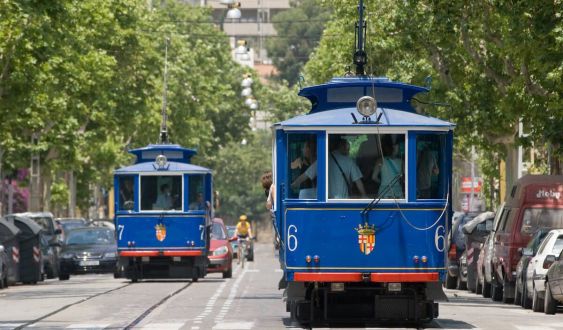
The emblematic Tramvia Blau stopped running along Tibidabo Avenue at the beginning of 2018, when it was approaching 120 years of history. The service stoppage was made to modernize its infrastructure, with an estimated cost of about 19 million euros, but this process has been delayed over time and little progress has been made since its farewell.
The first sign of activity after the last trip was at the beginning of 2019, when urgent works were carried out to renovate the roof of one of the sheds in the depot where the trams were stored, motivated by the need to remove the asbestos that was in the old roof sheets. Now, after three long years, timid steps are beginning to be taken to approach the recovery of the commercial service of this tram.
The Barcelona consulting firm Tec-Cuatro, specialized in civil engineering and architecture services, has just won the tender to draft the construction project for the renovation and updating of the Tramvia Blau facilities, both the vehicles themselves and the depots, and the urbanization of Tibidabo Avenue and Kennedy and Doctor Andreu squares, its start and end stops.
Specifically, the remodeling that Tec-Cuatro has to design will involve the construction of a new railway platform on the same route; the change of all tracks (2,662 linear meters), track devices, catenary and the 139 support poles, and the restoration and updating of the trams.
Tec-Cuatro's offer, for a value of 561,190 euros, has been the best valued and now an 18-month period opens to develop the corresponding projects. Once this is done, the works resulting from the Barcelona company's proposal will have to be tendered, awarded and put into operation. That is to say, there is still a long way to go before seeing the oldest tram in the city run again.
Tec-Cuatro, extensive experience in mobility works
The winning company of the tender has extensive experience in the design and supervision of key works for mobility in Barcelona and its metropolitan area. Tec-Cuatro has participated in the design of part of the L9 and the L10 viaduct in the Zona Franca, as well as in some of the stations of these two lines.
The Barcelona consulting firm Tec-Cuatro, specialized in civil engineering and architecture services, has participated in the design of L9 and the viaduct of L10 in the Zona FrancaBeyond the Barcelona metro, the company has also been in charge of supervising the works on the tunnels under Glòries squareor from the Eix Macià station of Ferrocarrils de la Generalitat de Catalunya (FGC) on the Sabadell line.
The last survivor of the old tram network
The Tramvia Blau is the last remaining survivor in Barcelona of the old tram network, after they disappeared from its streets in the early 70s. The history of this line is intimately linked to the avenue where it circulated. Its creator, Dr. Salvador Andreu, proposed the urbanization of the area, designed for the city's wealthy classes, at the same time that he created the means of transport to be able to move around.
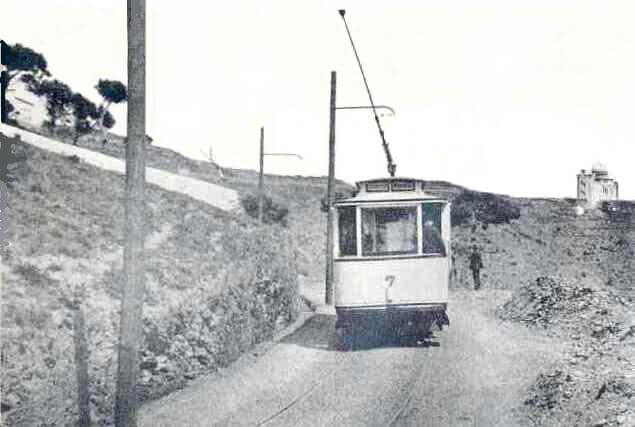
The Tramvia Blau vehicles were originally green, but they were painted blue after an accidentIt was in 1901 when this tram service was inaugurated.Of the cars that debuted that year, only number 2 remains, explains the director of the Terminus CET study center, Joan Carles Salmerón. Tram number 2 will be the one that escapes the remodeling work that Tec-Cuatro is now beginning to define, with the aim of maintaining its value as a historical piece. As a curious detail, the first vehicles were not blue but green, but the color was changed in 1945 after an accident, when it also began to be called Tramvia Blau.
The tram was not the only means of transport that Andreu devised for Tibidabo. In 1901, the Tibidabo funicular also kicked off, connecting the current Doctor Andreu square, in honor of its promoter, with the amusement park. As Salmerón points out, while the new Tibidabo funicular, the Cuca de Llum, is expected to be back in operation in the second half of this year, we will still have to wait quite a while to be able to connect with the city via the Tramvia Blau.
Add The New Barcelona Post as your preferred Google source for free
Stay informed with the latest news.
