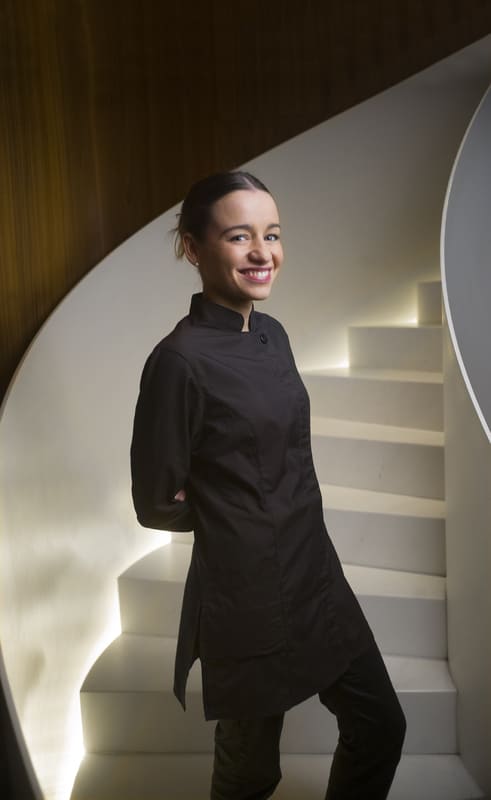
Martina Puigvert Puigdevall, head chef of the Les Cols restaurant in Olot (Girona), often uses the plural when talking about life, cooking, or what fascinates her. She is very clear that hers is a team success and that, with others, one learns and improves, in a display of sensitivity that, inevitably, translates into conscious, ethical, and imaginative recipes where many disciplines and influences converge. We talk with the chef about the menu she has designed for the Veraz restaurant at The Barcelona Edition hotel, where she shares the kitchen with Pedro Tassarolo, and also about the recovery of ancestral tastes, the importance of linking to a garden, or how technology can connect us with nature. Martina thinks in the plural; yes, but her singularity is unbeatable.
--- Hello Martina! Tell us why you decided to join the Veraz restaurant with this pop-up.
--- From the beginning, I liked Edition's values and philosophy. They pay great attention to detail and I would say they understand luxury in a different way. It is also a place that champions art, they even have Salvador Dalí armchairs, and is sensitive to architecture, as we are at Les Cols.
--- How did you select the dishes that will be available during these months?
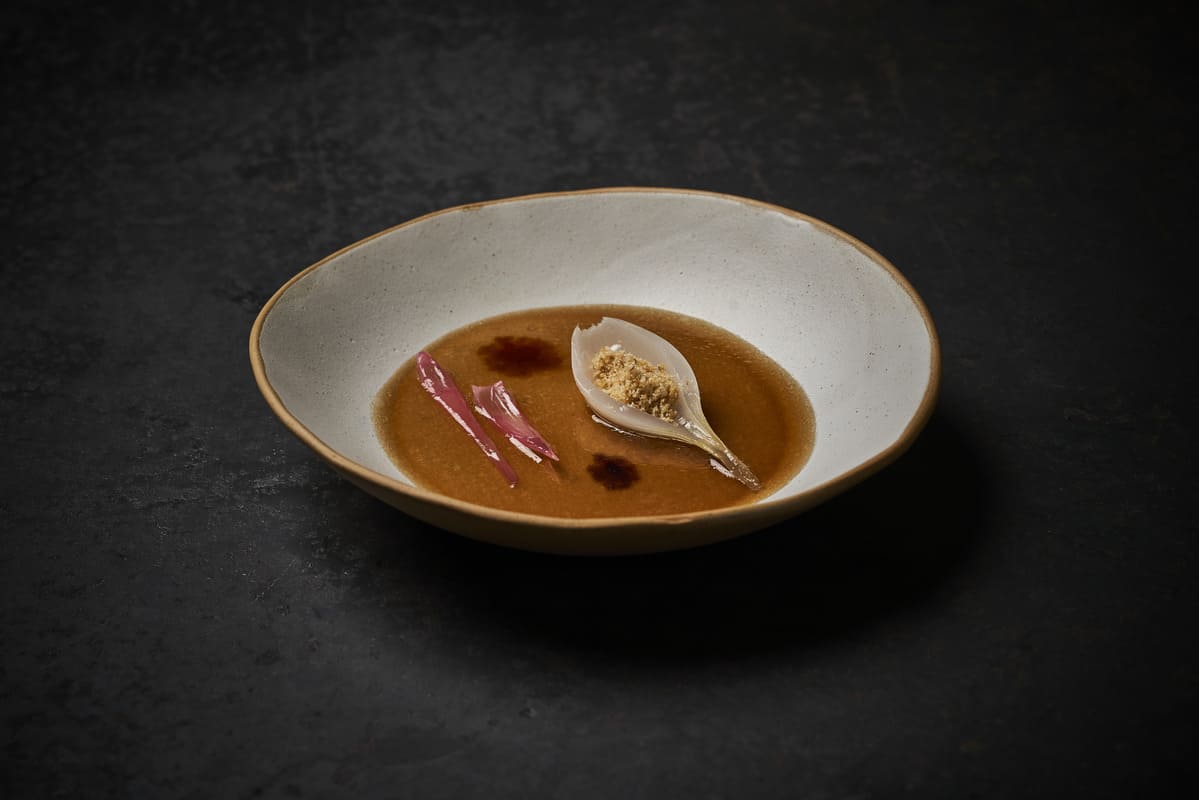
--- I wanted to capture the philosophy of Les Cols with several proposals. The first is a sweet onion royale, which is a very humble product, but one that is part of the La Garrotxa landscape. It also exemplifies this luxury understood in a different way that we talked about before, very far from caviar or shrimp.
--- You will also make a dish where the protagonist is the egg from your garden in Bianya.
--- Yes, the egg is always present in our tasting menu, although it changes according to the seasons. At Edition, we will serve it with four different vegetables, each of which provides a specific color. Its taste is reminiscent of Russian salad, but, visually, it takes us to Kandinsky; it is very artistic.
--- Years ago, at Les Cols, it was decided not to cook fresh fish. The third dish you propose follows that line.
--- Exactly, it was decided to cook only with canned, salted, or mountain fish for philosophical reasons. At first, it was very difficult for customers to understand. But we wanted to reflect the cuisine and culture of a territory where, before, it was very difficult to find fresh fish and, for that reason, river animals such as trout, crab, frog… or salted fish like cod, which is our third proposal, were cooked.
--- And what have you prepared for dessert for this menu?
--- I was excited for the dessert to be vegetable-based, because we do very green cooking and we also have our own garden. We have chosen carrots, which we serve as if they were a crème brûlée, with different textures.
--- Is there any ingredient that you would like to highlight in the future from this garden, as you have done with the Santa Pau beans?
--- The garden serves as a space for knowledge and allows us to recover varieties of tomato and eggplant. Also ciri apple, cross corn or buckwheat, together with Carme, who is a local producer. We also have a mill to obtain farro, corn flour, naturally.
--- There you also have Casa Horitzó, your R&D center. Give me an example of a proposal you are working on.
--- For us, R&D has to do with recovering local varieties and being in contact with artisans. For example, we have created new tools or ways of serving, such as a Brussels sprout trunk to place appetizers or a boxwood board where we place the petit fours. We also want to be consistent with the environment and, for that reason, we make compost with vegetable scraps and give leftover bread to chickens and lambs... Our R&D is in contact with nature.
--- A biologist, Maria Colldecarrera, and a naturalist and geographer, Miquel Macías, also work in the garden team. What does their perspective bring you?
--- In the restaurant, we have always liked to mix disciplines. It is important for an outsider to be present, because they have a different perspective on what we do. Miquel, for example, convinced us to put boxes in the garden for owls, as there are fewer and fewer, and now the space is much healthier. And we also work with Guillem Coromina, who is an agricultural engineer. With Maria, we also did one of the presentations that I have liked the most to date, at the Fòrum Gastronòmic.
--- Speaking of congresses: a few years ago, at San Sebastian Gastronomika, you presented a study on the concept of rancid. What can this flavor bring to haute cuisine?
--- Rancid is a taste linked to Catalan farmhouses and pig slaughter, which originates from storing cured meats in the pantry. The rancid taste is considered a defect, but we wanted it to become a virtue because it actually shows a gastronomic culture. At that time, we devised dishes with pork fat with local artisans. Among them, river trout impregnated with lard or a broth with the bone of rancid ham... we were looking for the exact percentage so that the rancid was not a defect.
--- Have you served any dish with a rancid flavor at Les Cols?
--- Yes! In autumn we collaborated with Jordi Vilarrasa, an artisan who raises pigs and makes his own cured meats. He stuffed wild mushrooms into a raw botifarra, achieving that rancid point we were looking for.
--- Before joining Les Cols, you did stages at Gustu, in Bolivia, and also at Dan Barber's Blue Hill at Stone Barns, the chef who says "it's not just what we eat that's important, but what what we eat eats."
--- They were two very different experiences and I learned a lot from both. In La Paz it was a more social project and about contact with producers; in New York, I learned a lot about methodology. With what you say, I remember that, at Blue Hill, they served a red yolk because their chickens ate peppers. Sometimes, we focus so much on cooking and textures, which on the other hand are very important, that we forget other aspects.
--- And from your mother, Fina Puigdevall, what have you learned?
--- Everything! (laughs). She has transmitted to me the passion for the craft and, especially, the way of taking care of things: the team, the space, the chickens... I have a very close and intimate relationship with her and, in fact, cooking is a tiny part of everything that unites us. That's why, entering the restaurant has been a very natural process for me.
--- Do you believe, as your mother has said on occasion, that a restaurant's team should be an extension of a family?
--- Totally. Ours is a horizontal restaurant where the team is an extension of the family. I joined at 22, but there are people who have been there since day one, that is, for over 33 years! Carme Roca, for example, has been working since a week before the opening. She even saw me being born!
--- It's clear that a family spirit reigns at Les Cols and, perhaps for that reason, you dedicated the Michelin Young Chef Award 2024 to your parents and sisters, the team, and the producers who work with you. What has that award meant to you?
--- I didn't expect it at all! I still don't know what to say and, in fact, I still can't quite believe it. I loved receiving the award, of course, but I think I liked even more the joy it generated in my environment. I truly feel it's shared; it's not just my merit but that of many people. I'm still surprised when chefs congratulate me!
Add The New Barcelona Post as your preferred Google source for free
Stay informed with the latest news.