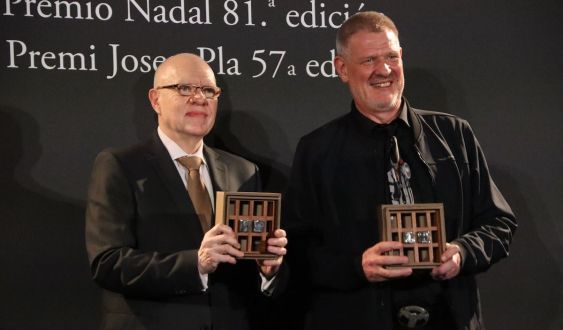
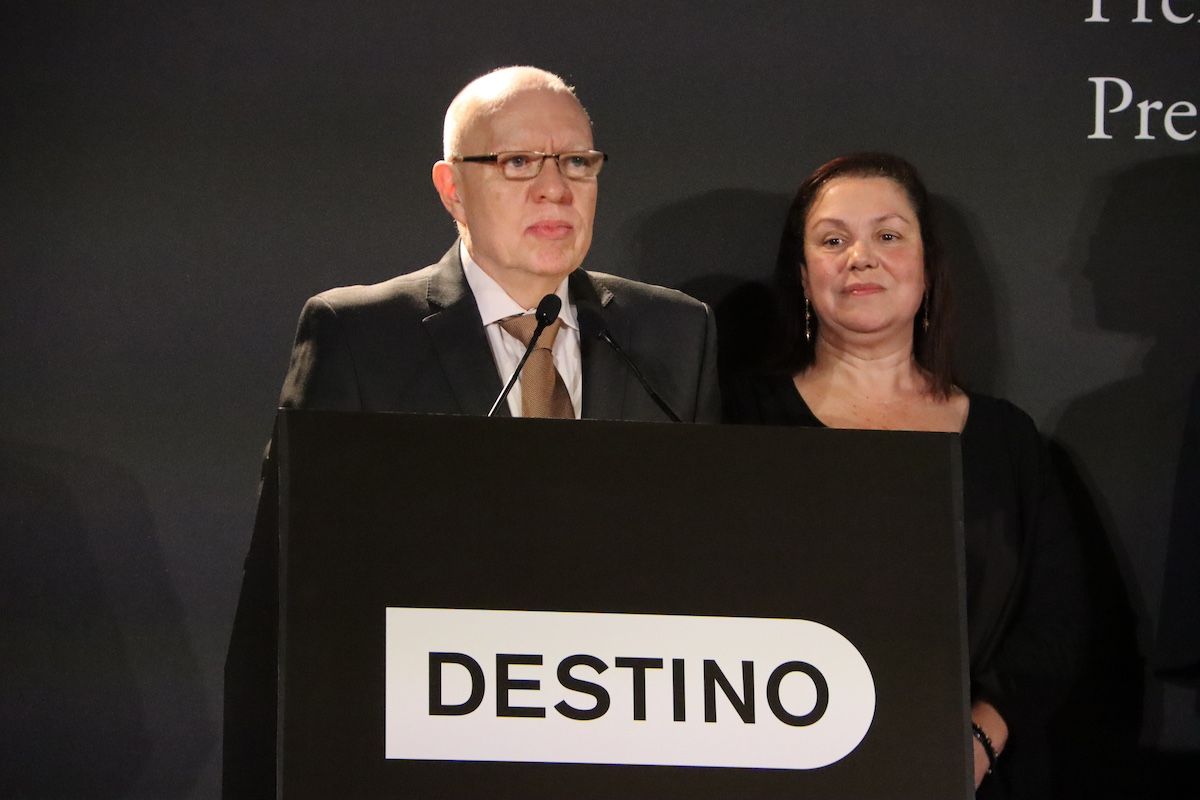
David Bueno (Barcelona, 1965) is not usually one of the regular guests on Three Kings' Day at the Palace hotel for the Nadal and Josep Pla Awards ceremony. Literati are seen, also politicians, but not so many scientists. The biologist and professor at the University of Barcelona (UB) has won the Josep Pla Award with L'art de ser humans, presented under the pseudonym Carro de foc. It won by a majority among the 40 manuscripts that participated in this 57th edition. It is an essay on art, although Bueno is better known for his specialty in neuroscience, which he applies to how to improve the educational system. A work of these characteristics does not usually win, and many had forgotten that the award recognizes prose works in Catalan, from diaries to novels, varied genres like those cultivated by Josep Pla.
A well-known author of scientific popularization titles, Bueno has vindicated in his speech the arts "in plural," also including science and philosophy, to enrich life and mind thanks to the ability to reason, be creative, and abstract. "As long as we continue to speak the language of the arts, there is hope in the world," he maintained. He also did not forget that Biology teacher he had at 14 who gave him homework that he took to the Jocs Florals of his school. "I won all the Jocs Florals I entered. It was the beginning of my passion for science and for writing. This book is the continuation of all that. It is not the culmination of anything, but a renewed impulse to continue working," he stated.
In the case of the Nadal, an award entirely focused on the novel, there have been no great format surprises, but there have been name surprises. The winner of the 81st edition has been Jorge Fernández Díaz (Buenos Aires, 1960), an Argentine journalist and writer who has nothing to do with the politician who comes to mind when that name is heard. Just after hearing the jury's verdict and amidst surprised faces, it had to be clarified that it was not who everyone was thinking of at first, and a generalized "Ahhh" was heard in the room.
His is a novel about a writer who wants to understand his father, "the most mysterious person" in his life. "He was from a generation of men who couldn't communicate with their children. Watching old Hollywood movies together was the sentimental education he gave me," he recounted, recalling titles like Gilda, Mogambo, and Gone with the Wind and directors like John Ford.
El secreto de Marcial arrives 20 years after the writer wrote a novel about his mother in which his father was a secondary character, with only one chapter. Fernández was the son of one of the many Spanish families who left the country after the Civil War. "I am the son of two Asturians who emigrated to Argentina amidst hunger and fear," he said as soon as he stepped onto the stage.
His novel was the winner among the more than 760 manuscripts submitted this year for the Nadal Prize. "My father gave me up for lost when he found out I wanted to be a writer. I think he confused literature with idleness. It's an ironic twist of fate that my father returns to Spain with this novel," he said. Both Fernández's and Bueno's books will be published on February 5.
Remembering Ana María Matute
Monday's awards were mixed with a tribute to Ana María Matute, the Barcelona novelist whose birth centenary is celebrated this year. The writer, a key figure for children's and young adult literature who always slept with a copy of Peter Pan nearby, won the Nadal in 1959 with Primera memoria, after the award had eluded her a few years earlier. "My ambition is fabulous, unlimited," she declared on the night of Three Kings' Day when she won, as Inés Martín Rodrigo recalled this Monday. "She created fantasy kingdoms," defended the journalist and writer, also winner of the Nadal in 2022 with Las formas del querer. To mark the anniversary, Destino will publish different titles by Matute, starting with Primera memoria this week.
Add The New Barcelona Post as your preferred Google source for free
Stay informed with the latest news.
