The 'new space' sector will change our way of life, just as the Internet changed it.
The CEO of Sateliot, Jaume Sanpera, assures that Barcelona "has the opportunity to create a great industry" based on the space economy thanks to projects like that of the Barcelona telecommunications startup, which plans to launch a constellation of nanosatellites to provide universal coverage for the Internet of Things. By the end of the year, the second satellite will be put into orbit and mass commercialization will begin with the challenge of reaching a billion in revenue.
After the launch a year ago of the Catalan nanosatelliteEnxaneta, now ten possible names have been chosen for the second unit to be launched into orbit ---borinot, carquinyoli, espiadimonis, espurna, esquitx, estel, galet, menut, minairó, tafanerThe definitive choice will be made shortly, because the satellite should take off at the end of this year.
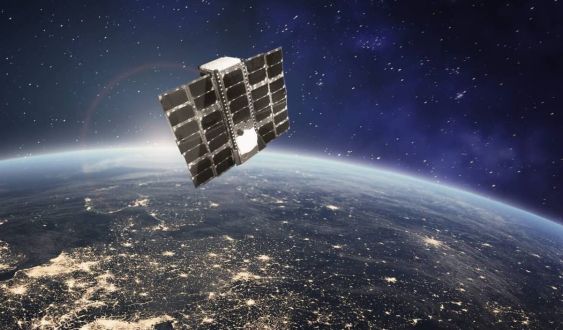
The launch will serve to complete the project of the startup Sateliot which, within its business plan, foresees managing a constellation of nanosatellites to operate in the Internet of Things (IoT), with 5G mobile coverage for all telecommunications operators in the world.
"Our idea is to have the first constellation of 16 satellites next year, to reach 64 in two years and 256 nanosatellites in orbit in 2025, to provide global service to operators worldwide", explains Jaume Sanpera, founder and CEO of the company, based in Barcelona. With the new satellite in orbit, the company will be able to begin the mass commercialization of its services, as it has pre-agreements signed with 46 operators in America, Asia, Europe, and Africa, totaling more than 1.2 billion subscribers. "We must be able to provide universal coverage to all objects in the IoT world", Sanpera specifies. They will do so through the services they will provide to operators so that they, in turn, can guarantee their customers the connection of devices with the full certainty that they will have universal coverage.The research and development of this startup has accumulated an investment of 20 million euros in the last five years.Last March, it closed a 10 million euro financing round, which facilitated the entry ofIndra and Cellnexin the shareholding, with 10.5% and 3.5%, respectively. The round was completed by other European investors such as the Danish software company GateHouse, which was already a strategic partner of Sateliot for its technology; the British fund Seraphim or the technology incubator Evonexus, from San Diego (California) ---an accelerator sponsored by Verizon and Qualcomm---. "We wanted to have a foot in the United States because investment funds there are larger, risk aversion is much lower, and investors are more capable of betting on companies in early development," Sanpera specifies and explains that next year a 50 million euro financing round should be opened and "we trust in European capital, but it doesn't hurt to also be present in the US." In addition, Evonexus haspartner to Verizon, one of the world's leading telecommunications operators with 5G. The CEO of Sateliot, Jaume Sanpera. However, for the full deployment of the network, an investment of up to 300 million euros will be necessary until 2025"Bearing in mind that the satellite sector requires a lot of initial investment but generates a lot ofcash-flow", Sanpera foresees that one or two more rounds of financing (of series B and C) will have to be made, but from the moment it enjoys a sufficient mass "it will generatecash-flowenough to renew and expand the satellite fleet", whose turnover will reach 1,000 million euros, according to forecasts. For 2022, turnover could be between 15 million and 18 million euros.The company has a staff of 22 engineersand another 45 people who workfull timeoutside the company because "we have divided all R&D development into sub-developments and are working with companies, institutions, and universities to advance faster.""We have the opportunity to create a great industry and develop the new space sector, which will change our way of life, just as the Internet changed it, in its time". Sanpera asks the administration for more resources to help develop the sector "because if we want the second Amazon, the second Google, to be in Spain, in Barcelona, we must invest because the competition is investing and putting a lot of resources to make this happen in their country." The CEO of Sateliot defends that Barcelona has potential because there ismany companies with a long trajectory that can also boost this sector. Sateliot's constellations will be formed by satellites orbiting in low orbit. The range of connection needs for Internet of Things sensors is almost immense, and even more so when talking about 5G. Sateliot will provide universal coverage becauseits constellations are formed by satellites that gravitate in low orbit ---at a distance of 500 kilometers from earth-- and are not static,are global and are homogeneous, so we can provide coverage anywhere, at any time, and every day." "As we have more satellites, we will increase coverage and frequency for information transmission," Sanpera assures. Therefore, the company can resolve any connection at an affordable price. "It must be said thatMassive Internet of Things makes no sense without Artificial Intelligence behind it, go hand in hand, because it is necessary to use data from all devices," explains Sanpera. The company is already working with some pilot tests and knows that its universal connection will favor, for example, some processes in agriculture and livestock, that it will be a very important source of geolocation, and that it can manage data with a very significant social impact.
Add The New Barcelona Post as your preferred Google source for free