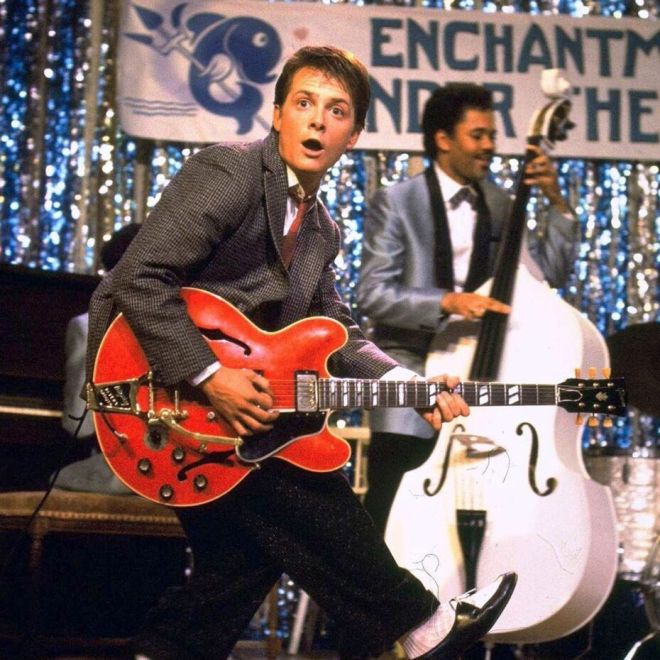
What do the mythical film Back to the Future and the history of rock music have in common? Much more than you imagine. Marty McFly, the character played by Michael J. Fox, stars in a scene where he performs a Chuck Berry song with a red guitar that was a revolution for many artists of the time.
In fact, as Juanjo Castellano told us, many of the artists who today fill stages started playing guitar thanks to the mythical scene in which McFly plays at the prom. A clear example is Jorge Salán from Mägo de Oz, who admitted that he fell in love with the instrument after seeing that movie and that, because of it, he started playing the guitar. "That movie was a real inspirational boom," Castellano tells us from the room of the temporary exhibition Ahead of their time.
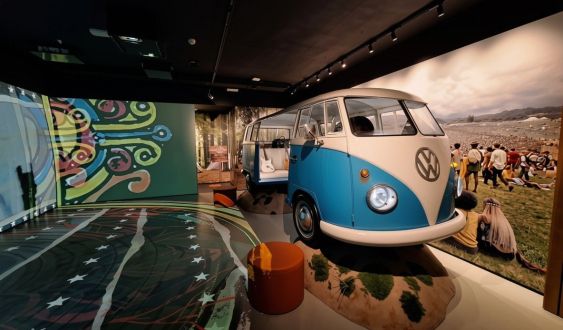
The Rock Museum now begins a new stage in which its founder has wanted to give rock the historical importance it deserves; therefore, the exhibition reviews the history of this musical genre, linking it to the sociopolitical context in which it emerged. We travel from the beginning of the genre in the 50s with the influence of blues, to the hippie era, passing through the 70s and the heyday of record labels, the 80s and the aesthetic revolution marked by MTV, to the last decades of the millennium, where artists began to perform in large stadiums and where other related genres such as punk or grunge appeared.
As Castellano tells us, "The objective is to show what rock music meant in the 20th century: a catalyst for cultural, political, and protest movements that absolutely impacted everything, from fashion and vocabulary to television and social expressions. We want to disseminate rock as the great social phenomenon it was."
The Sound History of a Revolt is the name given to the new direction this museum space has taken because, as Castellano explains to us, "In the museum, we don't just talk about rock bands, artists, or anecdotes, but we try to put the genre in context. Rock was not a catchy song or a guitar riff; it was a social and protest movement."
The guitar is the common thread of rock music
One of the most outstanding elements of the exhibition is, without a doubt, the prominence of the guitar, the instrument that unites all decades of rock and remains intact with the passage of time. Music can change, bands can change, the essence can change; but the electric guitar is still there. "The guitar in the 50s transforms blues into rock and roll when the instrument is electrified and a completely different sound is achieved; that is what truly makes rock evolve," Castellano recalls.
Walking through the museum halls, we find original and historic guitars that belonged to artists and were part of those key moments, such as the guitar of Pete Townshend of The Who, that of George Harrison of The Beatles, that of Jimi Hendrix, or of Gary Moore.
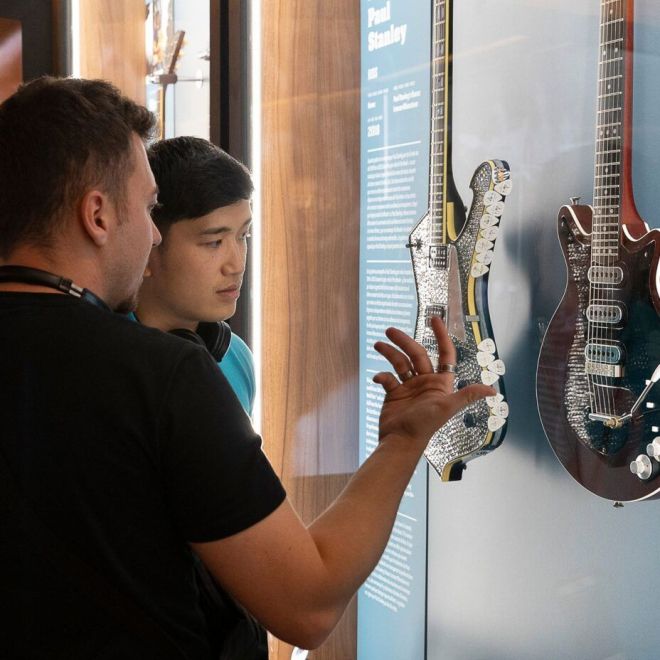
Castellano decided to found the Rock Museum in Barcelona to be able to exhibit the 70 guitars he had bought as a collector and had stored at home. "I thought it was a shame that they were kept in suitcases, closed and unseen by anyone. That's where the idea of setting up the museum came from." When you walk through the rooms of this space, you find authentic musical gems that are pure history; a clear example of this is the guitar of Pepe Roca, from the group Alameda, a very important instrument because it participated in a key change in music: it was part of the recording of Camarón de la Isla's album La leyenda del tiempo.
As Castellano tells us: "When you listen to the end of Volando voy or the song La Tarara, there is a small part of an electric guitar solo; Pepe Roca plays it with this very guitar, which is the one Camarón held in his hands. This piece revolutionized flamenco. From that album, along with Kiko Veneno and that whole generation, is when flamenco-rock was born."
Ahead of their time is the museum's temporary exhibition
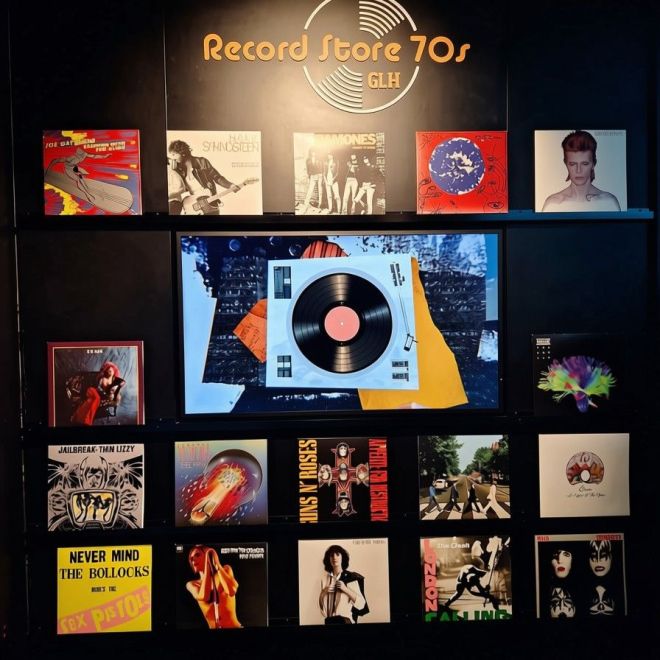
The visit to the Rock Museum is complemented by a temporary exhibition that will be renewed every five or six months. Currently, we find Ahead of their time, a review of those artists who, as the title suggests, were ahead of their time, either because of their musical style, their lyrics, or the messages they shared with society.
They were the "misunderstood" who, years later, became music icons, as is the case of Tony Iommi of Black Sabbath. Working in a metal workshop, he cut off the phalanges of his right hand fingers and, to be able to continue playing, he had to make himself some homemade prosthetics. That physical limitation forced him to press the strings in a completely different way, creating a much darker, denser, and heavier sound. "Basically, it was a work accident that invented the sound of heavy metal," Castellano tells us.
But, in this space we also find other artists such as David Bowie, Frank Zappa or The Rolling Stones (represented with a limited edition replica of Keith Richards' guitar); and groundbreaking women like Nina Hagen or Grace Jones.
A pioneering museum in Europe
The Rock Museum is unique in Barcelona and throughout Europe. Castellano tells us that there is a rock museum in Dublin (Ireland), but it is very focused on national Irish artists. The one we have in our city is much broader and covers the most prominent artists and groups globally.
"Our main goal is to make this space a nerve center for music in Barcelona; a meeting point for anyone passionate about this art. We want the museum to become a dynamic cultural engine, a place for recurrent visits for citizens and for all music lovers," Castellano emphasizes.
Our main goal is to make this space a nerve center for music in Barcelona.
A space that also wants to attract young people and students who want to broaden their cultural horizons and learn history with a soundtrack accompanied by guitars, long hair, and pure attitude. Because rock has always carried in its DNA being revolutionary, rebellious, and transgressive. It has been, without a doubt, the soundtrack of a great social revolt.
Add The New Barcelona Post as your preferred Google source for free
Stay informed with the latest news.