The Mountain can be seen at the Teatre de Lliure de Gracia until March 28, after its success in the last edition of the Grec Festival. It is a problematic and inspiring, ingenious and self-referential work, which pushes the viewer to become aware of their position in relation to a notion —that of "truth"— which, even sounding old, they will discover, in the course of the play, that they need, or to which they are not completely alien. The epochal diagnosis, the starting point, is unequivocal: today, artificially constructed information circulates, whose supposed veracity is endorsed by likes of dubious origin (they can come from accounts created ex profeso or from bots). How to distinguish truthful information from that which is not? At one point in the performance, the creators state that they themselves have carried out that exercise, consisting of spreading invented news, in the name of the project. Is this part of the theatrical fiction, or is it a really happened action? The question, beyond possible answers, reveals the suspicion consubstantial to the narrative voice, while focusing on the question of what gives a discourse credibility.
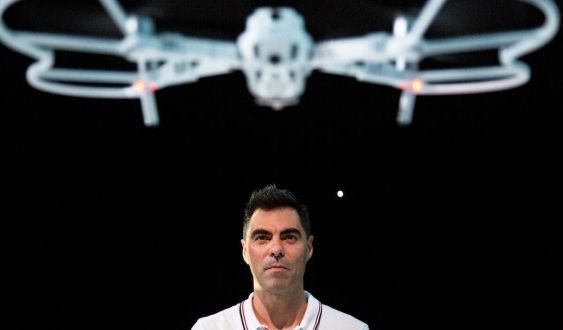
A considerable cast of technological gadgets is used by the four actors of the Agrupación Señor Serrano to make visible the manipulation of images, consciously perpetrated with a drone and a battle of cameras that select a parcel of reality to offer the final image. The potentially tendentious nature of the synecdoche, pars pro toto, is behind the manipulation that, with other means —and probably other ends— baroque art had already practiced.
In any case, The Mountain succeeds in showing that sensitive, real matter, lies at the base of every story, however fictitious or artificial it may be believed to be. Simultaneously, in this sense, the British expedition to crown Everest for the first time —who knows if truly successful— coexists with the action perpetrated by Orson Welles in 1938, when through radio waves he represented a passage from H. G. Wells' The War of the Worlds. It happened during a Halloween night, but that was not enough of a clue. Listeners experienced the certainty that an alien invasion was taking place.
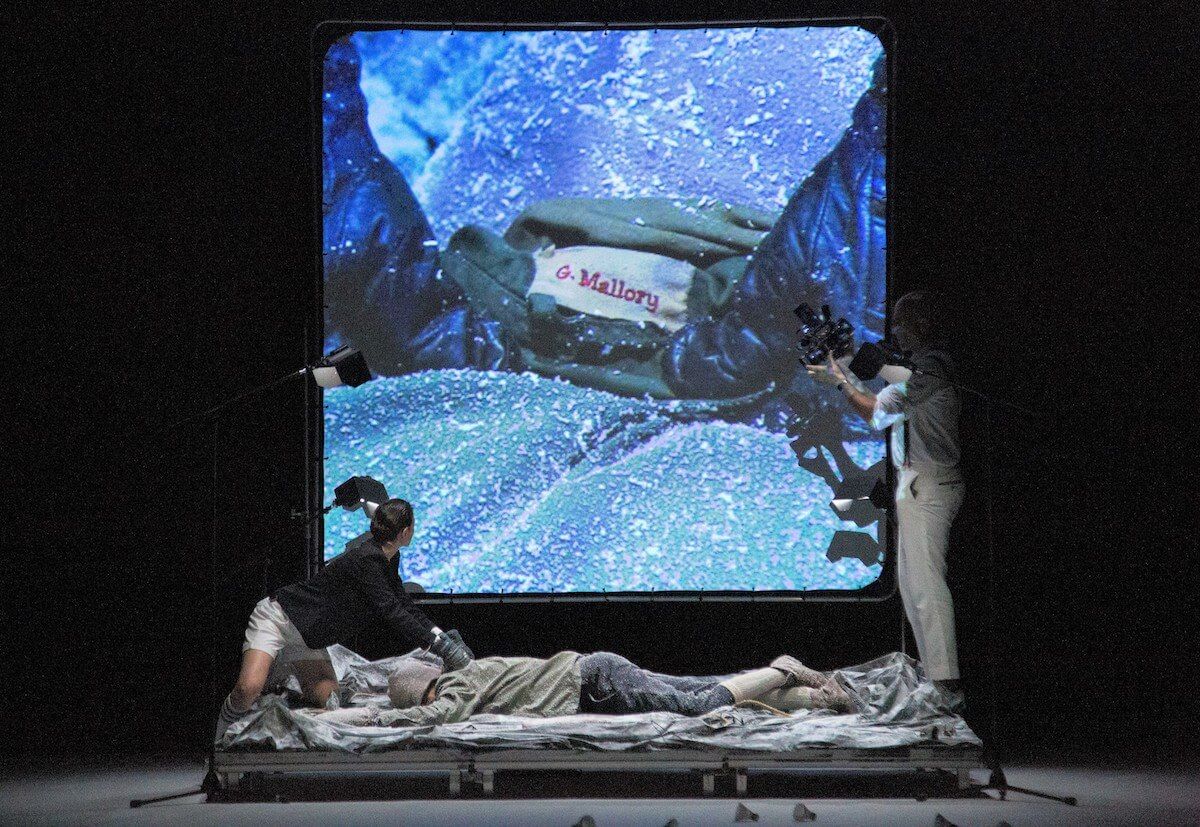
At the Teatre Lliure de Gracia, Welles himself appears on several screens, years after that false alarm, explaining the purposes of his youthful prank ---to unmask blind belief in unverified information---, in parallel to the narration of George Mallory's feat, the first who could have climbed Mount Everest in 1924. The mountain, that which is considered "the roof of the world," is the metaphor for truth. The total, absolute truth, which his beloved wife, Ruth, wants to achieve through philosophical means. Both are climbers, she writes to him. But did the epistolary exchange really exist? Did Ruth herself exist? We will affirm that she did, but perhaps the opposite can also be maintained, because it was not truly her voice that we heard. About Mallory's corpse, found a few years ago in a frozen state, the voice-over warns that only the camera and the image of Ruth that the climber carried were missing. Can we attribute the merit of his endeavor to him without graphic evidence? And, if we had it, would it be sufficient guarantee?
The questions tumble in a fascinating spiral, upon seeing the manipulation to which the members of the Señor Serrano Association consciously subject us, recreating the destruction of the war of the worlds with models, partial filming, and the action of that flying monstrosity, accompanied as master of ceremonies by a distorted image of the Russian president, after the narrating voice ---that of the actress who adopts his digital mask--- has invited us to consider her as a baseball player despite the evidence that she has been practicing another sport. As soon as they arrive at the hall, before taking their seats, spectators discover the four members of the performance exchanging racket strokes with shuttlecocks that come and go, with the characteristic sound of the air being combed and the front capsule hitting the ground, when it eventually falls.
The manipulation of the voice-over may not be new (it has been cultivated with special relish by creators like Lars von Trier in Dogville or Manderlay, accompanying with false objectivity the interpretation of everything that happens) but it works, it arouses interest and fuels reflection. The novelty can largely be found in the means employed on the occasion and in how these transform the message, without us being able to draw the clear and distinct boundary ---to use the Cartesian expression--- between what appears to be and what is.
Perceived reality is equated with imagined reality in the representation that each person, usually unconsciously, makes. The power of narrative lies in this way of processing information, which modern thinkers like Immanuel Kant had already discussed in critical terms ---delimiting the use and faith in reason. In this sense, philosophical inquiries are made explicit in The Mountain in the role of Ruth, who even mentions George Berkeley, to evaluate the property or relativity of reality as it is perceived. When a tree falls in the middle of the forest, what sound does it make if there is no one there to hear it? The game of trompe l'oeil ---the inherent equivocation in sensory experience, which on the other hand provides us with materials to determine what is, or what there is--- is not new, nor is the universal tendency to believe in the stories we tell ourselves about reality, precisely to understand it as such.
The actress and narrator, through the digital mask that partially conceals her appearance, not only offers equivocal or fallacious messagesWith a tonenaïfwe can bring up theThis is not a pipeof Magritte, or the terrifying "hat" drawn by the narrator ofThe Little Princein his childhood before the profound incomprehension of adults (it was a boa, in the process of digesting an elephant). At the other extreme, much less tender, we can recall the famous paintingThe Ambassadorsof Hans Holbein, housed in the National Gallery in London. A skull in anamorphosis tears the canvas inadvertently, hinting ---for those who know how to position themselves--- at the dark side of the explorers' enterprise; what truly awaits everyone, including those who seek fortune or fame enough to deny it, to transcend their time or simply live better. In the words of Heraclitus the obscure, "they dig much earth and find little gold," and on the path that leads to the end, perhaps they have already stopped living.
Digging one's own grave unknowingly, at the moment of maximum glory. Making the ascent of the mountain the end, and the end of temporal existence. Metaphors of the search for an absolute and saving truth that, sharpening modern criticism, postmodernity has replaced with a maximally relative truth, or as "consensus." As a provocation ---alluding to possible insufficiencies of democracy, especially in its digital aspect--- the narrator poses an almost childish, yet irresolvable question: is information with more likes truer than information that no one has seen, read, or voted for? Again, Berkeley. The actress, with a mask that partially conceals her appearance, not only offers equivocal or fallacious messages. She also practices flattery, calling the attendees educated, intelligent people with a critical spirit. That which sounds false ---at that point in the play--- at the same time appeals to an inner longing in each of us. Another "truth" she supplies, unexpectedly, is that which says that we tend to identify with and stick to the certainties that confirm "what we already think about things".
Stepping out of fantasy, or delving into it from another language, neuroscience has certified that that way of "thinking" ---based on unconscious prejudices--- takes place for reasons of psychological balance and therefore because it is an evolutionary advantage that facilitates self-preservation… at the risk of falsifying reality, with the notion of a single reality. The Mountain exudes an absolutely contemporary aroma, in the current context of infoxication, but at the same time refers to that tendency inherent to our species. It evokes so many situations in which sapiens sapiens ---as Nietzsche already pointed out--- demonstrates the deeply instinctive character of his rationality. Examples, in short, that illustrate the artificial nature of all representation. Or what is the same, the quota of ambiguity that accompanies truth, changing according to the perspective or plane of reality adopted. Or according to interests.
It is especially glorious, to conclude, the moment when one of the few narrators we believed reliable, Orson Welles ---respected for his artistic production and for the critical purpose of his manipulation, which he himself exposes before our eyes--- inserts into his discourse, with complete naturalness and without clashing, the word "Facebook". And the even more unexpected culmination, if possible: from nothing will finally emerge the mountain. Inconceivable. Or not? After all, it is a representation, titled ---as we knew from the start--- The Mountain. An unusual mass that blinks, onto which the battle of black and white flakes from old video recordings is projected. It vibrates before our eyes with a clear and distinct presence. And, yet, perfectly nonexistent.
Add The New Barcelona Post as your preferred Google source for free
Stay informed with the latest news.
