
I am sure that the finicky people in the world of culture who spend their afternoons flattering each other from the top of their ivory towers and the progressives on the administration's payroll who consider any private initiative perverse ---like a Hermitage franchise, for example--- will find the new Moco Museum in Barcelona horrifying. I'd bet the Picasso I don't own that they consider it too commercial, flashy, superficial... A contemporary art center that looks like a Bershka store where young people queue to see works by Banksy, Warhol, Basquiat, LaChapelle, Haring, or Hirst? No way, man! These types of museums should be cryptic and their rooms should always be deserted, because that's what we maintain them with our taxes for! A museum that shows how art merges with the most advanced technology (TeambLab, NFT pieces...)? A rip-off! A walk through contemporary art that ends with an immersive dreamlike experience difficult to forget (Irma Vries's Diamond Matrix)? If the public wants to experience, let them go to CosmoCaixa!
Well, yes, comrades. The Moco is all this and much more. I visited it for the first time on Saturday and left thinking that it is a great stroke of luck that Lionel and Kim Logchies have chosen Barcelona to open the second branch of their museum. I have read that they hesitated between the Catalan capital and Florence, but that, in the end, these two Dutch art collectors opted to open the branch here.
The Moco has produced a bit of the same effect on me as the Saatchi Gallery in London when I visited it for the first time more than twenty years ago. That is, when I was also just over twenty years old. Damien Hirst's more than four-meter shark preserved in a tank full of formaldehyde was, at that time, one of the sensations of the Saatchi, a space dedicated to contemporary art with pieces that explored or pulverized its limits. An art that provoked and scandalized. That made you wonder if everything they presented to you as art was not, in reality, a big joke.
The Moco does not go that far in terms of provocation, but I believe it is a type of museum that did not exist in Barcelona until now. Therefore, it not only completes the city's museum offerings but does so with a proposal that is clearly attractive to the general public. I want to briefly comment on four aspects that I particularly liked about this new facility:
1.- The public
One of the best things about Moco is that it knows how to attract an audience that I am convinced does not usually go to museums. When I entered the courtyard of Palau Cervelló and saw all those boys and girls queuing, I was stunned. Most were closer to twenty than thirty. It seemed to me that they were wearing very carefully planned outfits, I suppose to look good in the dozens of selfies they would take during the visit. They were the kind of people you can see queuing at the doors of H&M, every time the Swedish multinational launches an exclusive limited edition collection. In my humble opinion, that hundreds of young people decide that spending a Saturday afternoon in a museum is a good plan already seems to me a reason to applaud the arrival of Moco.
2.- The collection
There are few works and, evidently, the vast majority are not the most important ones their authors have made, but, as a whole, they are like an excellent trailer that encourages you to go to the cinema to see the full movie or like a good appetizer that whets your appetite. Because Moco, I believe, should do this: provoke a hunger for art. Let's face it: there aren't many people who, out of nowhere, become passionate about art after contemplating a succession of Gothic altarpieces at the MNAC, Tàpies' Mitjó, or, much less, the noble walls of a great art gallery full of portraits of kings and nobles from the year of the catapum. On the other hand, perhaps there are a few who, after visiting Moco, will feel like knowing more about Warhol, Basquiat, Murakami, or Dalí. People who, after contemplating Banksy's Forgive Us Our Trespassing ---one of Moco's big names--- will go back in art history and, perhaps, one day will end up ecstatic before the simplicity and strength of our pantocrator.
In my humble opinion, that hundreds of young people decide that spending a Saturday afternoon in a museum is a good plan already seems to me a reason to applaud the arrival of Moco3.- The space
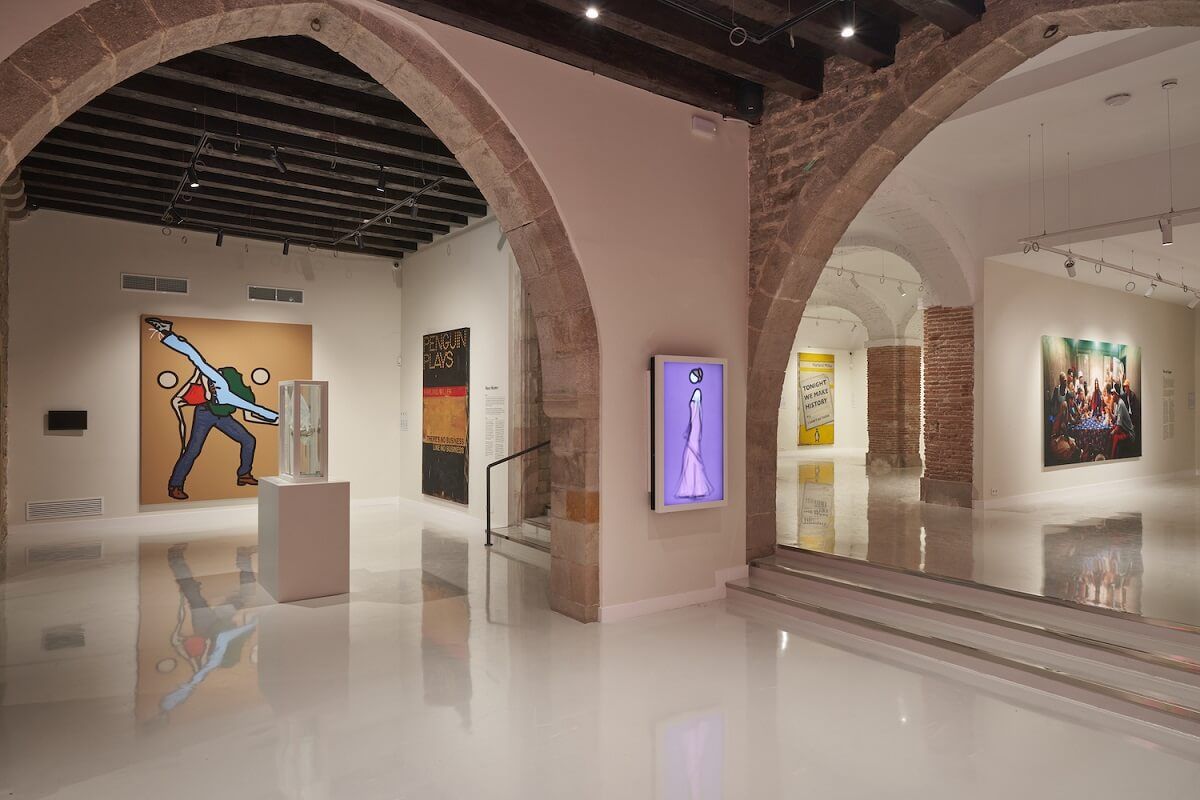
The Moco occupies the Palau Cervelló, located at number 25 Montcada Street, next to the Picasso and the Museum of Ethnology and World Cultures. What is most striking about the renovation that has been done in the palatial enclosure is the immaculate white floor that gives it a modern appearance and makes the pieces stand out. The entire museum breathes a spaciousness accentuated by mirrored walls and high ceilings. However, the large influx of public forces true balancing acts to manage entry to the rooms dedicated to immersive art. By the way, the museum's managers should thoroughly review the Catalan version of the explanatory texts because they are full of errors.
4.- The discovery
Without a doubt, Guillermo Lorca. The two rooms occupied by his enormous works made a great impression on me. Lorca is a Chilean artist who paints large-format paintings full of scenes as beautiful and luminous as they are perverse and disturbing, reminiscent of mythology and fairy tales. The Moco dedicates its first temporary exhibition to him, Splendor of the Night. Don't miss it!
Not all museums should be like the Moco, but I believe that, for Barcelona, it is fortunate to be able to add this new facility to its cultural offer. The Moco Museum Barcelona is a great showcase of contemporaneity: not only for the works it exhibits but also, and I think this is very interesting, for the public that admires them.
Add The New Barcelona Post as your preferred Google source for free
Stay informed with the latest news.