
For those who know nothing about the hypnotic figure of literary agent Carmen Balcells, they must begin by knowing that, if she liked a book, she would cry. According to her biographer, writer Carme Riera, her easy tears were accompanied by her ability to become the life of the party or be relentlessly tough to secure a good contract. The important thing was to get her to like you. And to have your astrological chart in your favor. Or, failing that, to have passed a graphological analysis.
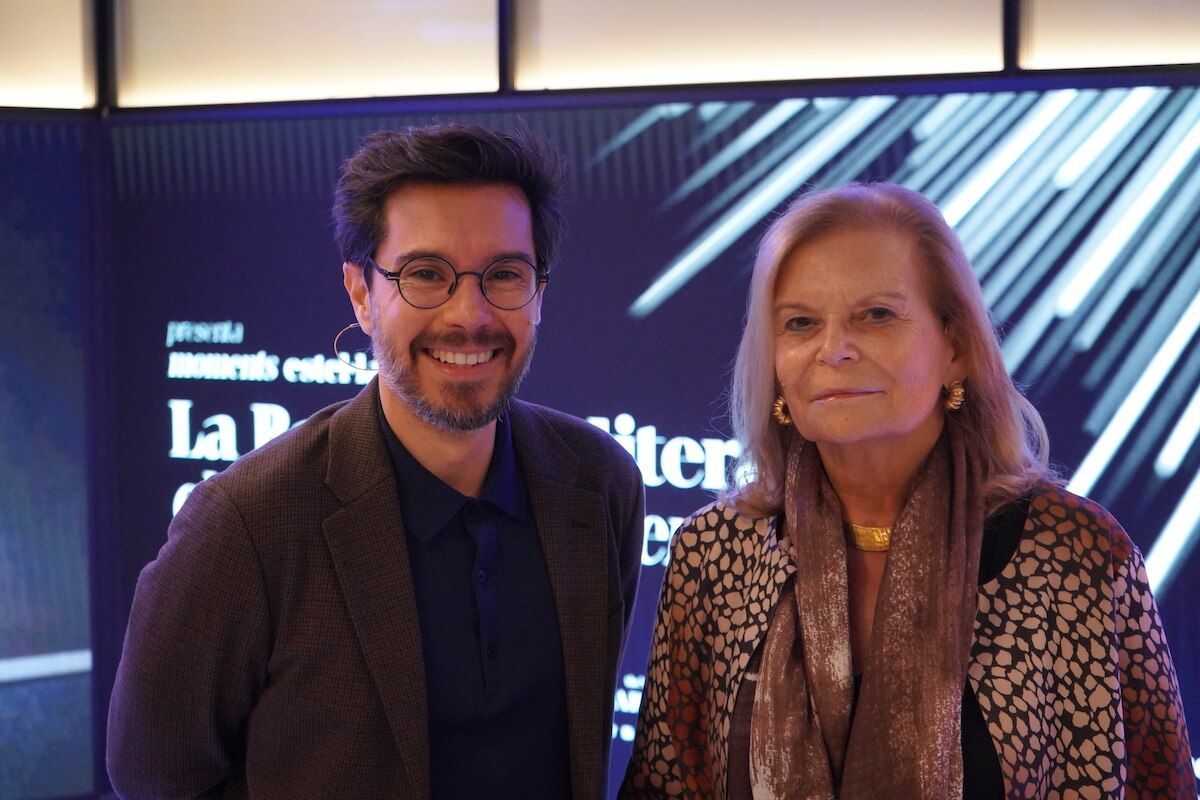
These are some of the infinite anecdotes surrounding the literary agent who fascinated a long list of writers, including six Nobel Prize winners, and put Barcelona on the literary map. Carmen Balcells (Santa Fe de Segarra, 1930 - Barcelona, 2015) had a life like a book and, as it could not be otherwise, it has been collected in Traficante de palabras (Debate, 2022), a biography that the protagonist would not have authorized. Despite this, Riera, one of the writers represented by Balcells, wrote it to contribute to her beatification, as she explained this Monday in a new session of the cycle The New Barcelona – Moments Estel·lars, organized by The New Barcelona Post, in collaboration with Must Media Group, CASA SEAT and Barcelona Global, and presented by journalist and UPF-BSM professor Toni Aira.
The writer, friend, and "client" of Balcells ---as the literary agent always defined her represented authors, even if she had a good relationship with them---, had plenty of material, especially being the lucky one who interviewed her for the first time, in 1982, although Balcells was completely disappointed. "She used to say that writers were the ones who had to speak and agents, to keep quiet," Riera recalls.
To get to know the literary agent well, Riera first had the good fortune of getting her to like her. Then, she passed another binding test: the fortune teller that the literary agent had on her payroll had done the astrological chart for her and her children, and there were no clouds in sight. There were some for whom she had their handwriting analyzed to know if she could trust them. Balcells not only believed in ascendants, but also preferred to sign contracts on the 7th, 17th, or 27th of each month. And, obviously, beware of salt and no number 13s. So, if she ever met with people and it happened that the total number of guests was that unfortunate figure, she would call her daughter to break the bad luck.
Once these unconventional procedures were completed, Balcells cooked macaroni, as Eduardo Mendoza recounts, or sent flowers whenever she could, for birthdays, name days, and whenever necessary. To Riera, she once sent them on July 26. "As if your name were Ana," the card said, because, of course, it was Saint Anne's Day and not Saint Carmen's, but it's never a bad idea to have a thoughtful gesture. There were some to whom she lent her house so they could write. She always had Dionisio, a taxi driver prepared for any situation, at the disposal of whoever needed him. And, if the washing machine broke, there were authors who would call the agency first instead of looking for the warranty. "Carmen, deep down, what she wanted to be was God," Riera summarizes, "she wanted to be up to the circumstances, even if it meant ruin... She had immense generosity."
It's hard to believe that someone like that wasn't a character imagined by authors like Gabriel García Márquez, one of the main writers whom, fortunately being flesh and blood, she represented. Although it started badly, that relationship ended up positioning the Catalan capital and shaping what became known as the Latin American boom. Balcells had heard about García Márquez and decided to go introduce herself. She traveled to Mexico in 1965. But the writer thought what she was proposing was "a shitty contract." The literary agent persisted and managed to get the Colombian to settle in Barcelona in the late 1960s. Mario Vargas Llosa followed, as did all his friends, including Carlos Fuentes.
Balcells had heard about García Márquez and decided to travel to Mexico to introduce herself. The writer thought what she was proposing was "a shitty contract." Fortunately, the literary agent persisted.Despite Barcelona being a gray city, in the midst of a dictatorship, Latin American writers found a Mediterranean capital where they could live comfortably, without being too expensive and close to France, according to Riera. "Carmen expanded the boom Latin American," her biographer points out. She did it because it united them, as writers in Spanish, without differentiating which country they came from.
Beyond the anecdotes, Balcells managed to change a sector characterized by draconian clauses, such as those that suffocated Spain's best-selling author, Corín Tellado, with a contract that tied her for life. The literary agent managed to get approval for what became known as the Balcells clause, allowing writers to fractionate tax payments when they received an award or a substantial advance. What she achieved was so miraculous that Balcells threw a party and went dressed as the Pope, distributing blessings among the attendees. If she wasn't God, she came close. Whoever doesn't believe it, ask the priest to whom she had given a computer. It had never worked until the day Balcells died. "I haven't been able to fabricate anything," Riera assures.
Add The New Barcelona Post as your preferred Google source for free
Stay informed with the latest news.