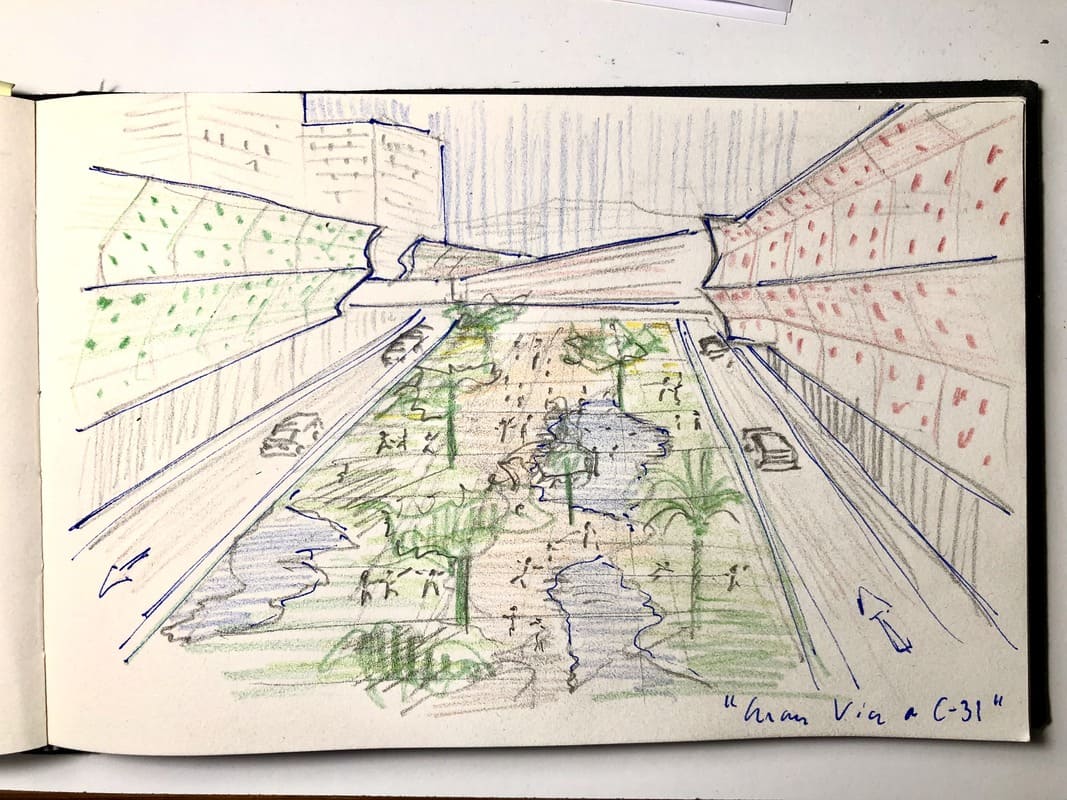
"Sara celebrates that for some time now we return home with dirty shoes after walking through the city, as when you come from strolling along the Gran Via de les Corts Catalanes, where a landscape has been recovered that one was not accustomed to despite being the original one. Of the old paved space, only a strip for non-motorized vehicles remains. The rest passes under a layer of green mass that isolates the passerby from external impact. In turn, it is a playful green, not merely functional. Today, walking along the Gran Via is doing so along a wide path of earth and stones combined with spaces for coexistence".
The utopian Barcelona is the result of conversations held with 5 municipal architects. Each of the conversations has revolved around a specific theme, although the result, a consequence of an integral vision of the city, incorporates transversal ideas. The idea for this series of 5 articles about a utopian Barcelona was born to give wings to these architects who maintain close contact with the city, some for many years and, moreover, daily. The creative scope of municipal architects is often limited by budget allocations, by execution deadlines, by the policies of the government in power… So, without entering into partisanship, they have ventured into the exercise of speculating about a Barcelona that will never exist, but that we can imagine.
The articles have a futuristic bent. However, not all of them delve into science fiction. The readings invite imagined locations and corners. To invented forms of the city. To projections of a Barcelona society far removed from the current one and, above all, they seek to give the reader a good time. With the exception of the text in italics, which is a transcription of part of the conversation or a research process, the rest is the fruit of imagination.
*Guest architect: Sara Udina, municipal architect of the Barcelona City Council.
Sara proposes we meet at the cliffside cocktail bar, where the Collserola mountain range meets the sea, a rugged stretch of coast of remarkable majesty at the height of the seagulls' flight. The cocktail bar is a renovated natural cave that was once inhabited by privateers. Inspired by Madrid's Angelita or Paris's Little Red Door, it is part of a new bar concept that is more affective than conventional ones to date; a bold commitment to artisanal and sustainable products that makes classics like Sidecar, Bloody Mary, or Cosmopolitan disappear from the menu. Hers is an invitation to proximity. A good part of the cocktails evoke childhood sensations from the eighties and nineties, such as quince, cilantro, carrot, chamomile, or homemade jams. Other details are not lacking, such as an atmosphere created from aromatic plants or the glassware itself, which has been hand-blown. Sara, recommended by the barman, orders a Holy Basil, based on basil, organic anae gin, and apple wine. I opt for an Olive, a cocktail of soda, Baldoria dry vermouth, and olive spirit.
In this urban space, we are special guests. It is a privilege to be able to live here. Sara begins by saying. Barcelona is no longer a city. We have finally accepted that this is part of a territory and we, humans, configure an environment. But not the other way around. Before, we inhabited this territory from a dominant perspective. And it was a mistake, because if we have been able to create this urban environment, it is because the territory has allowed us to.
Barcelona has known how to rethink itself. It has left behind the strong impact of the ecological footprint it accumulated over the years. It has even managed to create its own biocapacity reserve, that is, the ability to save the natural resources that supply the community. The ecological footprint is key to understanding what impact humans have on the environment in order to quantify the natural resources we have and use. In this sense, the implementation of control scales has made it possible to calculate the return we provide to the territory in exchange for the use of resources. It has been a long process. And it has been achieved through brave policies such as the deconstruction of a closed city model, without openings or real contact with nature. Also from the new concept, where public and private buildings are oriented towards the preservation of the environment and reconciliation for a more relaxed lifestyle based on coexistence.
The implementation of control scales has made it possible to calculate the return we provide to the territory in exchange for the use of resourcesBristol, in southwest England, was the prototype. Much of the energy it uses is generated from wind and water, among other things, to power the city's more than 34,000 streetlights. In addition, Bristol has managed to create a fabric that combines everything from large exclusive pedestrian zones in the center and surroundings, to an extensive bike lane or the restaurant industry's commitment to vegetarian and vegan offerings and local produce. Some buses even run on organic matter. The result is that in ten years they have managed to reduce their emissions by almost 40%. Not far from Bristol, another example of a commitment to biodiversity that goes beyond a proposal for coexistence for human beings is that of Brighton, also in the south, where the urban planning scheme requires new buildings to incorporate bricks designed to be nests for bees or swifts.
Sara highlights as strengths of this new Barcelona the city's capacity to recover rainwater that falls on covered areas, its aptitude to mitigate the heat island effect by rethinking streets, with 50% less asphalted surface, and the increase of native vegetation that generates shaded areas. It was shown that Barcelona, designed to make the urban environment more comfortable for people, ended up negatively impacting long-term aspects such as cardiorespiratory health and stress. For this reason, it has been crucial for cities like Barcelona to rediscover the territory on which they were built. This exercise of memory, of reconnecting large cities with their roots, has allowed them to abandon the egocentric focus on the citizen and rethink their relationship with the planet.
Sara celebrates that for some time now we return home with dirty shoes after walking through the city, as when you come from strolling along the Gran Via de les Corts Catalanes, where a landscape has been recovered that one was not accustomed to despite being the original. Of the old paved space, only a strip for non-motorized wheeled vehicles remains. The rest passes under a layer of green mass that isolates the passerby from external impact. In turn, it is a playful green, not merely functional. Today, walking along the Gran Via means doing so along a wide path of earth and stones combined with spaces for coexistence: urban furniture, cafes, kiosks, etc. Only if you delve into the thickness of nature and cross to the other side do you come into contact with the Barcelona that moves in a hurry and that is increasingly virtual. The Barcelona that, like other large cities, needs oases to return to reality.
For this reason, it has been crucial for cities like Barcelona to rediscover the territory on which they were built. This exercise of memory, of reconnecting large cities with their roots, has allowed them to abandon the egocentric focus on the citizen and rethink their relationship with the planet.From the Gran Via, similar branches emerge, though of smaller dimensions. All of this forms a network that crosses and surrounds the city, creating a natural space. The Gran Via is also the corridor of 22@, which, in addition to being the reference area for companies in the digital environment, is the global paradigm of cohabitation models in communes and of social and cultural activism. The 22@ has become an ecological and real alternative to a life governed by stress.The model that prevails in this area is cooperative housing, a model that promotes decent housing at an affordable price, as well as coexistence projects oriented towards energy saving, environmental preservation, and a lifestyle opposed to market dynamics.
This afternoon, after hanging clothes in the shared laundry room of the apartment block where she lives ---a model that has been normalized in Nordic countries for years--- Sara took part in a yoga session in the same district. When she finished, she sent me an email. She wanted to complement the conversation we had had in the cave: people have reconnected with the environment. This makes us now feel privileged by the place where we live and not by the way we live. Undoubtedly, this fact has an extraordinary impact on education and, therefore, on the future of the species and the planet.
Chapter 1. The mobility of the future. Guest architect Joan Sansa.
Add The New Barcelona Post as your preferred Google source for free
Stay informed with the latest news.