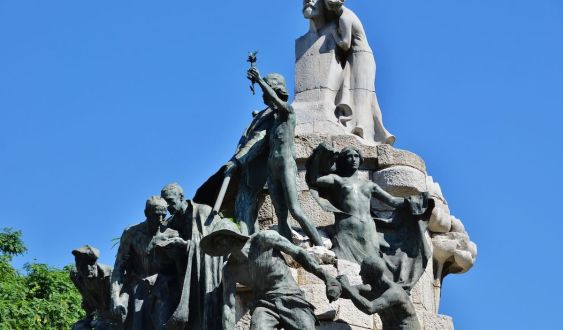
In the middle of a deserted island surrounded by cars and traffic lights, in the most absurd Tetuan square, the Monument to Doctor Robert today looks like an old object inherited from grandparents that no one knew where to put. In a way, that's exactly what it is: a work displaced by history. Dedicated to Bartomeu Robert, a prestigious doctor and mayor of Barcelona during the tumultuous period of the "tancament de caixes" (closure of cash boxes), the monument is much more than an individual tribute. It is one of our monuments with the greatest collective symbolism, with the greatest political charge, and with the greatest aesthetic power.
When Robert (born in Mexico, by the way) died suddenly in 1902, the city immediately turned him into a symbol. He had embodied an idea of civic dignity in the face of the State, a way of doing politics based on professional prestige and commitment to a city that was already tearing down walls. The popular subscription to erect a monument to him was immediate. It was not just about honoring a beloved mayor, but about raising an emblem of emerging Catalanism in full Modernist euphoria. A sweet moment in which society, politics, economy, and architecture went hand in hand (unlike now, where fear and laziness engender fearful and lazy architectural and urban products).
The commission fell to Josep Llimona, one of the most refined sculptors of his time (with the intervention, however, of Lluís Domènech i Montaner). The result, inaugurated in 1910 in front of the historic building of the University of Barcelona (near his house, by the way), was a set of notable iconographic ambition. From the outset, Gaudí's imprint appears unmistakable: in the bulging shape of the base and in the organic decomposition of the stone, a close relative of Casa Milà.
But furthermore, regarding the symbolism, there is not only the portrait of the doctor (a bust with a serene and contained expression, despite the kiss given to him by Glory): around him, allegorical figures of all social strata such as peasants and workers, politicians, intellectuals, and clerics (Jacint Verdaguer, with the Catalan flag), as well as allegories of Music and Poetry, and references to medicine (in fact, there is a whole recreation of a medical visit on the back). In short, the city, the people (if I may be redundant) and science. We are all portrayed in some way.
But also, regarding the symbology, there is not only the portrait of the doctor (a bust with a serene and contained expression, despite the kiss given to him by Glory): around him, allegorical figures of all social strata such as peasants and workers, politicians, intellectuals and clerics (Jacint Verdaguer, with the Catalan flag), as well as allegories of Music and Poetry, and references to medicine (in fact, there is a whole recreation of a medical visit in the back). In short, the city, the people (redundancy intended) and science. We are all portrayed in some way.
The monument, moreover, breathed modernism in its integral conception. Architecture and sculpture dialogued with a will for organic unity, with that white and pyramidal grotto shape, in tune with the aesthetic ideas of the moment. Certainly, our celebrated Antoni Gaudí also participated in the project, contributing criteria on the structure and the relationship between sculptural volume and architectural base. Although the main hand was Llimona's, that of the Great Architect of the Universe is undeniable. It singularly elevates it and, in fact, gives it a very opportune stylistic leap.
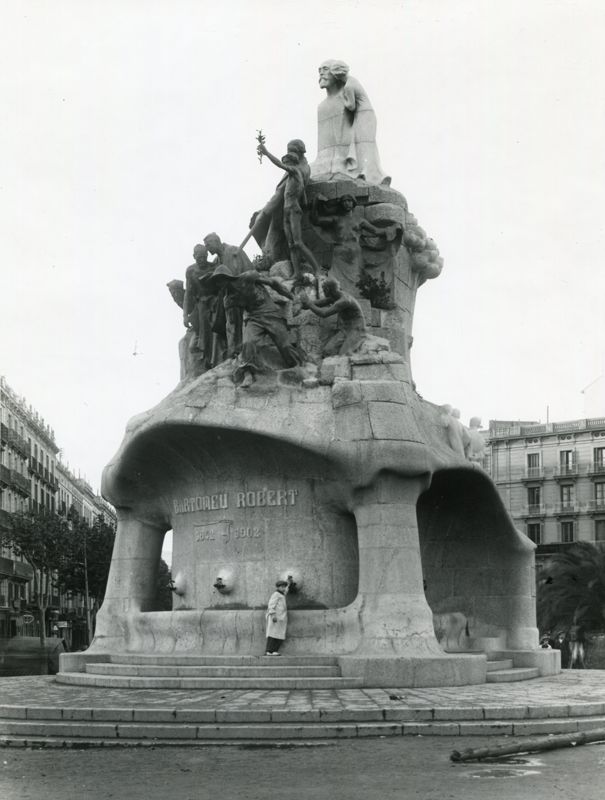
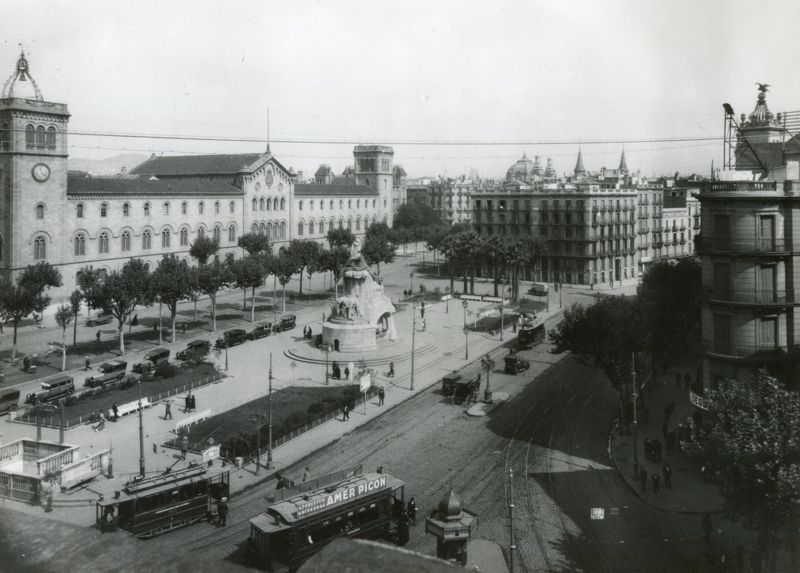
When it was located in Plaça de la Universitat, the ensemble dialogued with the academic space and reinforced the scientific dimension of the character. It was not an isolated statue, but a piece inserted into a scenario of knowledge. But history had other plans: in 1940, in the midst of the consolidation of the Franco regime, the monument was dismantled. The Catalanism it represented was incompatible with the new official symbology. The figures were removed, dispersed, condemned to a warehouse silence that would last decades. In fact, two bronze figures (a man whose hand the reaper shook and a flag) were melted down during the 1940s to create the image that crowns the Basilica of Mare de Déu de la Mercè.
It would not be until 1985 that the monument was restored, this time in Plaça Tetuan. The return had a reparative value, but the change of location altered the urban reading. Far from the original university setting, the work was now surrounded by incessant traffic, like a sculptural island drowned in the middle of traffic. The ensemble, designed for a serene dialogue with architecture, now had to survive the dense noise of Gran Vía.
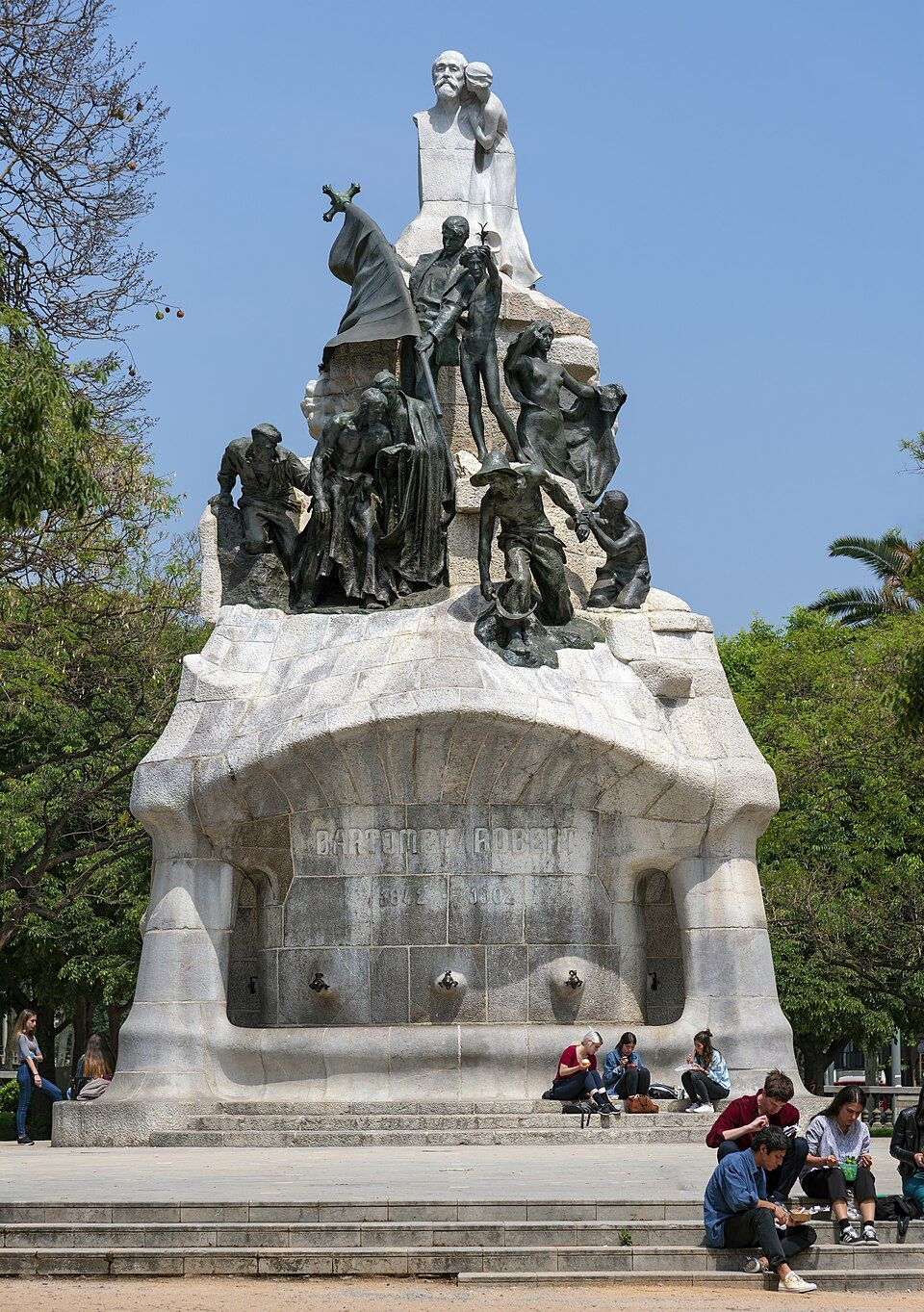
And yet, it is worth a visit: the iconography is still relevant, the allegorical figures continue to build a program. A city-town conscious of itself, the rootedness of Robert's leadership in citizen support, the true affection of the people. It is not a triumphalist monument, as the name of the "square" tries to evoke, but a civic one. It does not exalt strength, but service and collective complicity.
Today, what is most impressive about the Monument to Doctor Robert (besides its sculptural quality) is its resistance. Its imperturbable meaning and its impressive gathering of major artists. Like the character it represents, the monument has survived authoritarianisms and capricious changes of location. And sometimes, under one regime or another, we never quite measure up.
Add The New Barcelona Post as your preferred Google source for free
Stay informed with the latest news.
