
On Saturday, I noticed a woman in her thirties simply because she was wearing a sailor shirt. I discreetly scrutinized her from a safe distance and wondered if, that morning, when she had opened her closet to choose the clothes she would wear, she had opted for that garment without thinking, by pure chance, or if she had done it intentionally, premeditatedly. It could perfectly be that she had put on the classic white and blue striped shirt because she was running late and that garment was the one she had most at hand. But perhaps she had chosen it after trying on half a dozen other shirts in front of the mirror because she felt beautiful in it. Speculating further, we could imagine that the day before she had cut her hair à la garçon and, without quite knowing why, with that sailor shirt bought online at a bargain price, she felt like a movie star.
Since we will never know for sure why that stranger I met last weekend at CaixaForum Barcelona put on a marinière, I have decided that she did it in homage to Jean Paul Gaultier. The sailor shirt – as anyone who knows the fashion world even minimally knows – is one of the French designer's most iconic garments. Gaultier not only wears it regularly but has also turned it into a runway piece. Driven by his fascination with the sailor shirt, he even went further, and the bottle in the shape of a male torso for his first perfume, Le Male, also features this garment. With this, he connects the already mythical fragrance of the former enfant terrible of French fashion with the port eroticism of sailors turned into object-men.
But where does Gaultier's passion for the sailor shirt come from? Well, mainly from the discovery of Querelle, the captivating sailor played by Robert Davis in Querelle de Brest, a film released in 1982 and directed by Rainer Werner Fassbinder. A film that adapts the eponymous novel published by Jean Genet in 1947 along with about thirty erotic drawings of sailors that Jean Cocteau made for the occasion. A scandal for the time that cost Genet an 8-month prison sentence.
But Genet, why did he know so well these port and tavern environments full of sailors? Well, largely thanks to the years he spent running through the streets of Raval, the red-light district that was then also known as District V. Son of a Parisian prostitute, Genet settled in Barcelona in the 1930s and in the city's underworld he felt like a fish in water: he hung out with petty thieves and prostituted himself in the cabaret La Criolla. He also met Madame Petit, a more refined brothel on Arc del Teatre street and which, according to Paco Villar in Historia y leyenda del barrio chino, is the source of inspiration for one of the brothels that appears in Querelle de Brest.
Who would have told Jean Genet that the Querelle he imagined in the dives of the Chinese quarter would be brought to the cinema by Fassbinder and then Gaultier, after seeing it on screen, would turn the simple sailor shirt into an iconic and fetishistic garment?
Perhaps the girl I mentioned at the beginning of this article was not aware of the multitude of literary and cinematographic references her t-shirt contained. In fact, perhaps she didn't even know that with that short hair and that marinière she bore an astonishing resemblance to Jean Seberg in Breathless. Don't you think this pulling on the thread of culture is a fascinating journey?
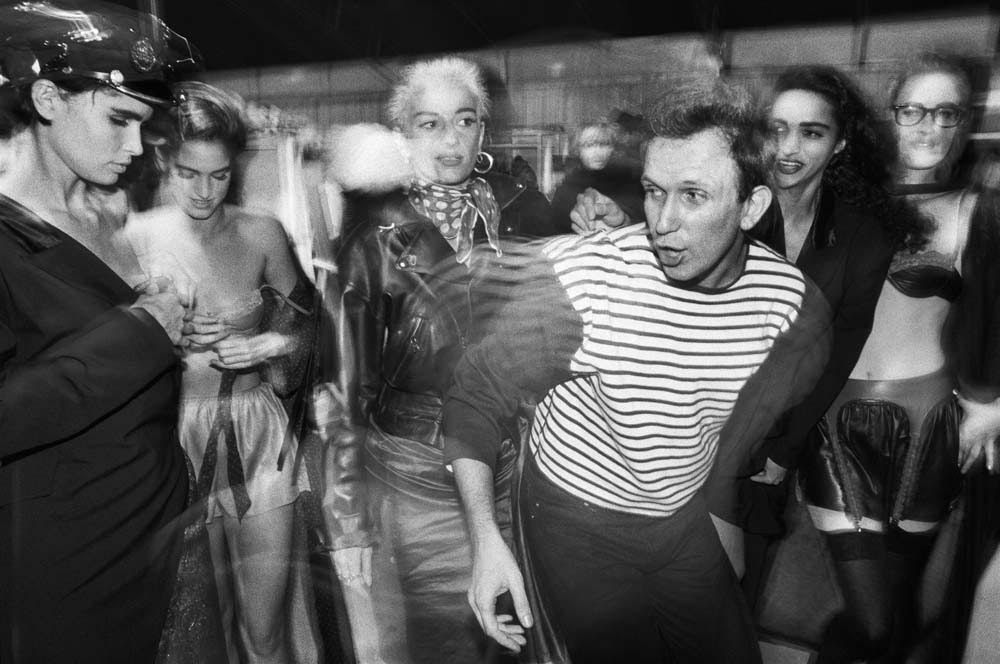
The wonderful exhibition Cinema and Fashion. By Jean Paul Gaultier is precisely about that. About the relationships and influences between the film and fashion industries, but also about how they become a reflection of their time. Gaultier acts as co-curator and artistic director of an exhibition organized jointly with La Cinémathèque Française that brings together a collection of garments consisting of costumes, posters, photographs and film fragments of great magnetism for anyone who is minimally a mythomaniac. The rooms of CaixaForum Barcelona transport you to a haute couture runway and Hollywood studios. Creations by Coco Chanel, Balenciaga, Pierre Cardin or Sybilla –by the way, where has Sybilla been these last few years?– and cinematographic looks that have gone down in history such as those worn by Marlene Dietrich, Sharon Stone, Grace Jones, Catherine Deneuve or Victoria Abril and Antonio Banderas in some memorable films.
You still have time to see it –the exhibition closes its doors on October 23–, don't hesitate to go!
Add The New Barcelona Post as your preferred Google source for free
Stay informed with the latest news.