
The Generalitat has made a U-turn in its patrimonial policy in the face of a volatile real estate market with rising rental prices and complex management. After selling many of the properties it owned in Barcelona due to the economic crisis, the Catalan administration wants to become a major owner again and have almost 70% of the buildings that its workers will occupy in the next 15 years in its portfolio. For the Minister of Economy and Finance, Natàlia Mas Guix, this is "a 180-degree turn" that will serve to reduce rental expenses and free up resources for the provision of public services.
Between 2012 and 2014, the Catalan administration sold a total of 40 properties located in the city, with the aim of obtaining income and reducing the public deficit. By obtaining liquidity, it has gone from owning 63% of the buildings in 2012 to only 22% in 2023; in the same way that leased properties have grown, from 22% in 2012 to 63% this year. The forecast now is to reduce leasing to 13% and increase ownership to 68% by 2038.
To this end, the Generalitat plans to build new buildings, primarily on land it owns or that of other institutions, but also to rehabilitate and optimize those it already occupies, with a global return on investment forecast ---without specifying--- in less than 10 years. This new policy responds to the need to relocate nearly 11,000 workers in the next 15 years, when current rental contracts expire.
In the first group, about 145,000 square meters are expected to be built, with capacity for 10,000 civil servants. This includes an office tower that will be integrated into the expansion project of the Gran Via de Fira de Barcelona complex. With an area of 25,000 square meters and capacity for 1,200 workers, the Catalan administration will be the main tenant and will share space with the fair institution. This building will have a budget of 68 million euros and is expected to be completed in 2027.
With the new office tower projected in L'Hospitalet de Llobregat, the Generalitat's commitment to the Paseo de la Zona Franca will be reinforced, concentrating more than 6,000 civil servants, moving away from the current dispersion, with 20,000 public employees spread across a hundred buildings in the Catalan capital. Currently, the Generalitat's Administrative District is already located in this area, where workers from the Department of Economy and Finance and Justice went when the buildings where they were located were sold, totaling some 3,400 public workers. Also located there are headquarters of the Catalan Tax Agency, the territorial services of Education, the Catalan Waste Agency, the Telecommunications and Information Technology Center (CTTI), the Open Administration Consortium of Catalonia (AOC), the Catalan Cybersecurity Agency and the Medical Emergencies Service (SEM).
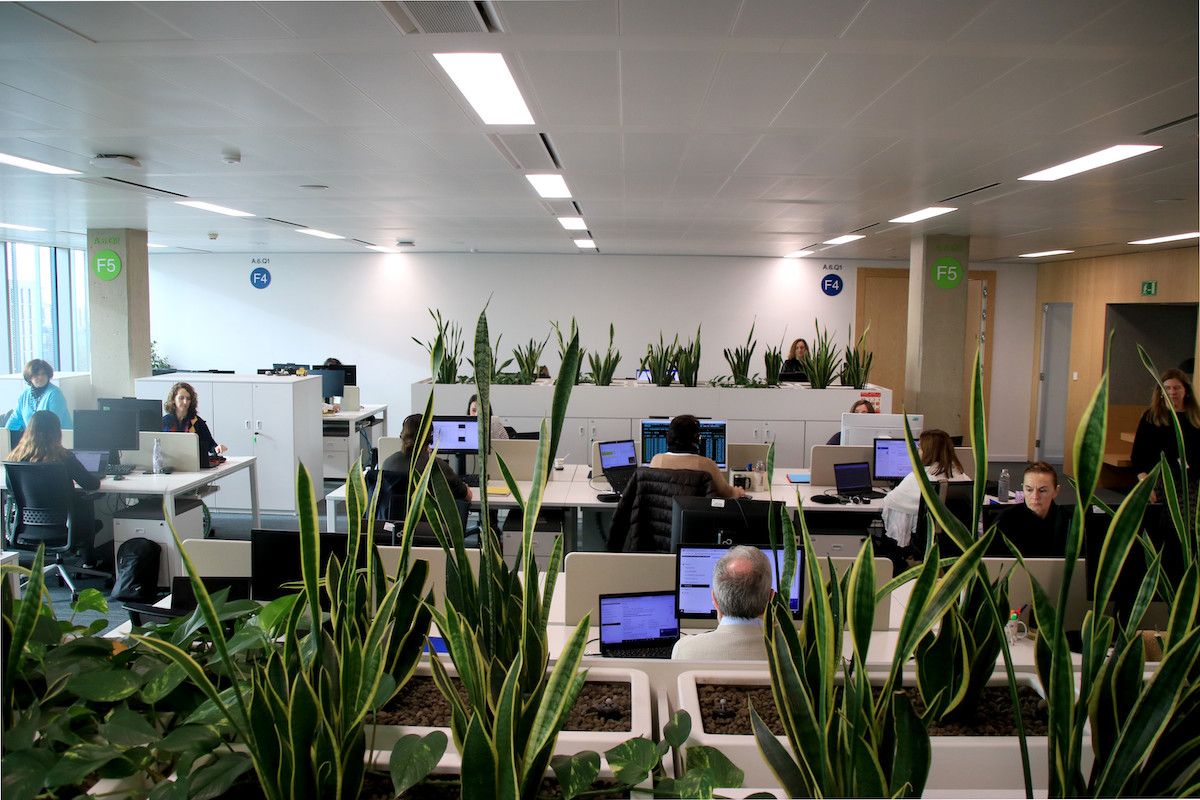
The Catalan administration also plans to transform the oldest buildings it occupies towards a new office model, in line with the Administrative District in the Marina de Port neighborhood, criteria that will also be incorporated into new constructions. Taking into account that Generalitat civil servants generally telework two days a week, the aim is to optimize space to accommodate the maximum number of workers. As is happening in the private sector, there will be a move towards offices without assigned spaces, fewer desks and open-plan, where there will only be offices for senior officials. The aim is also to promote collective and flexible spaces, eliminate paper consumption and guarantee energy efficiency. Currently, some 6,500 public workers are assigned to already transformed properties.
Add The New Barcelona Post as your preferred Google source for free
Stay informed with the latest news.
