
On the grounds of the old hospital laundry, the new headquarters of the Vall d'Hebron Institut de Recerca (VHIR) has opened its doors to boost research and respond to medical challenges such as advanced therapies, immunomodulation or the use of data and artificial intelligence (AI), as well as to attract talent. "It offers us many opportunities for the future," defends its director, Dr. Begoña Benito. Offices, laboratories and scientific infrastructures such as a cyclotron are fitted into the newly completed building, which will have capacity for 600 researchers and will serve the institute's 2,000 workers. It is one of the first pieces to be unlocked from the healthcare complex, immersed in an expansion and modernization process, with a global budget of 300 million euros for works expected to be completed by 2030.
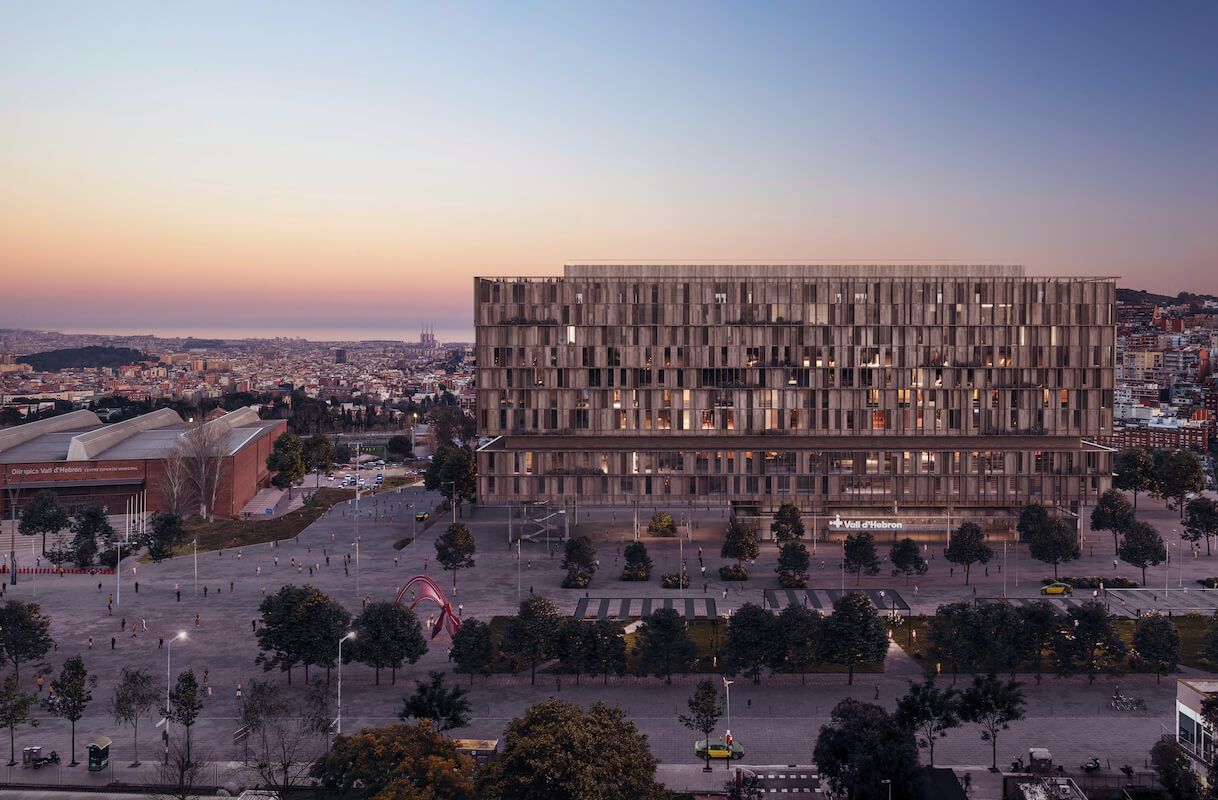
After an international architecture competition was called in 2017, the VHIR building, designed by local firms BAAS Arquitectura and Espinet/Ubach, features spacious and open areas, as well as plenty of natural light. Located between the teaching building of the Universitat Autònoma de Barcelona (UAB) and the Hospital de Traumatología, the first stone was laid at the end of 2021 and the works have extended until the third quarter of this 2024. Once completed, the relocation of the first research groups began in September, with the forecast of having finished moving all of them before the Christmas holidays.
The budget has been a total of 43 million euros ---40 million euros for the construction of the building and 3 million euros to equip it with the necessary technology---, with contributions such as a loan of about 17 million euros from the Generalitat, three million euros from the "la Caixa" Foundation and 250,000 euros from the pharmaceutical company Ferrer, as well as VHIR's own resources, Feder funds and private donations. To these figures, we must add the almost 20 million that have been invested to incorporate a cyclotron, a type of particle accelerator that allows finding new diagnostic tools and personalized treatments, with examples such as drugs to treat cancers. In this case, the resources come from European funds.
Until now, VHIR researchers were distributed between the Mediterrània and Collserola buildings of the Vall d'Hebron Campus, separated from each other and with only 4,600 meters for the institute's staff. With the new headquarters, it reaches almost 17,000 square meters, which implies a 300% growth in the surface area dedicated to research within the university hospital's facilities. In addition, the space for laboratories is doubled, with more than 5,500 square meters. The bulk of VHIR researchers will be installed in this space, but some groups, with up to 200 researchers, will remain in the Collserola building, behind the new center.
In addition to the laboratories, located on the first and second floors, the VHIR facilities have an underground floor where there will be scientific infrastructures that will serve researchers. First, the cyclotron, which will focus on gene therapy, will have 810 square meters. Then there will be an advanced therapies center, with more than 200 square meters. The building also wants to open up to the public, with activities to promote dissemination and teaching. At the very top, a green roof offers a resting space.
In a future phase of development, VHIR will host an innovation hub, where spin-offs, biotech and pharmaceutical corporations, and investors are intended to be housed under one roof, a model that is expanding throughout the city after success stories such as the Pier buildings of Tech Barcelona or the Barcelona Health Hub. It will be in the same building, in an area yet to be built, with more than 2,200 square meters. The institute is working on defining what it will be like, with the forecast of having the project finished next year and having completed the works by the end of 2026.
The future Vall d'Hebron
With the aim of improving its healthcare and urban integration, the public center, a small city through which 50,000 inhabitants pass every day, undertook an expansion and update project seven years ago. With a total area of about 125,000 square meters, fenced and not very accessible, the campus wants to open up to its surroundings, as well as modernize buildings built years ago and improve the internal functioning of a complex in which the hospital itself and the VHIR coexist, but also the Vall d'Hebron Institute of Oncology (VHIO), the Multiple Sclerosis Center of Catalonia (Cemcat) and the Autonomous University of Barcelona (UAB). In addition to the VHIR headquarters, a space that has already been completed is the new helipad, which has reduced the time from when the patient lands on the runway until they enter the emergency room to two minutes.
One of the essential pieces of the future Vall d'Hebron will be the new adult outpatient care building, which will concentrate almost all outpatient services, until now dispersed throughout the complex. The new outpatient clinic, with 250 consulting rooms spread over ten floors, is estimated to involve an investment of 70 million euros and will be located on the other side of the Ronda de Dalt, in the Teixonera neighborhood, just in front of the General Hospital. It will be built on a municipally owned building, known as La Losa. This project had been somewhat stalled and has been reactivated, after the announcement by the Government and the City Council last week to tender the work corresponding to the first phase of the expansion, for an amount of 40 million euros.
Add The New Barcelona Post as your preferred Google source for free
Stay informed with the latest news.
