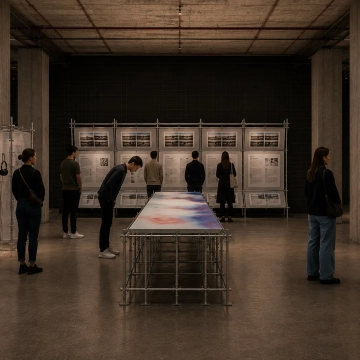
It is a grey autumn day in Barcelona. The kind of day when the leaden, heavy sky invites introspection and quiet melancholy. So I make my way up Montjuïc to the Fundació Joan Miró, carrying with me the sense of unease that certain gloomy mornings can bring. Yet, as I cross the threshold of this white building designed by Josep Lluís Sert — a friend and colleague of Perriand's since the days of Le Corbusier's studio and the CIAM congresses — the atmosphere changes dramatically. Inside, a diverse crowd of visitors moves through the exhibition, captivated by bursts of colour, wood and metal that seem to stand out more vividly than usual against the building's understated backdrop.
I am here to visit Charlotte Perriand. The Freedom to Rethink the World, the first major solo exhibition in Spain dedicated to the legendary French architect and designer, running from 9 October 2026 to 28 February 2027 at the Fundació Joan Miró in Barcelona. Before stepping into the galleries, I am overcome by a mixture of fascination and astonishment, as I can already picture the iconic pieces that I recognise.
There are pieces of furniture, chairs and shelving designs that I have encountered before — sometimes in design books, sometimes in architecture and interiors magazines — and I realise something unsettling: for years, I had simply taken it for granted that many of these works had been conceived by a man.
"For years I took for granted that many of these works had been conceived by a man"
This revelation stings. It deeply saddens me to see how much Charlotte Perriand's figure was eclipsed by the long shadow of Le Corbusier. I clarify that the work of the celebrated Swiss-French architect fascinates me and has always seemed brilliant; it is not about denying his genius. But it is painful to recognize how the historiographical canon systematically tended to relegate women creators to the role of secondary collaborators or muses, reducing their authorship to a mere footnote in the great workshops of the 20th century.
This exhibition at the Miró precisely comes to readjust the balance, granting the space, volume, and light that correspond to a pioneer without whom the act of modern living simply would not be understood.
The exhibition itinerary is not limited to displaying objects, but rather proposes an intellectual and, above all, vital journey through the geographies that shaped Perriand's sensibility. In this journey, her stay in the Balearic Islands is particularly curious and revealing to me. In the summer of 1932, Perriand decided to circumnavigate the coast of Mallorca by canoe, an initiatory journey that put her in direct contact with the Mediterranean, its light, its popular craftsmanship, and the rotundity of organic forms.
It is fascinating to recognize how the observation of stones polished by the sea, driftwood —what she called objets trouvés or "art brut"— or vernacular island architecture infused her initial work with a unique warmth and a sensibility towards raw material in its pure state.
However, this primordial organicism did not remain a simple taste for the rustic. As the exhibition progresses, one perceives how this initial influence filtered and transformed into a kind of rigorous order, a functional geometry. This evolution is marked by her intense creative exchanges with the painter Fernand Léger —with whom she shared a deep friendship and a vision of art integrated into daily life— and by her contact with the Soviet avant-garde during her stay in Moscow.
Perriand understood that design had to respond to the real needs of society, an ideal of democratization where the inhabited space directly influenced the emancipation of the individual.
But if there is a geopolitical and vital milestone that definitively reconfigured her plastic language, it was her departure to Japan in 1940, just at the beginning of the Second World War. Invited by the Japanese government as an industrial art advisor, Perriand discovered there a universe where the economy of resources, spatial flexibility (sliding panels, tatami), and respect for natural material reached absolute mastery.
The oriental imprint on all her subsequent production is dazzling: she learned to intertwine bamboo with chrome-plated steel and to conceive space not as a rigid box, but as an articulated and fluid void.
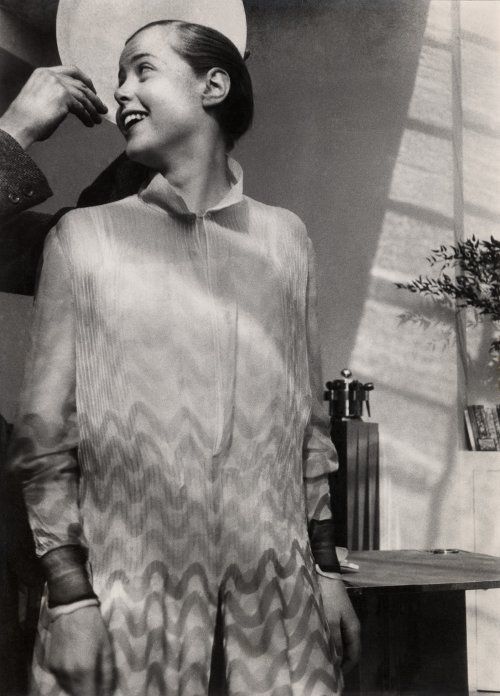
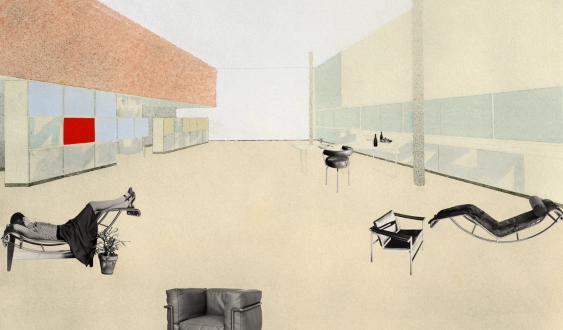
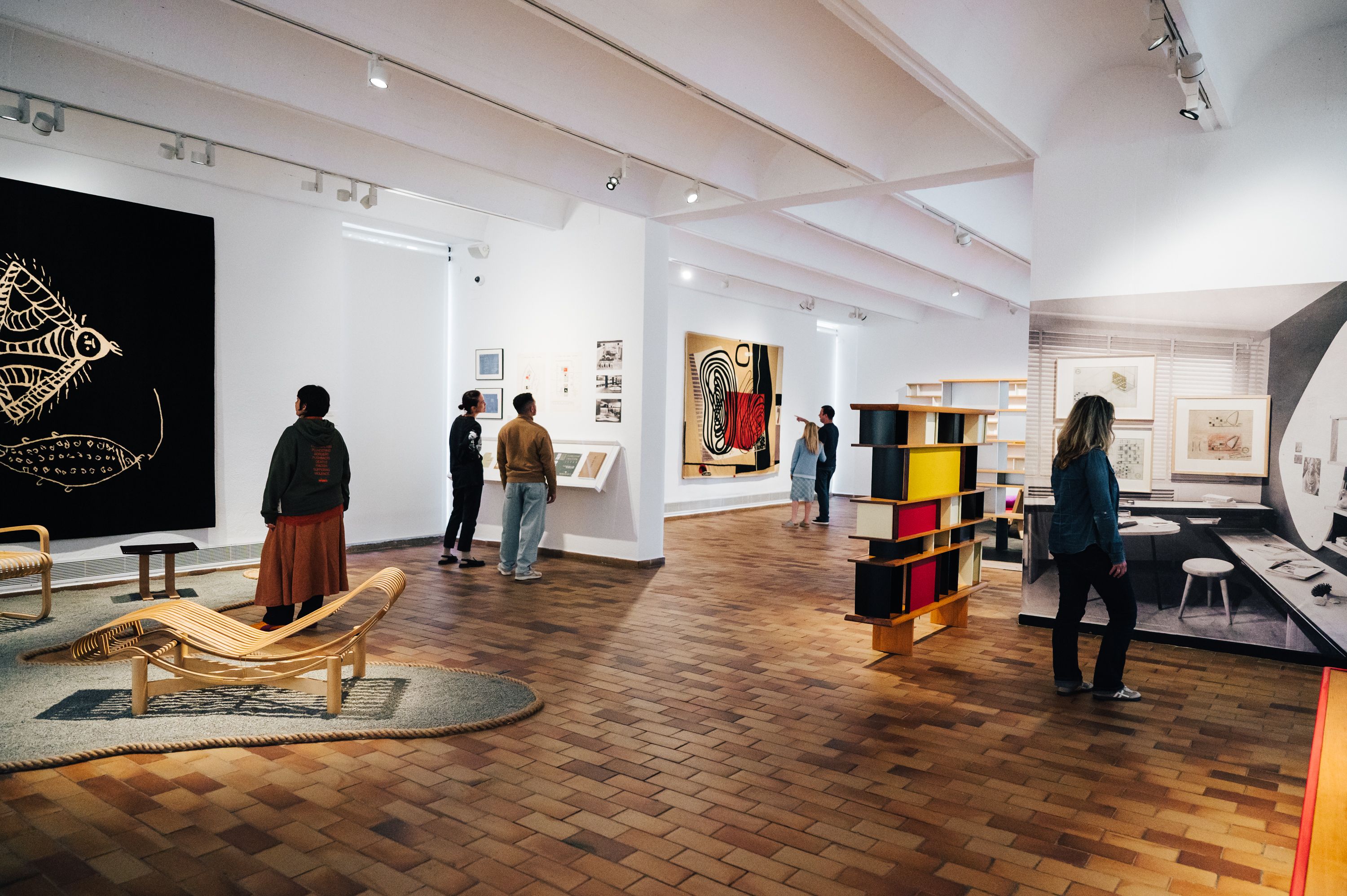
Descending to the lower floor of the Miró Foundation is, without a doubt, one of the most stimulating experiences of the visit. Here the exhibition abandons contemplative distance to become experiential. The space houses careful reproductions and historical prototypes of her most emblematic pieces: from the mythical chairs and armchairs to the very famous Chaise Longue LC4 (so often attributed exclusively to Le Corbusier and Pierre Jeanneret, when the human touch and ergonomic lightness came from Charlotte's hand).
What leaves me utterly fascinated on this floor is a kind of habitable, full-scale recreation that evokes her innovative minimal housing modules and prefabricated interiors (such as her famous projects for university residences or mountain shelters developed alongside Jean Prouvé and Pierre Jeanneret). It inevitably reminds one of the best modules of contemporary Ikea-type exhibitions, but with an elegance, warmth, and architectural precision that current mass design rarely aspires to.
Perriand thought about ceiling heights, about the rotation of arms when cooking, about the natural light that should bathe a work table, and about how to optimize every square centimeter without suffocating the gaze. Seeing this standard of "art of living" (l'art d'habiter) designed so many decades ago provokes deep admiration. Back then, real modernity did not consist of superfluous luxury, but in the dignity of everyday space.
"Real modernity did not consist of superfluous luxury, but in the dignity of everyday space"
In this section, I once again highlight the vital importance of curating exhibitions like this one. It gives deep satisfaction to see how cultural institutions are beginning to give the space they deserve to these great creators who did so much for contemporary architecture and interior design. Women who, despite facing the institutional disregard of their time, never gave up the freedom to create or the ambition to transform the world through design.
I leave the exhibition comforted, but also with a pang as I remember my own domestic environment. As I observed the wonderful modular storage units (the famous Nuage shelves created for the Maison du Brésil or the Cité Universitaire) —where the colored aluminum sliding panels organize the space with a mathematical and almost poetic harmony— I couldn't help but think about the state of my own home.
At this moment, as I write these lines watching the last lights of this gray day fall, I contemplate the mountain of stacked books overflowing everywhere in my home. What wouldn't I give to find a bookshelf like Charlotte Perriand's.
A piece of furniture that not only supports the weight of the pages, but also brings to my daily chaos a bit of that freedom, that intelligent order, and that luminous beauty with which Perriand demonstrated that inhabiting a house is, in essence, a noble and free way of rethinking the world.
Add The New Barcelona Post as your preferred Google source for free
Stay informed with the latest news.