
A cliché (in this case false) persists about Barcelona, according to which ours is a city that has produced little literature. In fact, there are many neighborhood culture vultures who still pontificate about when "the great novel of the city" will arrive, ignorant of the fact that it already exists, and could be titled Vida Privada or La Plaça del Diamant, or that the streets and interior courtyards of the Eixample are the main character and the narrative cause of one of the most important works of Catalan philosophy of all time: El Canvi, by Miquel Bauçà. The prejudice also overlooks one of the spaces where Catalan literature can be equated without any complex to the great European prose; namely, journalism. In Barcelona, the Bible and guide for anyone who wants to learn to use adjectives, El Quadern Gris, is conceived, and from its corners also comes Ors's Glossari and the extraordinary literary journalism prior to the Civil War.
The richness of all these works I have cited is not only comparable to the best of continental literature, but in the case of journalistic literary prose, it is far superior in ambition to Joseph Roth's German prose or the admirable Chaves Nogales's neighboring prose. In the case of the novel, this frenzy that demands a "great work" expresses our sickly and dreadful modesty, and also the prejudice according to which good literature is only hidden in large tomes like those of Balzac. This comes to mind to remind us of something as basic as that caviar is often found in the corners of the press and in works of apparent modesty, which is evident while reading El senyor Palomar a Barcelona (Anagrama), a book that Barcelona-native Tina Vallès gave birth to in attempts written in the frivolous magazine Time Out and that has evolved into a literary project of great ambition.
With a vaguely drawn identity and profession, Palomar lands in Barcelona in August 2019, after having lived from city to city with his wife and daughter. We know he returns to stay and we follow him on micro-explorations through the city until July 2020. In this temporal arc, Vallès precisely weaves the portrait of a re-dimensioned flâneur through an intentional lack of observation and comprehensive voracity ("he is a slave to a present that he always carries by the arm, and when he tries to take a step forward to turn around and observe with perspective, time catches up with him again to make him understand once more the complexity of the world"), a neurasthenic being (the dictionary says; weak, unable to exert himself, inattentive and yet somewhat irritable) who walks through the streets experiencing national decadence with an anger as uncontrolled as it is liquid, a source of parsimony, frustration, and decay.
Unlike the dandy, who finds meaning in the contempt of the crowd, Palomar observes the large political demonstrations of the post-procés with an almost naive indifference ("he cannot see any certainty in this constellation of people, and little by little his eyes want to flee towards the darkness of the sky, not to see the stars, but to get lost in the obscurity"). If he had described the micro-journeys of a simple onlooker disenchanted with life, Vallès's book could have fallen into cliché or tedium. But hand in hand with Calvino, the character's putative father, he indirectly describes the image of a city tired of itself, still living nostalgically for a faded Olympic glory, a city where the maximum quota of happiness we can afford are the (excellent) forquilla breakfasts, roast pork and artichokes, from the Gelida winery or contemplating the still life of furtive kittens and mutant trees in the parks.
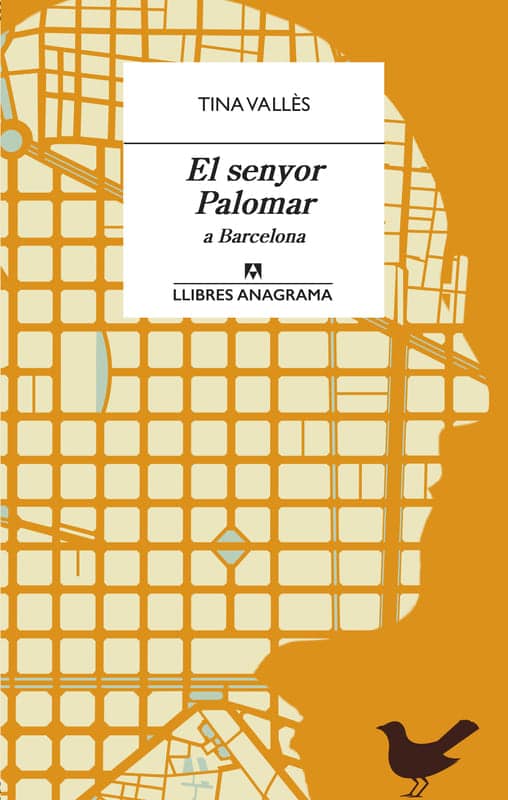
The irruption of the pandemic and the realization of the dystopia of a dead city offers an interesting twist to the book, with the transformation of the narrative gaze into a particular species of homo videns. After taking a walk around an island of houses (we intuit it's from the great Grid), Palomar "es descalça al replà, deixa els pans al marbre de la cuina, es renta les mans i en veure's al mirall s'adona que els pocs minuts que ha sigut fora no ha mirat res, només veia, i això sí que és un canvi" [takes off his shoes on the landing, leaves the bread on the kitchen marble, washes his hands and, seeing himself in the mirror, realizes that in the few minutes he was out he didn't look at anything, he just saw, and that is indeed a change]. Intelligent prose, in effect, which through an unfussy and seemingly telegraphic style very well captures the configuration of a post-pandemic identity in which the urban exterior will be content with minimal excursions and the imposed vital confinement will lead to increasingly isolated subjective identities in a corner of being ("l'acte de mirar se'l reserva per a dins, no dins de casa, sinó dins seu. Des que el món ha canviat, no se l'ha tornat a mirar" [the act of looking is reserved for inside, not inside the house, but inside himself. Since the world changed, he hasn't looked at it again]).
My dear Ponç Puigdevall wrote that this is a character who "trama una lògica particular o elabora unes faules filosòfiques de factura extraordinària i venç així, al capdavall, a través del cultiu de la intel·ligència les nombroses contrarietats que omplen les hores de cada dia" [weaves a particular logic or elaborates philosophical fables of extraordinary making and thus, in the end, overcomes, through the cultivation of intelligence, the numerous adversities that fill the hours of each day]. To me, and perhaps it is a generational reading (which I share with the author), Palomar has interested me much more for his dime-store metaphysics and for the impotence he configures as a wise man's project in a city that no longer offers any stimulus and in a historical environment that shapes beings who have quickly gone from contemplating uncontrolled anger to the impotence of social control, all embodied in a man who even has "por de no saber sortir al carrer com abans (...) i avui que surt per recuperar el fil del propòsit que el va fer tornar a Barcelona, els passos li han quequejat" [fear of not knowing how to go out into the street as before (...) and today that he goes out to pick up the thread of the purpose that made him return to Barcelona, his steps have faltered].
Mr. Palomar in Barcelona is, in this sense, a very skillful exercise in irony about the present of the tribe and a very timely look at the future of the city that awaits us. As I told the author, I believe that the character desperately calls for the continuation of a saga of novels where Vallès abandons the micro-story chapters and raises the bar of her pen to a higher level. I will not fall into the cliché of asking for a great novel about Barcelona, because of everything I told you at the beginning of this Punyalada, but I do dare to ask the author that, apart from returning to the city and admiring its worn nooks and crannies, Palomar stays a few more years looking at it. Because we, despite himself, see him and he tells us a lot about Barcelona.
Add The New Barcelona Post as your preferred Google source for free
Stay informed with the latest news.