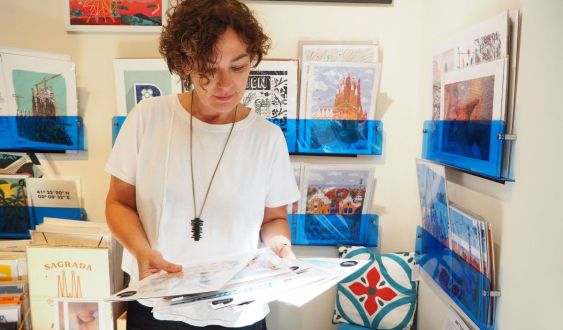
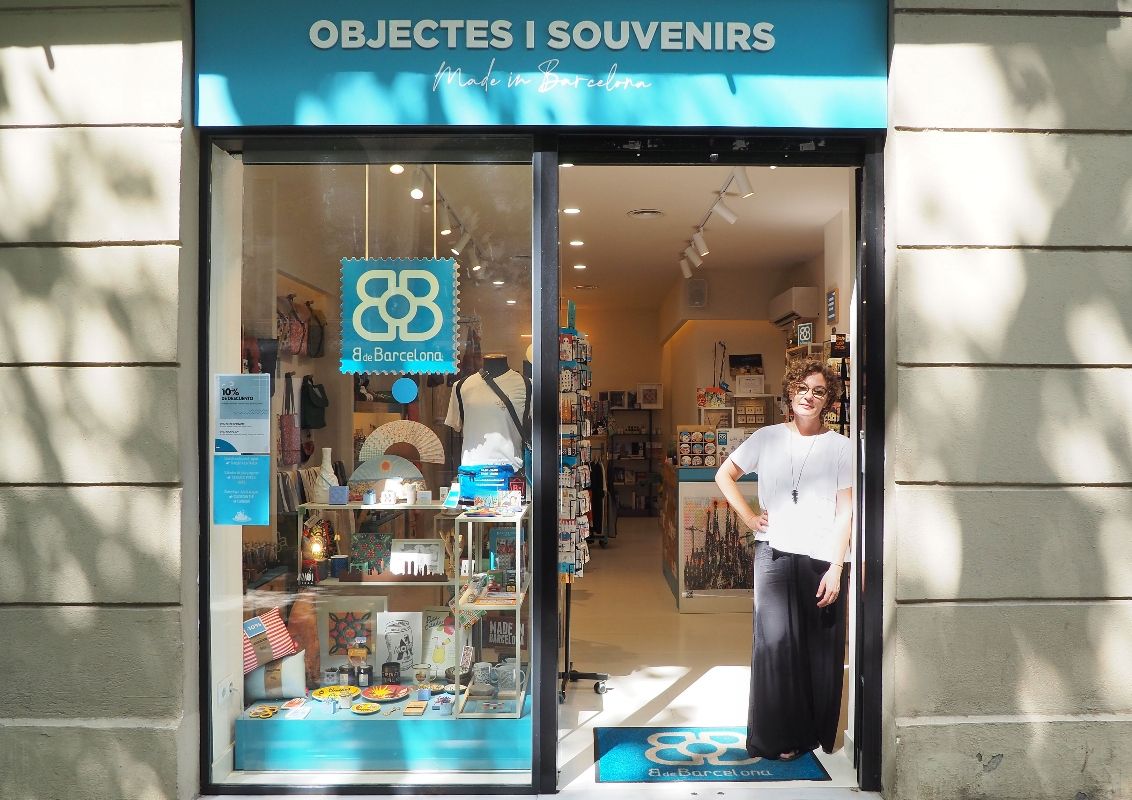
Souvenir is a word dirtied and worn out by pongos that, in general, are neither aligned with the local culture nor made where they are sold and that, furthermore, with small variations, but with the same forms, we can find in Barcelona, in Berlin, in Paris, in London, in Vienna, everywhere. They are "the ugly duckling of a trip." This is how Maite Guillem refers to that industrial, mass-produced figurine that, in reality, does not identify a specific place. Maite has a souvenir shop on Gaudí Avenue which is, in Barcelona, a small oasis in the trade of objects that remember and identify this, and only this city. She already named it BdeBarcelona with this idea, and she does not let any ugly duckling in. Practically everything she exhibits and sells is designed and produced in Barcelona, or nearby. It is all very local and indigenous, each item has roots and a link with the territory.
If we look at the etymological dictionary of the National Center for Textual and Lexical Resources of France, the CNRL, we see that the word souvenir has its origin in the Latin language, in which subvenire, in its first sense, came to express "to come in a hidden way," which gave rise to the meaning of "to come to help" or "to succor." The transition from the impersonal sense and form to the personal, identifying something that brings a person or an object to mind, arrived in the 12th century. Over time, this term has evolved towards the semantic field of memory, designating, in French, the act of remembering, and this is how it has come to designate, in the French language, an object that represents, that recalls a moment from the past, that makes one think of a place or the person who gave it as a gift.
Just over ten years ago, Maite lived right next to Gaudí Avenue. She was just another resident of this neighborhood where, back then, tourists were not yet seen walking up and down the promenade that connects the Sagrada Familia with the modernist complex of Sant Pau. At that time, the magnificent rehabilitation works of the old hospital pavilions, designed by the architect Lluís Domènech i Montaner, had already been completed. Since 2014, visiting these spaces conceived in the modernist style of the early 20th century has been an attraction in the city, a benchmark of architectural beauty and a precious piece of its history and the lives of many people in this city.
And Maite thought: if the modernist site starts receiving visitors, Gaudí Avenue, as a connection between it and the Sagrada Familia, will be very busy with tourists. And she saw that there was no shop where these tourists or visitors to Barcelona, in general, could acquire beautiful souvenirs that speak of this city, with knowledge, with cultural depth. And she was tired of seeing, even then, something that has not stopped proliferating, with shops full of Mexican hats ---how many kilometers from their place of origin---; bull figures ---when here bullrings have had other functions for a long time, and not to make those animals suffer---; red shoes with white polka dots ---so far from where sevillanas are danced---, or crystal balls with the name of Barcelona that, if you turn them upside down, simulate snow... Snow, as something typical in Barcelona?
So, this Barcelona native decided: "I'm going to make a beautiful shop, with things from here, local creations from all disciplines and by diverse creators, born here or who live and work here."
Connection with design
Having worked 18 years in architect Juli Capella's office gives us a clue about Maite's contacts and perspective, accustomed to focusing on object design. And now, when we enter her shop, we see it. "In the architecture office, I had the opportunity to get to know the work of architects, illustrators, people who, perhaps not as a main occupation, but did things that showed a more beautiful Barcelona," she explains. And everything she observed and knew made her think it was time to set up something on her own. She started looking in the city for small workshops of ceramists, jewelers, illustrators... She wanted to pay homage to Barcelona, her city, through all these local creatives. She believed it was time to make another type of souvenir, because Barcelona deserves it.
"On every trip I make, I notice what is most unique about the place I'm going to, and that I know I won't find anywhere else. I like to discover shops that inspire me in what, in my own way, I am also doing in Barcelona, with local productions that identify us," she says.
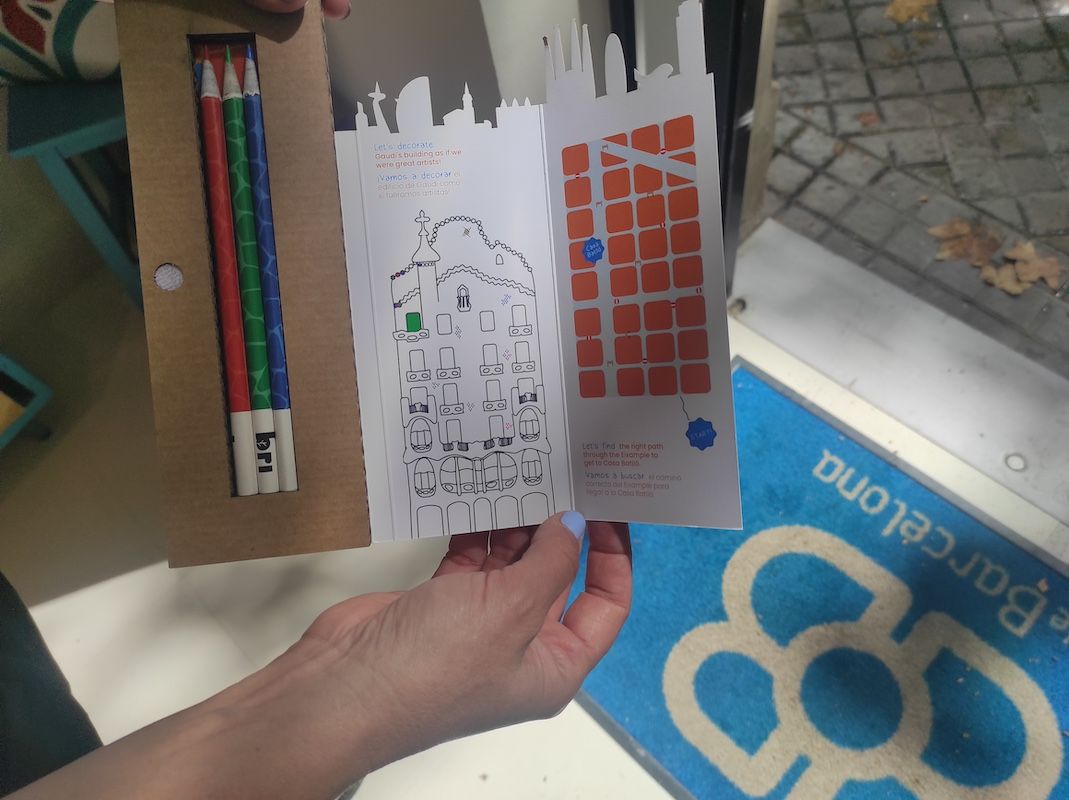
Behind every object Maite chooses, there is a story. That of Beti and Bárbara, two entrepreneurial friends who created the first anti-theft backpacks—with a zipper on the inside—under the brand Urbanauta. They have their workshop in Gracia, the same neighborhood where the ceramists of SOT make coffee sets, cups, and small dragons like those in Park Güell.
We also know the story of Noèlia and Beatriz, who started by making city guides explained from a local perspective, and now create articles that talk about the city through, for example, the modernist trencadís identity, applied to laces for sports shoes, glasses cases, or other useful elements inspired by this city. Behind the Bridepalla brand is the desire to contribute to caring for the planet, offering seeds to plant in original city souvenirs, such as those integrated into the tips of pencils that, when the useful life of this drawing and writing tool ends, invite you to plant the seeds. Damaestudi gives its name to earrings that, reusing wood from fruit crates, reproduce the design of real tiles and mosaics, which we step on in Barcelona doorways or in lands located in other cities. And recycled fabrics shape Numon's backpacks, stemming from their commitment to the local economy.
"I have great affection for the brands, because I know who is behind them and how they make everything they bring," says the owner of BdeBarcelona. "They don't make just any object that says Barcelona, but rather they are thoughtful objects that make you think of Barcelona. If you pick up a souvenir and it makes you think of the place it came from, it has added value, it fulfills its mission," argues Guillem. He says that one of the things he likes most, "perhaps the most, what inspires me every day, is the affection that creatives from all over have for this city, this bond and adoration for the city."
She also loves Barcelona. She regrets, however, that the city is losing businesses that were or are part of its charm. From the Sagrada Familia neighborhood, she has witnessed its evolution: "Although it should have been the other way around, over the years, the neighborhood has lost essence and authenticity. Gaudí Avenue and its surroundings are among the parts of Barcelona that still maintain a neighborhood life, with many elderly people, but as soon as a lifelong store closes, another one without essence and authenticity opens, bazaars, nail salons, mobile phone case shops proliferate… A traditional business closes and an electronics store or a franchise of anything opens." She, particularly, misses "a butcher shop like there was until not long ago, out of fear of everything that might still disappear."
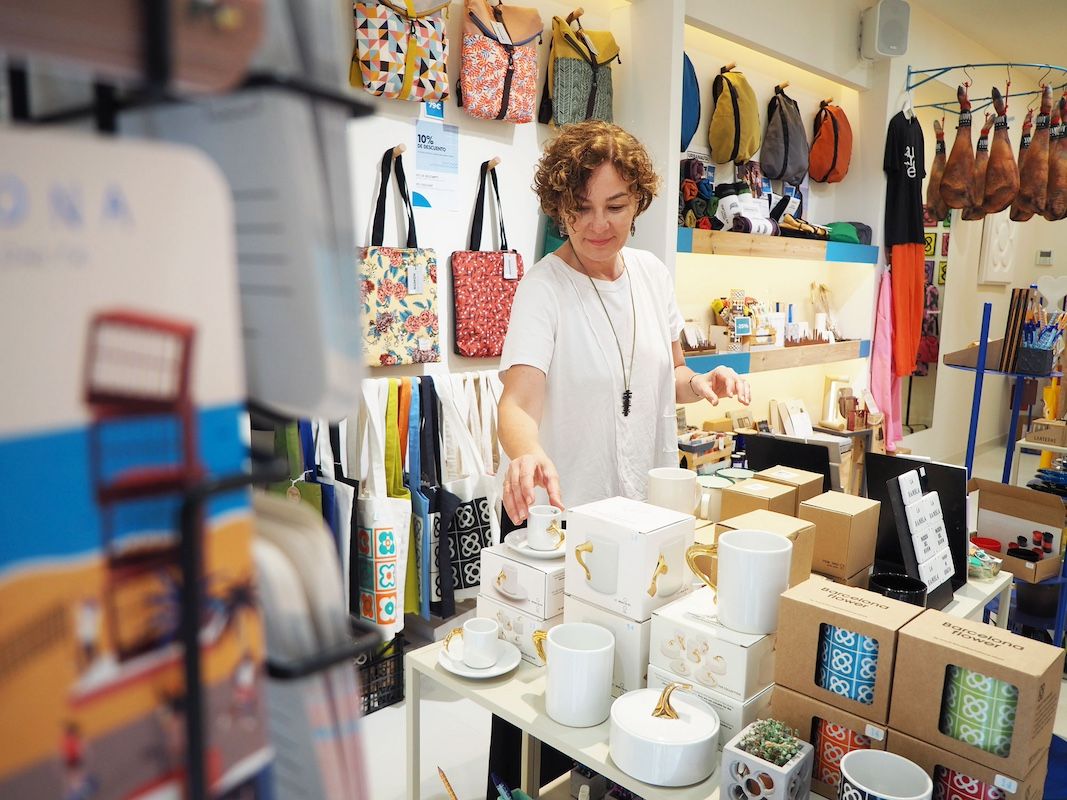
And what would she do if she had the mayor's wand in this city? "I would try to preserve the commercial fabric, preventing the existing one from deteriorating or disappearing. I would promote, even subsidize, commercial diversification, emphasizing cultural identity, which is maintained by certain types of neighborhood businesses," she points out. "Barcelona is fantastic, a model city for Europe and for the rest of the world, we have to do very well to preserve this city model. If institutions take it seriously, we will go in the right direction. It's a matter of everyone going together. I always talk about commerce, demanding quality commerce, that escapes clones, franchises. But there are merchants who cannot get ahead because they don't have any kind of help from institutions." Maite wonders, just as she does with pharmacies and tobacconists, why it is not filtered and that, with protective policies for certain businesses in high-traffic tourist areas, it is not allowed to open three stores selling the same thing within thirty meters, Barça t-shirts and Sagrada Familia ashtrays. That's how we are ruining the grace of being different."
In her small oasis, the philosophy is different. Curiously, in April 2015, when she opened her store, hers was the only establishment with a license that stated "exhibition and retail sale of souvenir items or souvenirs." Well, two months after opening it, the municipal planning plan prohibited souvenir licenses. But how is it understood that, even so, stores have not stopped opening where clearly, what is sold most are souvenirs? They register as gift shops, sportswear stores, household goods stores... The law is made, the loophole is made, and now, paradoxically, the City Council does not allow her to keep her original license because two months ago she moved the business a few numbers up the same avenue. The municipal regulations forced her to eliminate the shop window of the premises she had been renting for a decade and, fortunately, she was able to move to the premises where a Calcedonia franchise was closing.
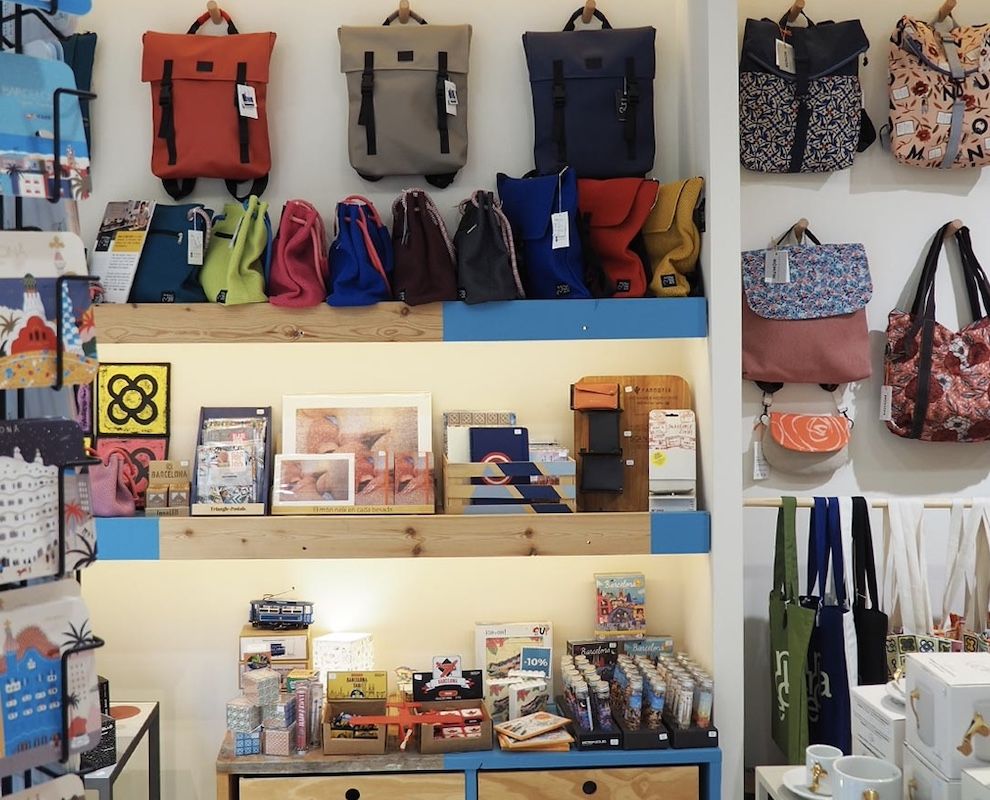
From franchise to local economy, a good change for the neighborhood, for the city, and for the planet, because now, what she sells is made nearby and does not have to get on any plane to reach her store. It is appreciated, in a city where the most common thing is for the change to be the other way around, that is, for authentic commerce to be replaced by a franchise of identical stores in the neuralgic centers of all cities in the world. Surely in all of them some merchants also unite to defend their uniqueness, as do those who are part of the association of merchants of Gaudí Avenue.
In a WhatsApp group, they have a security chat, through which they notify each other if they see someone suspicious. Maite says it has been a bit difficult, but now they see oriental, Canadian, American, and European visitors, especially French and German, coming up the avenue. These are the nationalities of many of their clients. But the BdBarcelona store is also a reference for residents of this and other neighborhoods of the city. What they buy most are magnets, bags, pens, covers, or reproductions of all sizes of the panot flower of Barcelona. "It continues to be, in all its versions, bag, keychain, mug... the item I sell the most. It is the icon of the city, and most tourists already know it, or have read it somewhere, or someone has explained it to them." Perhaps it is the most traveled flower on the planet, a souvenir of the tile on which, in Barcelona, one walks.
Add The New Barcelona Post as your preferred Google source for free
Stay informed with the latest news.
