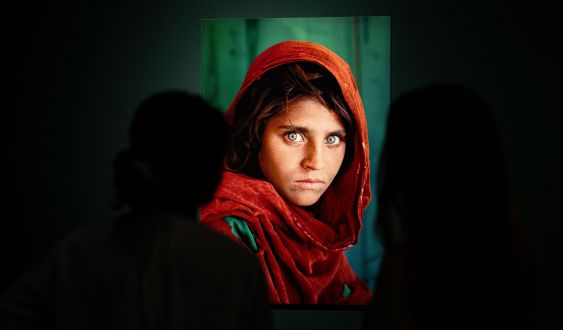
If, speaking of painting, I ask you if Girl with a Pearl Earring rings a bell, almost everyone will immediately describe the painting centered on the subtle reflection of an earring, and many, even, will give me Vermeer's name without hesitation. Such is the power of painting, capable of fixing an instant in collective memory for centuries. However, if we shift the thematic focus to photography and I ask you if Afghan Girl rings a bell, the first thing that will come to your mind will not be an object, nor a background color, but green eyes of an almost unbearable intensity.
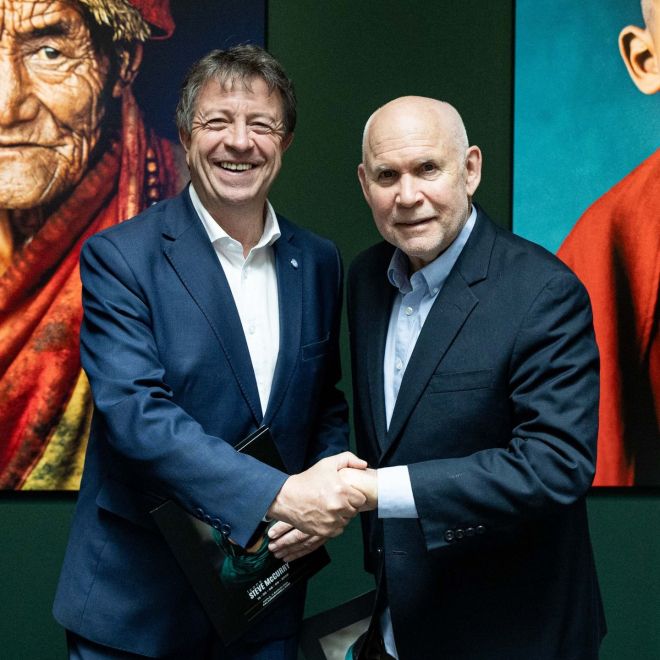
These eyes, I would dare to say, changed for many of us our vision of documentary portraiture, expanded the limits of traditional photojournalism, and opened new perspectives on how it is possible to look at and see the world around us. The man behind this iconic photograph is Steve McCurry, and the Palau Martorell now offers us the opportunity to immerse ourselves in his universe through one of the most extensive and complete retrospectives we have had the fortune to see in the Catalan capital.
I clearly remember the first time I saw this gaze. It was on the cover of one of the National Geographic magazines that my uncle Cele proudly received and collected at his home as a loyal subscriber to the publication. Those magazines were like small treasures, windows to remote worlds that I, being just a child, devoured with curiosity. The impact that this particular cover had on me, this mix of magnetism, vulnerability, and strength still resonates strongly within me.
Visiting this exhibition, I feel that this impact also resonates in much of the documentary photography that has been built since then. There is something of this unmistakable trail, for example, in some of the most striking images that are annually compiled for the World Press Photo, or in such incredible contemporary works as that of photographer Mihaela Noroc, who travels the world portraying women for her project The Atlas of Beauty.
Influenced by my deep passion for art, that almost pictorial portrait of The Afghan Girl activated aesthetic and intellectual connections in my brain that have never ceased. It made me understand, at a very young age, that photography is not a simple record of reality, but another facet of pure artistic creation. The camera can, as happened in its time with the historical avant-gardes of the 20th century, totally modify the path of artistic movements, alter our sensibility and radically transform our perception of the physical and human environment.
More than the camera, the gaze of the person holding it and using it as a means of expression
This exhibition at the Palau Martorell, which from my humble perspective is an absolute marvel and worth visiting several times, is conceived implacably under three fundamental thematic axes: portraits, childhood gazes, and animals, organically distributed on independent floors that invite a physical and emotional transit.
Upon entering, we not only encounter the images, but we can also listen to McCurry himself through the exhibition's resources, speaking with honest humility about what truly moves him. It is surprising to hear a giant of photography speak of the deep gratitude and fortune he feels for having been able to dedicate his life to this profession. In his reflections, something emerges that I consider key and essential for these times: the imperative need to learn to look.
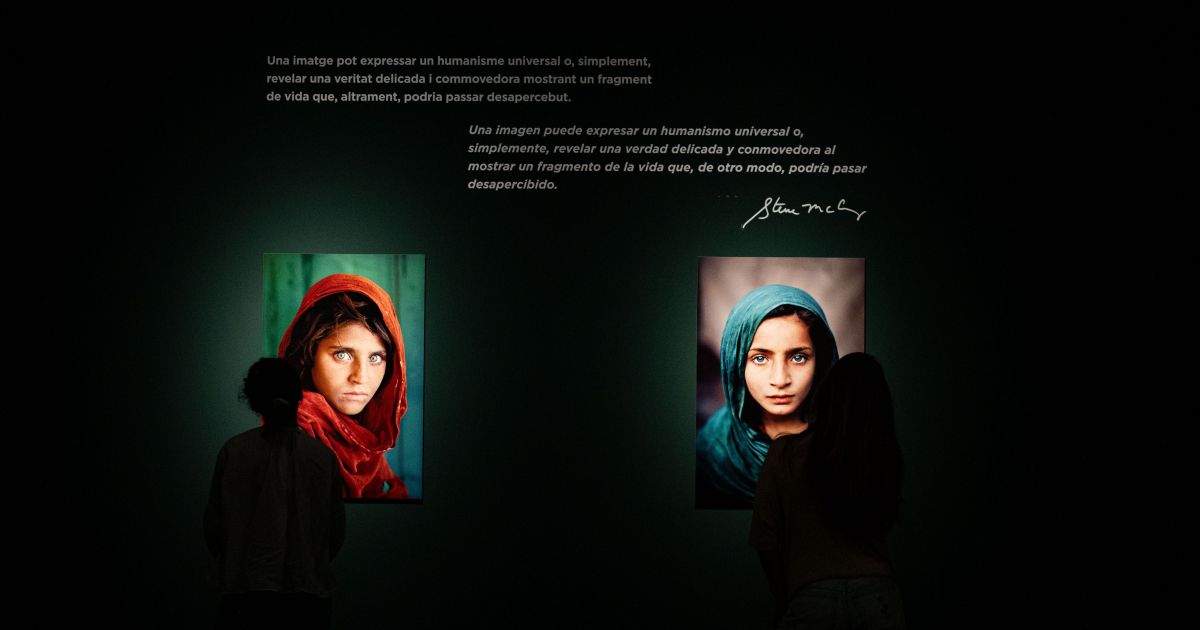
McCurry proposes that we train contemplation, exercise attentive waiting, and cultivate the augury of beauty in the most unexpected places. In a contemporary society that is accustoming us to systematic haste for everything, where we consume visual impacts ephemerally and anesthetized, truly inhabiting the world requires very different times. We need to recover that pause that allows us something so profoundly human and necessary as letting ourselves be moved by what seems beautiful or terrible to us.
The first space of this journey is entirely dedicated to portraits, a discipline where the author displays his maximum genius. The photographer himself defines his methodology with a phrase that condenses his philosophy: "Most of my images are centered on people. I look for the unguarded moment, the essential soul that emerges, the experience etched on a person's face. If you wait, people will forget your camera and the soul will come out".
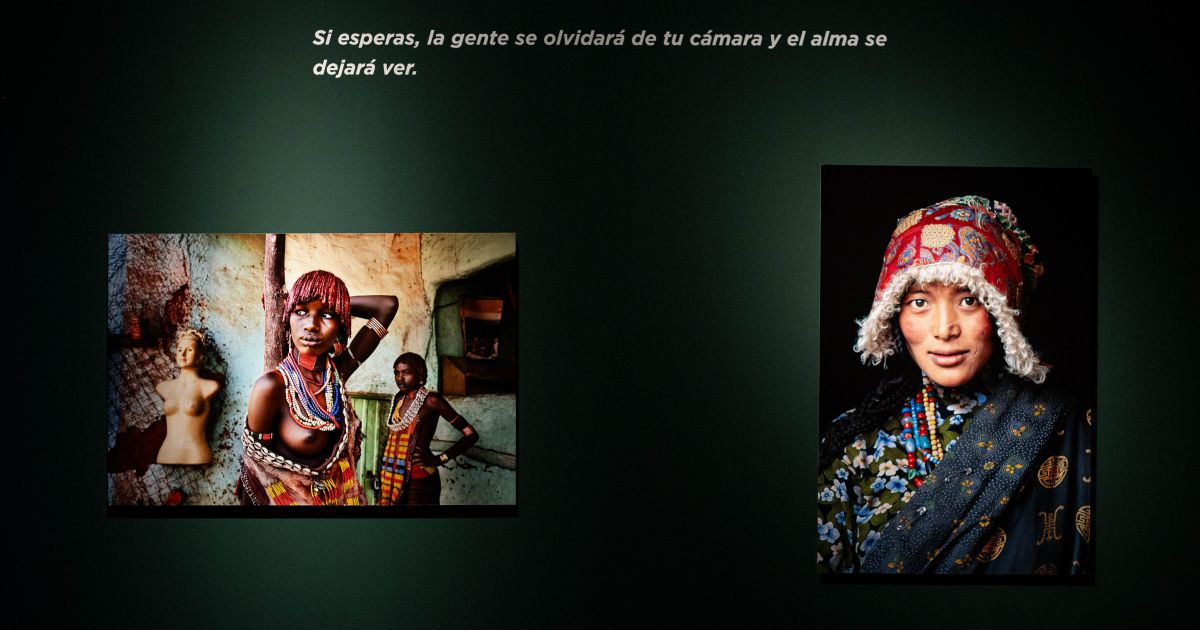
In these portraits by Steve McCurry, the human face is the protagonist. Although the people portrayed belong to worlds that seem distant to us, before his lens, all geographical or cultural distance completely disappears. A face-to-face of supreme value occurs, and we feel absolute respect. There is no simple search for aesthetics or easy exoticism; on the contrary, there is absolute dignity, never an attitude of submission or helplessness.
Those of us who observe the photographs encounter these faces on a plane of strict equality, from human being to human being. And then, inevitably, there is that direct, clean gaze, of an intensity that pierces. The photographer manages to establish an authentic and bidirectional dialogue despite language or cultural barriers. There is a universal understanding. For McCurry, we all belong to the same human family. And I am fascinated by the premise that, perhaps it is not us who observe them, but they who observe us.
Steve McCurry: "I look for the unguarded moment, the essential soul that emerges, the experience etched on a person's face. If you wait, people will forget your camera and the soul will come out"
On the upper floor, the exhibition transports us to a territory as tender as it is complex: that of children. McCurry's words once again place us before the harshness of global reality when he states: "I have seen children working in fields, factories, ditches, tunnels, mines, and shipbreaking yards. Hundreds of millions of children spend their childhood working and do not have the opportunity to play, go to school, or live in a healthy environment".
But through his camera, this childhood also knows no borders or differences. All these children share the same energy, the joy of living, and the innate capacity for play, even in the most hostile living conditions. Childhood, as McCurry's gaze reminds us, is not just a biological stage of life, but the ethical foundation upon which the future of any society that seeks to be just is built. Each of the photographs in this section is a reminder of our collective responsibility towards new generations.
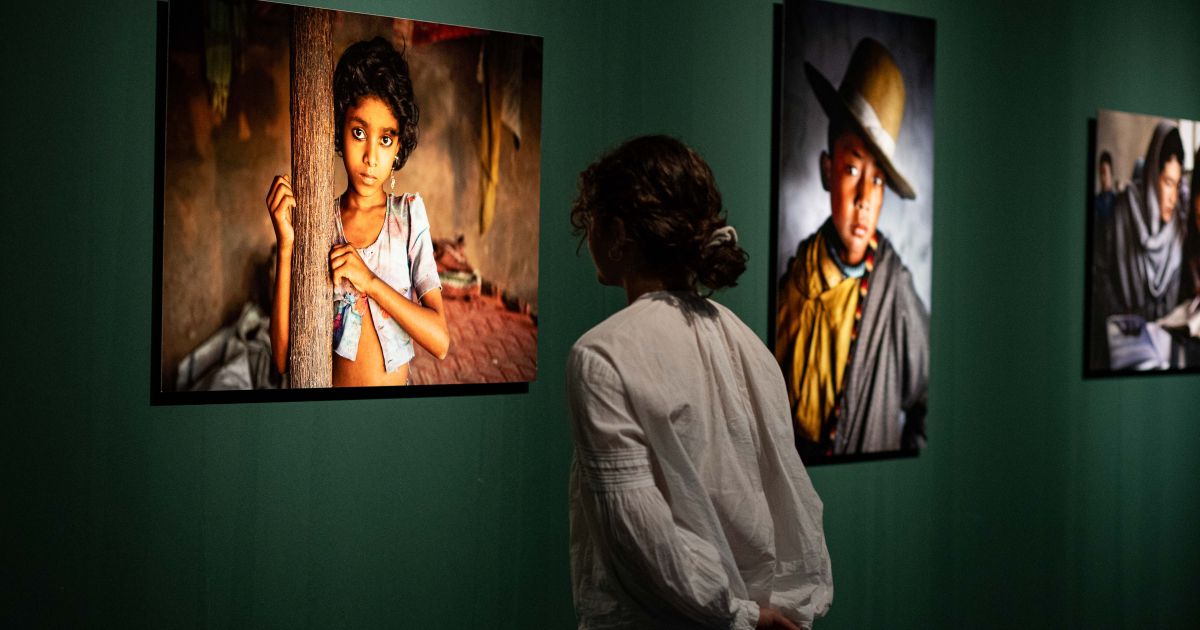
Finally, on the lower floor, the exhibition reserves for us the space dedicated to animals, an area that shares prominence with a moving corner reserved for images taken during the tumultuous days after the September 11 attack in New York.
Regarding his experience with the animal world, McCurry evokes one of his toughest missions: "Working in Kuwait after the first Gulf War was a surreal and unforgettable experience. There were 600 oil wells on fire, terrified and hungry animals roamed everywhere, and the landscape was dotted with dead Iraqi soldiers. It was heartbreaking to see these dying animals, of whom we were supposed to be the guardians...".
McCurry decided to document the impact of the catastrophe on the ecosystem covered by a dense layer of black smoke that blocked the sun. From that very harsh experience emerged imperishable images that are now an undisputed part of our universal collective memory, such as the striking silhouettes of camels outlined against a completely burning horizon, or the now iconic photograph of a small red-eyed bird agonizingly trapped in oil tar.
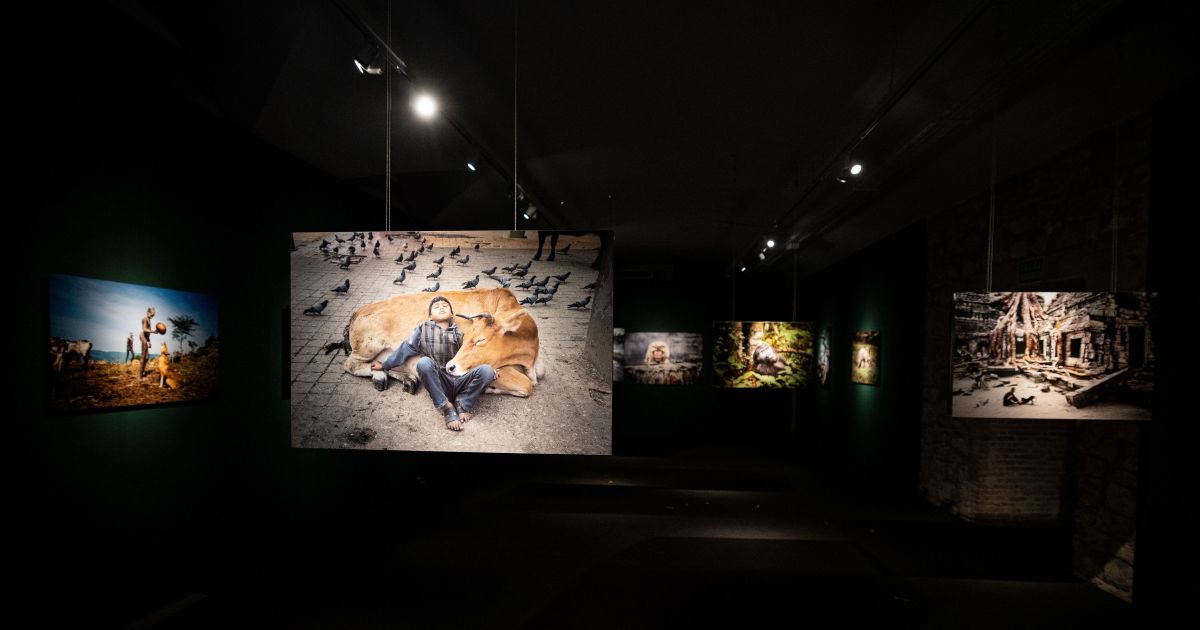
The expressive force and truth contained in these images were unanimously recognized by a very special jury of the World Press Photo, the Children's Jury, made up exclusively of children from different countries around the world, who selected the image of the camels.
A lesson in art, humanity, and respect
Beyond how extraordinarily iconic these photographs by Steve McCurry have become over the decades, printed on millions of posters, books, and magazines across the globe, it is deeply inspiring to see that the photographer continues to believe, with the same conviction as on day one, that what is truly important are people, their individual stories, and the social context in which they live. For him, his task still has an almost archaeological and urgent dimension: that of collecting testimonial, truthful, and artistic information about how life was lived on our planet before these traditional forms of existence are definitively lost forever under the yoke of globalization.
There is a truly special and elusive magic operating in each of his works, a latent inner history that we glimpse behind the apparent and that speaks to us of a shared vital experience: that of the real and honest connection between two human beings who recognize each other beyond language, religion, or culture. And it is precisely this truth, devoid of artifice, that makes us, as spectators walking through the halls of Palau Martorell today, feel so intimately addressed by his images.
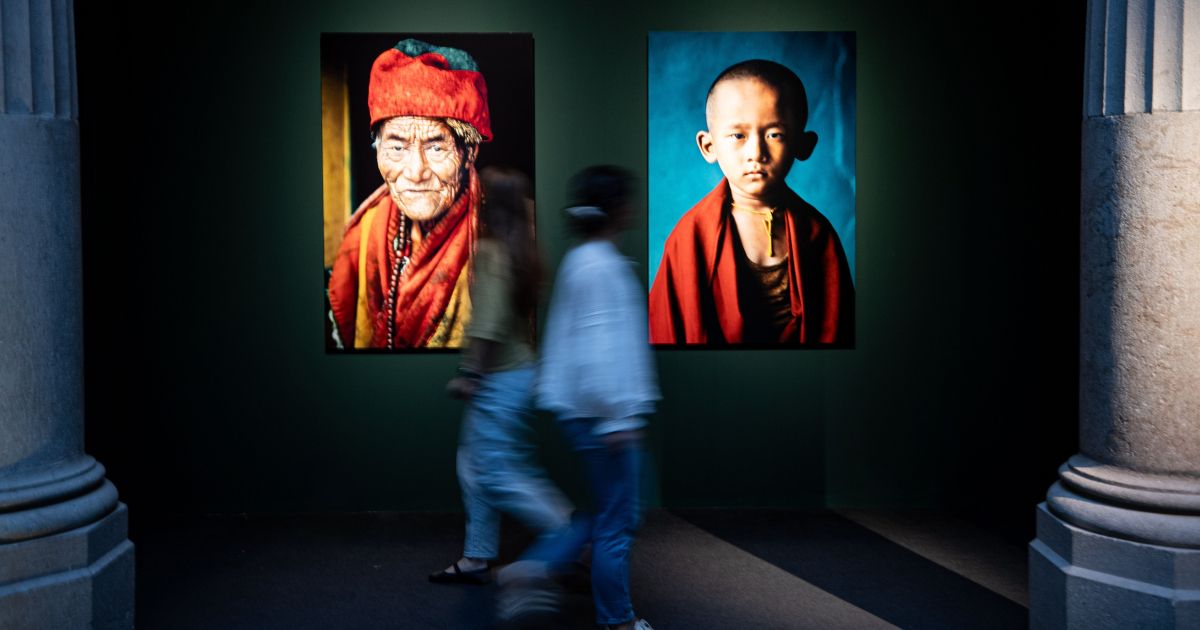
Because every subject we see in the exhibition, whether a Buddhist monk, a nomadic shepherd, or a child from a suburb, is looking directly into our eyes, face to face, as an absolute equal. That clear gaze is what breaks our colonial or paternalistic prejudices and allows us, immediately afterwards, to peer into their particular world to appreciate, understand, and value it with and from the most absolute respect, also pushing us to actively get involved in it and not remain as mere passive spectators of others' pain or beauty.
This ethical commitment to get involved in the reality of the photographed subjects is not, in McCurry's case, a simple declaration of intent for show, but a vital praxis that the photographer has demonstrated with actions throughout his career. History says that, healthily obsessed with the fate of that Afghan girl who rose to global fame from the cover of National Geographic, Steve McCurry did everything humanly possible for years to find his mysterious protagonist again.
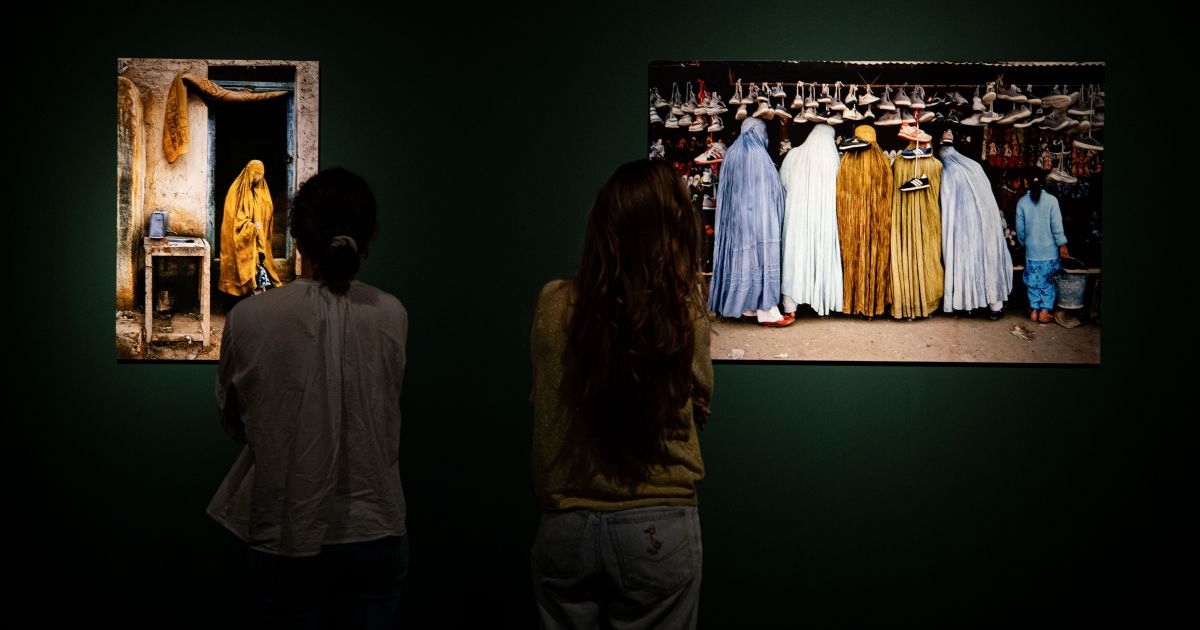
After a tireless search that seemed doomed to failure due to the political turbulence in the region, he finally managed to locate her almost two decades later in a remote area of Afghanistan. That girl had already become a mature woman and a mother, and her name is Sharbat Gula. Her face clearly reflected the inexorable marks of time, the harshness of the climate, and the extreme difficulties of a life of deprivation, but she retained intact and unmistakable the iconic strength of her green eyes.
The exhibition is a master class in art, a celebration of the diversity of life, and an essential mirror that forces us to stop our frantic pace to relearn
McCurry not only achieved the feat of photographing her again to document the reunion, but, demonstrating the humanist coherence that permeates all his work, he got personally and actively involved, doing everything in his power to help her financially and significantly improve her delicate and vulnerable legal and residential situation as a refugee.
It is this background of real solidarity that has just given a transcendental dimension to the exhibition at Palau Martorell; an exhibition that is, ultimately, a master class in art, a celebration of the diversity of life, and an essential mirror that forces us to stop our frantic pace to relearn, with humility and respect, the noble art of looking.
Add The New Barcelona Post as your preferred Google source for free
Stay informed with the latest news.